Darden's quiet AI strategy is buy-vs-build done right
Five days after Darden's Q3 print, the operator's read is that Cardenas and Vennam are running measured AI as the counterweight to measured retention. The trades called it AI-light. The stack — and the LongHorn culinary recertification underneath it — says otherwise.
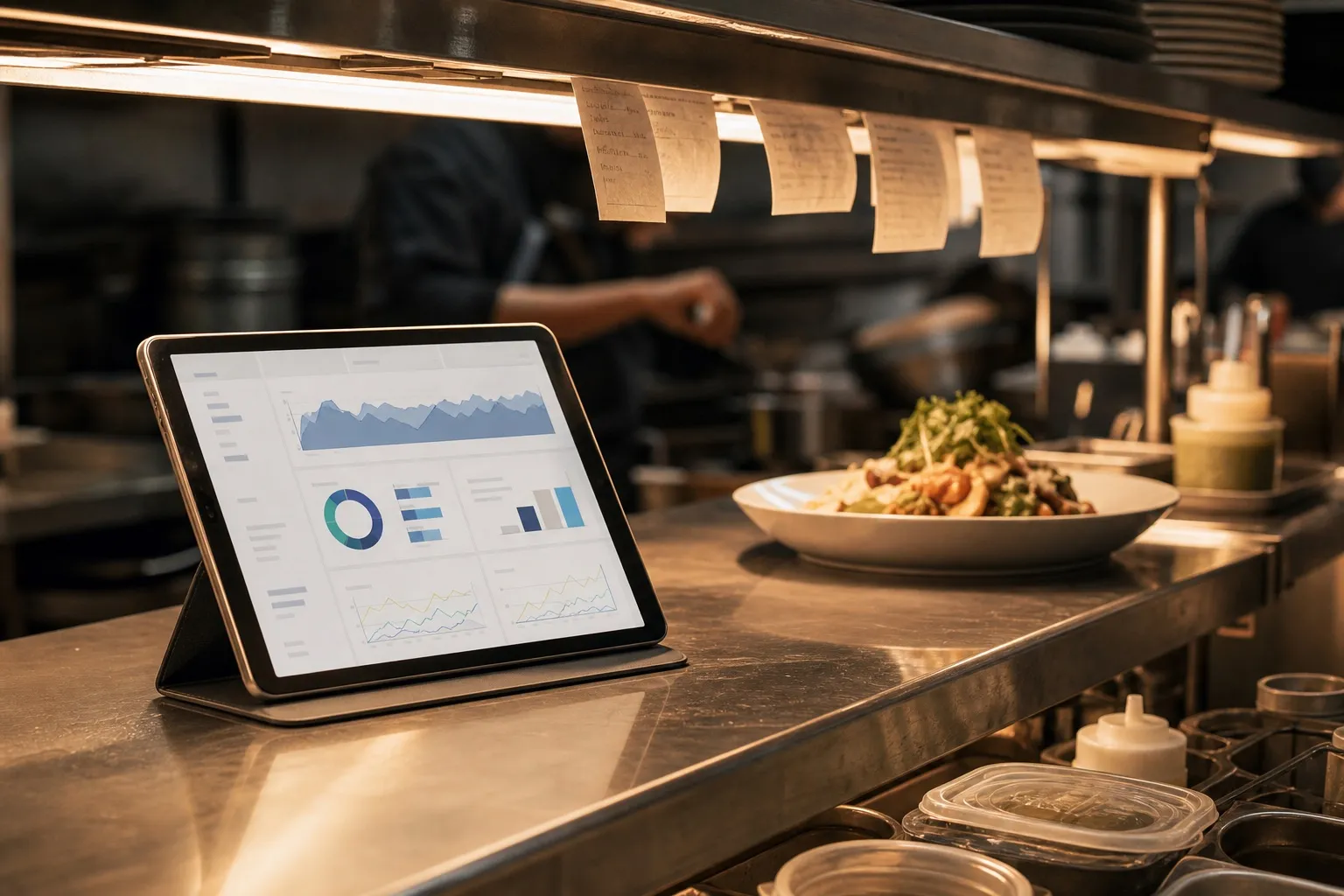
It is a Friday at six-twenty in the evening at a LongHorn Steakhouse in a strip-mall pad-site outside a mid-sized Sun Belt city, and the operating partner is standing at the expediter window with an iPad balanced against the salt cellar. He is not looking at tickets. He is looking at a thirty-question multiple-choice quiz on the iPad, the second of three modules he owes the brand this cycle, and the topic is the seasoning ratio on the bone-in ribeye. He passes a question, taps through, passes the next one, and then pauses on the question about hold time under the heat lamp. The line cook behind him, who has heard the question before because the operating partner has been studying out loud for two weeks, calls out the answer over the shoulder of a grill cook plating a Flo’s Filet. The operating partner nods, taps the answer, passes. The shift-change huddle is in eight minutes. The expediter rail is starting to fill. The quiz is not optional.
I am here because Rick Cardenas spent more time on the Tuesday earnings call talking about that quiz than he spent talking about any single piece of technology in the Darden stack. The Q3 FY26 earnings release Darden filed Thursday morning landed +5.9% on total sales, +4.2% on blended same-restaurant sales, +7.2% at LongHorn specifically. The PDF version of the release carries the same line items in the deck format the brand teams actually circulate internally. Cardenas and CFO Raj Vennam, in the prepared remarks and the Q&A, did the thing Cardenas has done now for a half-dozen consecutive prints: they framed the quarter through retention and operational rigor, named AI work where it fit, and otherwise let the absence of an AI narrative do the same job the absence of one has done at Darden for the last three years.
The contrarian thesis: Darden’s AI strategy is a strategy, and the reason the trade press keeps reading the prints as AI-light is that the trade press is calibrated on operators pitching the AI deployment to the buy side rather than running it. Darden runs it. Darden also runs a measured-retention program — operating-partner tenure, manager culinary recertification, team-member retention at what Cardenas has been calling “historically high” levels for several quarters running — that is, in operator terms, the human-systems counterweight to the AI work. The two programs are load-balanced against each other. Neither is the headline. Both are the strategy. Read the Yahoo recap of the call and the SEC exhibit together and the operator-level story is that Darden has, by accident or by design, drawn the cleanest buy-versus-build line of any large full-service operator in the public tape.
The shift-change quiz, and what it is doing
The first thing worth saying about the operating-partner culinary recertification is that I did not understand it the first time I read about it. The phrase Cardenas used on the Q3 call — “we have recertified every LongHorn operating partner on the steak” — sounds, on first read, like an HR exercise. It is not. It is a system, and the system is doing a very specific job.
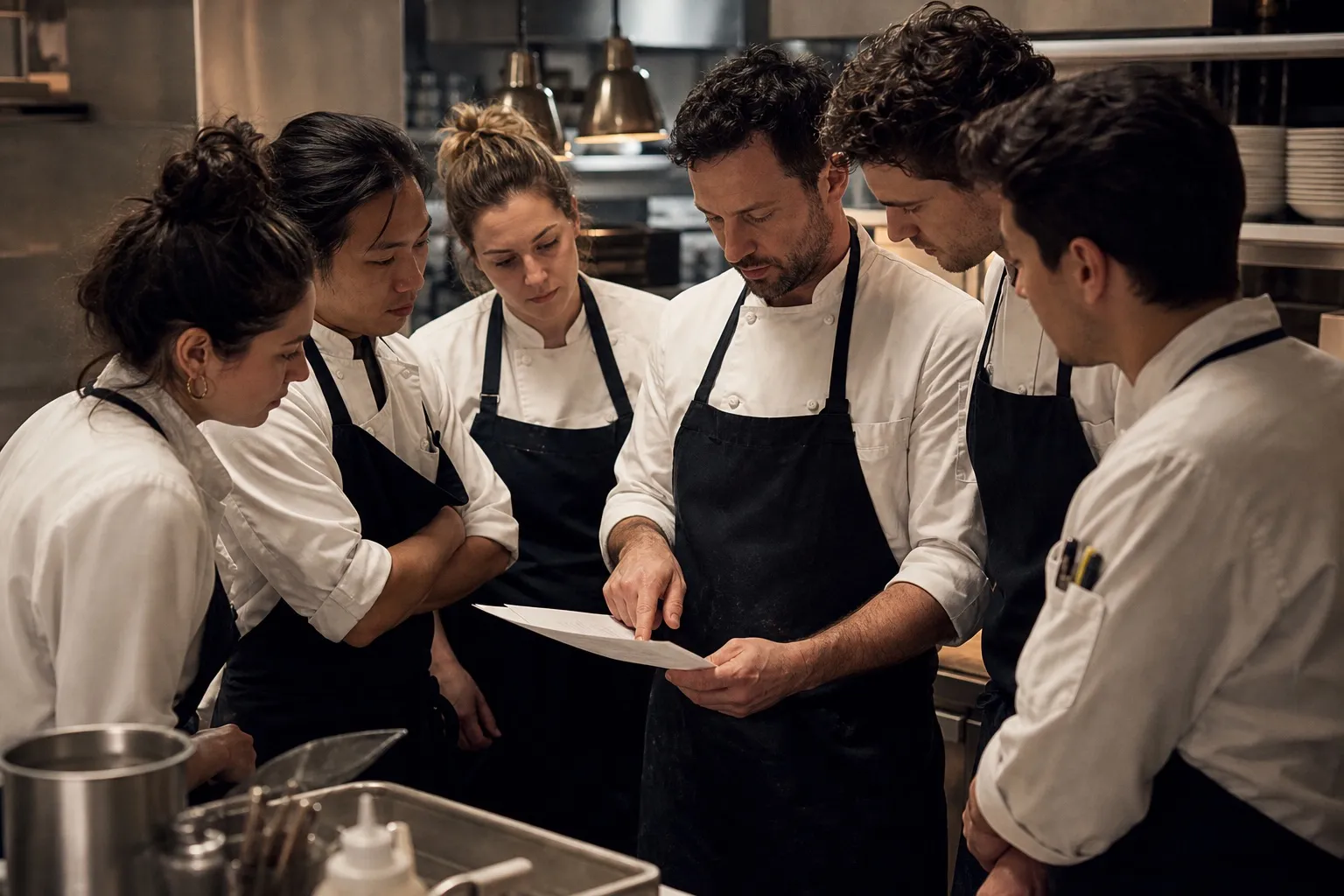
The operating partner walked me through the modules between table touches. There are three. The cut book is a visual identification quiz against the LongHorn cut specification — Flo’s Filet against a generic tenderloin, Outlaw Ribeye against a generic bone-in, the LongHorn Porterhouse against a standard porterhouse. The seasoning ratio is grams of blend per pound of protein, broken out by cut, with the variances the kitchen is allowed to run. The plate module is the visual quiz of how a finished entrée looks when it leaves the line, by side, by garnish, by hold time. Each is timed. Each has a passing threshold. The operating partner I sat with told me two of his peers at neighboring stores had failed the cut book on first attempt and were on a retake schedule. This is not a check-the-box program. It is designed to create scarcity in the operating-partner labor pool by raising the bar of what counts as a credentialed LongHorn operating partner, by enough of a margin that the people who clear it have a real reason to stay in the seat.
That is the lever. The lever is not the quiz itself. The lever is the operating-partner retention number, which Cardenas has been disclosing in directional terms for a half-dozen prints and which he again called “historically high” on the Q3 call. The recertification is the mechanism — the visible artifact of an operating-partner career path that, structurally, asks for a real commitment in exchange for a real stake. The Darden operating-partner program runs the partner-owner equity model that the brand has used for decades, and the recertification is the renewal cycle that keeps the partner-owner credentialed against a moving brand standard. Without the recertification, the equity goes stale. With the recertification, the equity compounds.
The AI margin assists, and the retention counterweight
This is the INTERPRETATION section, and I am going to mark the next several paragraphs accordingly because the operator-level read on the strategy is not anything Cardenas explicitly framed on the call.
The reason an operator-level reading of the Darden stack puts the recertification next to the AI work — not separately from it — is that the two programs are doing complementary jobs in the same labor system. The AI work, where it is deployed, is automating the parts of the manager’s day that do not require the culinary judgment the recertification is testing. The recertification is investing in the parts of the manager’s day that cannot be automated because they are the brand-level execution decisions that define what a LongHorn dinner is. In an operator’s labor P&L, the manager’s time is the most expensive variable input and the hardest to scale. Compressing it through automation is one lever. Increasing the return on what remains of it, by raising the credentialing bar and the equity stake, is the other. Cardenas is pulling both. Most of the trade press, and most of the buy-side desks I have talked to since Thursday, are reading the print as if only the second lever exists. The first lever is in the stack. It is just not in the press release.
Read the Darden tech stack the way an operator would and the AI work clusters into three lanes — scheduling, demand forecasting, and back-office centralization. The granular vendor mapping is not in the filing; what follows is what an operator-side reader can infer from the public record, from Darden’s own technology disclosures across the last few prints, and from a handful of conversations with people who have worked inside the building.
Lane one: scheduling. This is the cleanest AI deployment in the system and the one Cardenas has named most directly across recent calls. The scheduling program is the labor-model layer that takes forecasted guest counts, day-part demand curves, and certified manager and crew availability and produces a recommended shift grid for the operating partner to approve. The recommendation is what the AI generates. The approval — the part where the operating partner pulls a closer off the grid because the closer’s kid has a game, the part where the assistant manager flexes a server in because a regular four-top is on the books — is the human-systems layer. This is the lane where the measured in “measured AI deployment” matters most. The scheduling tool is a recommender, not an authoriser. The operating partner is still the boss of the schedule. The tool changes the manager’s job from grid-building to grid-editing, which is the bulk of where the manager-time savings show up.
Lane two: demand forecasting. This is the lane I am least confident about at the vendor level — Darden has not disclosed a specific vendor in any filing I have found — but the directional disclosure has been that Olive Garden runs a forecasting layer that feeds scheduling and inventory. Mark this as an inference. What an operator can see from the outside is that Olive Garden’s holiday-week execution, in the Yahoo coverage of the call, was the part of the quarter Vennam specifically cited as moving through the holiday cluster without the labor friction the prior year’s calendar produced. That is the kind of operational claim that maps cleanly to a forecasting layer that landed in production in the last twelve months.
Lane three: back-office centralization. This is the lane that gets the least trade-press coverage and is, in aggregate, doing the most P&L work. Darden has been centralizing back-office functions — accounts payable, scheduling administration, inventory reconciliation, training enrollment, payroll — into shared services for the better part of a decade, and the most recent layer of that centralization is AI-assisted: document processing, invoice OCR, training-record matching, payroll exception handling. None of it is what the AI-premium thesis the forthcoming buy-side note will frame as the bull case. But it is where Darden recovers a meaningful slice of the operating-partner’s calendar from administrative work without selling the operating partner an AI tool. The operating partner does not interact with the AI. The AI interacts with the operating partner’s paperwork, on a shared-services desk a thousand miles away. Different product. The product Darden has been building for years.
What these three lanes have in common is that none of them is being pitched, on any earnings call I have re-read going back two years, as the reason for the print. They are pitched as the reason the cost line did not lose ground. The retention work and the menu work are pitched as the reason the sales line won. That separation — AI in the cost-defense lane, human systems in the offense lane — is the cleanest operator-level frame I can offer for what Darden is doing, and it is the frame that explains why the trades read the print as AI-light.
The buy-versus-build call, lane by lane
The reason the Darden stack is a case study in measured AI deployment rather than no AI deployment is that the company has made an explicit, lane-by-lane buy-versus-build call on each of the three. The cleanest piece of public evidence for that call is the off-premise stack.
Off-premise: buy. Darden’s off-premise ordering and delivery aggregation runs through Olo. This is one of the few vendor relationships the company is open about. Olo runs the off-premise tech layer — the menu, the order routing, the courier aggregation across third-party marketplaces, the rails between the digital order and the kitchen ticket. Darden does not try to build that layer. The reason is the one a competent CTO would give in a thirty-second meeting: the off-premise vendor landscape is mature, the build cost is high, the differentiation from a Darden-owned stack would be approximately zero, and the maintenance load of seven third-party marketplace integrations would consume engineering capacity the in-house team needs for lanes where Darden actually wants to differentiate. Buying Olo frees the in-house engineering to build what only Darden can build.
Mobile and loyalty: build. Darden’s mobile app and the underlying loyalty-and-CRM platform are, by every public and informal disclosure I have read, in-house builds. Olive Garden’s e-Club, LongHorn’s loyalty tie-ins, the gift-card stack, the table-pay rollout — those run on Darden’s own platform. The reason this lane is build is the inverse of the off-premise reason: the data is the asset, the data is operator-specific, and shipping the customer relationship to a third party would mean shipping the most valuable proprietary signal Darden has out of the building. Cardenas does not pitch the mobile app as an AI deployment. He pitches the same-restaurant-sales line that loyalty feeds. The AI work inside the loyalty platform — segmentation, send-time optimization, offer personalization — is plumbing, not product.
Scheduling: build with a vendor stack. This is the hybrid lane and the one most operator readers will recognize from their own decision trees. The scheduling layer is in-house at the workflow level, but the demand-forecasting math and the labor-model engine underneath it are, by directional disclosure, a vendor stack. The buy decision is the math. The build decision is the workflow — the part of the system that touches the operating partner. The operator never sees a vendor logo. The operator sees a Darden tool that produces a Darden recommendation. The vendor is behind the curtain. That is the right division of labor, and it is the model the cleanest mid-cap operators I have written about — the Four Margins frame that David will be pulling together — have been converging on. Darden was there first because Darden has the scale and the in-house engineering to make the workflow build worth it.
The lesson for operators in the read across is narrow. The buy-versus-build call is not made at the company level. It is made at the lane level, and the test for which side of the line a given lane sits on is whether the lane is generic infrastructure (buy) or operator-specific differentiation (build). Off-premise is generic. Loyalty is differentiated. Scheduling is differentiated at the workflow, generic at the math. Darden’s stack reflects that triage cleanly, and the reason the stack reflects it cleanly is that the CEO has been in the seat long enough to have made each call deliberately rather than inheriting a vendor decision from a prior administration.
The portfolio decision that makes the stack work
Marco wrote the sidebar on the Bahama Breeze wind-down last Thursday, and the operator-level read I want to add to it is that the wind-down is not separable from the AI strategy. It is the prerequisite.
The Bahama Breeze decision — 33 units closing or converting between Q3 FY26 and Q4 FY27 — is, as Marco framed it in the main Q3 earnings piece, a portfolio-concentration call. The reason it matters for an AI conversation is that AI deployment in a multi-brand portfolio operator has an unavoidable scaling problem: every brand you keep in the portfolio is a brand you have to maintain a separate forecasting model for, a separate menu-mix layer for, a separate operating-partner training program for, a separate loyalty data store for. The marginal cost of the next brand in the portfolio is not trivial; it is the cost of a parallel set of models and a parallel set of operator workflows.
Bahama Breeze, at 33 units, was below the threshold at which any of those parallel investments paid out. Either the brand grew into a meaningful contributor to the system’s data footprint and earned its own AI lane, or it earned its way out of the portfolio. Cardenas has now answered which way the decision went. The strategic value of the Bahama Breeze ending is not, narrowly, the $0.21 per share Marco wrote up. It is the implicit declaration that the system going forward will run a tighter set of brands, each large enough to earn its own AI investment, each able to absorb the per-brand engineering and operations cost of a build-side lane without dragging the system’s economics. Olive Garden earns its lane. LongHorn earns its lane. Cheddar’s, Yard House, and Capital Grille earn theirs. Bahama Breeze did not. The wind-down is the AI prerequisite stated in the language of brand strategy. Mark this as INTERPRETATION. The framing is the operator-level read.
The headwinds that did not break the print
A short discipline note on the operating environment, because the bull case for the strategy depends on it landing in a quarter with real friction. The friction was in the deck.
Vennam called out 5% commodities inflation in the quarter, per the Yahoo coverage and the filed release, with beef as the heaviest contributor — the cattle cycle doing its usual job, and the back half of the LongHorn cost stack the most exposed line in Darden’s commodity book. He also called out roughly 100 basis points of weather headwind, with more than forty percent of restaurants experiencing temporary closures across the worst of the January cold snap. Either of those, alone, is the kind of headwind that in a flatter environment would have cost the quarter a comp print of meaningful size.
Neither did. The retention work and the menu work absorbed the inflation. The portfolio discipline absorbed the weather. The AI work, in the back-office and scheduling lanes, absorbed the cost-line variance that inflation would otherwise have leaked into operating margin. The three of them, stacked, are the reason the print landed where it did. The absence of a single headline lever is the strategy. The diversified, measured, lane-by-lane stack is what wins quarters like this one.
The contrast with Chipotle’s Ava Cado story
I wrote up Chipotle’s Ava Cado deployment at the start of Burrito Season three weeks ago, and the most useful thing an operator reader can do this week is read that piece next to this one. The two prints are not in conflict. The two strategies are not in conflict either. But they describe different shapes of the labor problem, and the contrast is the cleanest one in the public restaurant tape this March.
Chipotle’s story is a throughput story. The 7,000-unit target, the 24-hour unit-opening cadence, the 20,000-hire Burrito Season ramp — those are the inputs the Ava Cado deployment was built for. The eighteen-integration Paradox-on-top-of-Workday layer compresses the cost and the time of running a hiring conveyor at a scale and cadence no operator has run before. It is a top-of-funnel deployment, and it is the right deployment for a brand whose growth math is dominated by new-unit pipeline.
Darden’s story is a retention story. The unit-count is not growing on a Chipotle cadence. The Bahama Breeze decision actively shrinks the count in the near term. The growth lever is same-restaurant sales — Olive Garden +3.2%, LongHorn +7.2% — and the lever underneath that is operating-partner tenure compounding into a brand-execution premium guests can taste. The recertification quiz is the artifact. The retention number is the metric. The AI work is the cost-defense layer that keeps the operating margin from leaking while the retention work compounds on the sales line.
Both companies are running the labor problem they actually have. Chipotle is running a velocity problem. Darden is running a durability problem. The two AI strategies are not interchangeable. The operator-level lesson, the one I have been circling since the Burrito Season piece dropped, is that the right AI strategy for any operator is a function of the labor problem the operator actually has — and the wrong AI strategy is the one borrowed from a peer whose labor problem looks superficially similar and is structurally different. For an operator reading these two columns next to the forthcoming Marriott AI piece, the three-way contrast is the one to mark. Marriott’s labor problem is property-level operational variance. Chipotle’s is funnel velocity. Darden’s is retention durability. Three different problems, three different AI shapes, three different buy-versus-build divisions.
The bet
Read the +5.9% sales line, the +4.2% blended comp, the +7.2% LongHorn comp, the 5% commodities inflation, the 100 basis points of weather, the Bahama Breeze wind-down, and the Cardenas commentary on retention and recertification together — and the operator’s-eye summary of what Darden did this quarter is the following.
Darden ran the cleanest measured-AI playbook in large-cap full-service, and the proof is that you cannot point to a single headline AI feature on the call. The stack is in production. The scheduling tool is live. The demand-forecasting layer is feeding the labor-model engine. The back-office centralization is running on AI-assisted workflows that the operating partner never touches. The buy-versus-build call has been made cleanly, lane by lane — Olo for off-premise, in-house mobile and loyalty, vendor-stacked workflow build for scheduling. The portfolio has been disciplined to a set of brands each of which can absorb its own AI lane. The retention work — operating-partner equity, manager culinary recertification, team-member tenure — is doing the human-systems work that the AI work cannot do and is not asked to do. The two programs are load-balanced against each other. Neither is the headline. Both are the strategy.
The contrarian read for any operator looking at the AI-first trade press through this print is that the binary the trades have been selling — AI-deployed versus AI-laggard, AI-leaders versus AI-skeptics, AI-premium versus AI-discount — is the wrong axis. The right axis is measured AI deployment against measured retention, and the right strategy for most operators is going to look more like Darden’s than like the AI-first pitch decks the buy side has been reading all winter. Measured deployment is a defensible competitive position because it is the only position that scales without breaking the operating-partner relationship, and the operating-partner relationship is the thing that determines whether the guest-side execution holds when the macro turns.
My bet — and I will call it a bet because the data to validate it will land across the next three Darden prints — is that the operator playbook that defines the next two years of full-service is the one Darden is running, not the one the AI-premium thesis predicts. If your competitors are AI-first, your defense is retention-first, and the AI lanes you do build are the cost-defense lanes that protect the operating margin while the retention work compounds. The Q4 print, due in June, will show whether the LongHorn recertification continues to feed the comp line. The Q1 FY27 print will show whether the Bahama Breeze conversions hold the unit-count math the company is sketching. The Q2 FY27 print will show whether the back-office centralization is still pulling cost out at the same pace. Each of those is a quarter I will be reading against the Four Margins frame and the AI-premium piece that are forthcoming on this site.
For now, the read on the Tuesday-after print is that Darden’s quiet AI strategy is buy-versus-build done right, and the operating partner standing at the expediter window with the iPad against the salt cellar is the part of the story the trades are missing. The quiz is the strategy. The stack is the strategy. The portfolio is the strategy. None of them is the headline. All of them are the print.
— Priya covers operators for TableTransfers. Tips: [email protected].
Featured
More
Browse all 494 posts
The Voice Agent Maturity Curve
mise
·12 min read
The Four Margins of a Restaurant
mise
·14 min read
The AI Premium in Hospitality M&A: Broker Story or Real Number?
the bottom line
·9 min read
What the DoorDash/SevenRooms Deal Actually Buys
the bottom line
·11 min read