Chipotle Moves Autocado From Test Kitchen to the Floor
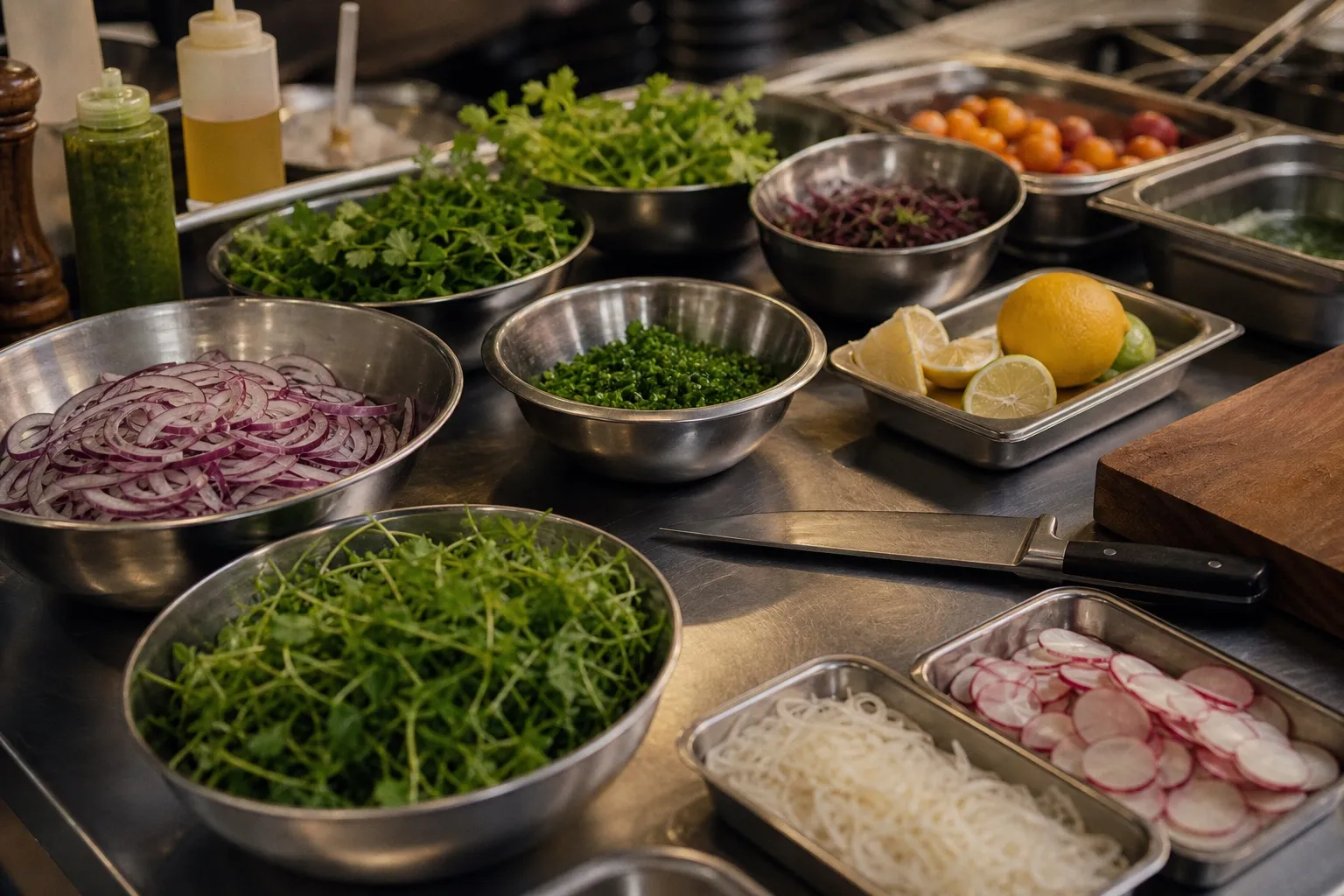
Autocado is no longer a lab toy. The Huntington Beach pilot, the Corona Del Mar Augmented Makeline, and Serve Robotics' acquisition of Vebu turn a press-release partnership into an operations program. Five-point-two million cases of avocados a year is the unit-economics ceiling that decides whether any of this works.
I am standing at the back of the Chipotle on Beach Boulevard in Huntington Beach, watching a robot peel an avocado. The arm comes down, the cup grabs the fruit, the blade does whatever a blade does inside a stainless box, and twenty-six seconds later — give or take — a clean half-avocado, pit removed, slides out into a hotel pan. The crew member next to it is doing the same job by hand on the next pan, three or four avocados deep into a bag, and his hands are visibly faster than the machine. He is also visibly more expensive.
That is the entire premise of the Huntington Beach test. Autocado, the avocado-processing robot Chipotle has been showing off in press photos since 2023, is no longer a demonstration unit in the Cultivate Center test kitchen in Irvine. It is sitting in a restaurant prep area, doing the actual avocado prep for actual guacamole that actual guests are eating at actual lunch. The Augmented Makeline that the company keeps pairing with it in trade press visits has moved out of the lab, too — into the Corona Del Mar location, fifteen minutes down Pacific Coast Highway. The two pieces of the public Chipotle automation story have left the test kitchen at the same time.
I have been waiting for this. The contrarian read in this column today is simple: 5.2 million cases of avocados a year is the ceiling on how much money Autocado can save Chipotle, and the ceiling is lower than the headlines suggest. The economics only close in California, only at peak hours, and only if the machine’s labor offset survives a real twelve-hour shift. The Huntington Beach and Corona Del Mar deployments are not press events. They are the unit-economics test. And the news in the background — that Serve Robotics has acquired Vebu, the startup that built Autocado — has changed who Chipotle’s automation partner actually is.
This is the operator’s reading of what’s actually on the floor, what it actually costs to run, and where the math stops working.
What is actually deployed, in plain English
Let me describe what I am looking at, because the trade press tends to use the partner’s marketing words.
Autocado is a roughly refrigerator-sized stainless-steel cabinet that lives in the prep area of a Chipotle restaurant. A crew member loads a tote of whole avocados into the top hopper, where the machine ripens, sorts, and stages them. The arm picks an avocado, orients it, and runs it through a cut-and-peel cycle that separates skin and pit from the flesh. The flesh drops into a bowl below. A human still finishes the guacamole — mashing, seasoning, the cilantro, the lime, the salt, the red onion, the jalapeño. The robot’s only job is the part of guacamole prep that crew members have always hated: the cutting, the pitting, and the peeling, three to four bags of avocados deep into a lunch shift, with a hand that is going to have a band-aid on it by Friday.
The Augmented Makeline at Corona Del Mar is the other end of the line. It is a section of conveyor that runs beneath the assembly station, lined with sensors and dispensers, and it builds the rice-beans-meat-toppings base of a digital-order bowl or salad while a human handles the front-of-line assembly for in-store orders. The human does not assemble two lines of orders in parallel anymore. The machine does the digital line and the human does the walk-in line. That is the architectural change.
These are the two units of automation that Chipotle has been showing in public for two years. They have never been deployed in the same restaurant. The Huntington Beach store has Autocado. The Corona Del Mar store has the Augmented Makeline. The fact that they are now both running in customer-facing restaurants at the same time is the operational news here.
The 5.2 million case ceiling
Chipotle has been straightforward about the size of its avocado consumption. The company’s own disclosures put US, Canadian, and European volume at roughly 5.2 million cases of avocados per year — about 129.5 million pounds. That number is the total addressable workload for Autocado at the chain level.
Spread across about 4,000 restaurants, that is roughly 1,300 cases per restaurant per year, or call it 35 cases a week, or call it five cases a day. A case is around 48 to 60 avocados depending on size, so the average Chipotle restaurant is processing somewhere between 240 and 300 avocados a day. A crew member doing avocado prep by hand does an avocado every fifteen to twenty seconds when fresh, slower as the shift wears on. Call it 80 to 100 avocados per labor hour at average crew speed.
Autocado does an avocado in about 26 seconds — slower than a fresh human, but the machine does not slow down. Over a twelve-hour operating day, Autocado at 26 seconds per avocado processes a theoretical maximum of around 1,660 avocados. The store only needs 240 to 300. The machine is wildly over-provisioned for any single store’s average workload, and that is the first thing to understand about why Chipotle has not pulled the trigger on a chain-wide rollout. You cannot justify the capex of a refrigerator-sized robot if its actual daily duty cycle is ninety minutes.
The economic argument only closes when you take the labor that Autocado offsets and multiply it by California’s $20 fast-food minimum, which has been in effect since April 2024 and applies to every Chipotle in California. At $20 an hour, three to four labor hours a day of avocado prep is $60 to $80 a day, or roughly $20,000 to $30,000 a year per restaurant in offset labor cost. If the all-in cost of an Autocado — capex, financing, service contract, energy, water, depreciation — is in the same range, you are at parity in California and underwater in most of the rest of the country, where fast-food wage minimums sit several dollars lower.
That is the ceiling. Chipotle gets roughly $100 million to $150 million a year in potential labor offset across the whole chain if Autocado works perfectly everywhere and California-style minimums spread. It gets a fraction of that in the realistic case, where the machine does the peak-volume lunch shift and a human still does the slow-day morning prep because turning on the robot for thirty avocados is not worth it. The reason Chipotle has done this work in public is not that the savings are enormous in relation to the company’s $11 billion-plus revenue base. The reason is that the savings are big enough to matter, and the labor-availability story is bad enough that you would build this even if the dollars were a wash.
Why now, why these two stores
Huntington Beach and Corona Del Mar are not random picks. Both are in coastal Orange County, both are within forty-five minutes of the Cultivate Center test kitchen in Irvine, and both are in the California $20 minimum jurisdiction where the labor math is most favorable. Picking those stores tells you what Chipotle is testing. It is not testing whether Autocado works — that question was answered in the lab. It is testing whether the machine survives the variance of an actual restaurant: an actual delivery cadence, an actual mix of avocado sizes and ripeness, an actual crew that did not interview to operate it, an actual manager who has six other things to worry about, an actual maintenance call at 11:45 on a Saturday.
The operator’s question at this stage is uptime. Lab uptime is not the same as restaurant uptime, and the gap between the two has killed more pieces of foodservice automation than any other single failure mode. A machine that breaks down twice a month is worse than no machine at all, because the crew has to be cross-trained on the manual workflow anyway, and the cognitive load of a sometimes-working robot is higher than the load of doing it by hand every day.
So I am watching for three numbers from Huntington Beach. One: avocados processed per hour, sustained, over a real lunch shift, not over a thirty-minute demo. Two: edible-yield percentage, measured against the trim a trained human produces — the machine’s blade angle is fixed, and a fixed-angle blade against a variable-shape fruit leaves usable flesh in the peel. Three: mean time between failures, measured in cycles, not in days.
Chipotle is not going to publish those numbers, and the partner is not going to publish them either, so the only way an outside operator gets a read on whether the test is working is to watch what Chipotle does next. If the company expands Autocado to a third and fourth store in California in the next ninety days, the test is working. If the company quietly stops mentioning Autocado on earnings calls for two quarters, the test is not working. That is the read. I have written about the company’s full AI stack in an upcoming May piece, and the pattern there is identical: the stuff that’s working gets more deployments, the stuff that isn’t gets quietly de-emphasized.
The Serve Robotics acquisition is the most important news in the partnership
The piece of news that the trade press has under-covered is that Vebu, the startup behind Autocado, has been acquired by Serve Robotics. Serve is the autonomous-delivery-robot company spun out of Postmates that most people know from the white-and-pink sidewalk robots in Los Angeles. The acquisition closed earlier this year. Vebu is now inside Serve.
That changes what Chipotle’s automation partner actually is, and the change is more consequential than the press treatment has implied. Vebu was a small, focused, single-product company that built Autocado and one or two related kitchen-automation prototypes. Serve is a publicly traded company with a different cost structure, a different investor base, a different cap table, and a substantially different product strategy — last-mile delivery robots with a meaningful Uber commercial relationship and a roadmap measured in thousands of units deployed on sidewalks.
The optimist’s reading is that Serve’s manufacturing scale, software discipline, and access to capital are exactly what Autocado needs to move from a hand-built lab unit to a production machine. Vebu was credible in a kitchen but not credible at scale-manufacturing. Serve, having spent the last few years building delivery robots in volume, has the supply chain and the operational rigor that a chain-wide Autocado rollout would require.
The pessimist’s reading is that Autocado is now a non-core product inside a company whose core product is sidewalk delivery, and the kitchen-automation roadmap is going to slip behind whatever Serve’s delivery roadmap demands. The pessimist’s reading has historical support. Foodservice equipment acquired by a non-foodservice parent has a poor track record. The exit cases the trade press loves to cite usually go the same way: the parent’s strategic focus drifts, the kitchen team gets reorganized into a “platform” group, and three years later the product is in maintenance mode.
I think Chipotle is aware of both readings, and I think that is why the contracting structure with the partner — to the extent it is visible in the Market Screener summary of the announcement and the partner’s own statements — looks like a co-development relationship rather than a vendor relationship. Chipotle’s venture arm, Cultivate Next, put capital into Vebu in 2023, and that minority investment likely survives the acquisition in some form. Co-development gives Chipotle a seat at the roadmap table that a pure vendor relationship would not. If you are running a multi-year automation program against a partner whose corporate parent has another agenda, you want that seat.
The operator’s question is whether the Huntington Beach unit is built by Vebu-inside-Serve or by Serve. The answer right now, six months into the integration, is Vebu-inside-Serve. The same engineers, mostly, with a new logo on the badge. Twelve months from now it is going to be a real question. That is the timeline Chipotle is implicitly running on.
The Augmented Makeline is the more interesting machine
Spend a day in the Corona Del Mar restaurant and you start to think the Augmented Makeline is the more interesting machine. Autocado removes a single, specific, painful task from the prep workflow. The Augmented Makeline restructures the assembly workflow itself.
The current Chipotle line is a brilliant piece of operational design. A single crew member assembles bowls and burritos in front of the guest, then a second member adds the salsas and the final toppings, and a third runs the cash. The line is fast because the steps are linear and the crew has done them ten thousand times. The problem is that the same physical line has to handle in-store orders and digital orders, and the digital order — placed on the app, picked up at the second-makeline or the Chipotlane window — competes for capacity with the guest standing in front of the line.
The Augmented Makeline solves that. The robot builds the digital order on a parallel line beneath or behind the human line, and the human keeps building the in-store order without interruption. Throughput goes up. The throughput improvement is the line-rate version of the labor-arbitrage that Autocado is doing on prep. It is the same shape of bet — capex against operating cost, with a payback that is most favorable in high-volume stores in high-wage jurisdictions.
The Augmented Makeline is the one I would watch for the bigger rollout. There are more high-volume stores than there are high-volume avocado-consuming stores, the payback math is closer to neutral outside California, and the customer-experience benefit — guests in line move faster — is bigger than the guacamole-prep benefit, which guests never see.
What the earnings call actually said
The most recent Chipotle earnings discussion picked up by Tipranks made the position the company is now in clearer than the press releases do. Growth holds. Margins are squeezed. That is the right context for the automation program. Chipotle is not rolling out Autocado or the Augmented Makeline because it has a labor crisis or a margin crisis severe enough to demand a moonshot. It is rolling them out because the chain has the cash, the operational discipline, the test infrastructure in Irvine, and the long-horizon investor patience to do a slow, methodical, store-by-store rollout that arrives at the right answer in three years rather than the wrong answer in one.
That is the part of the Chipotle story that other operators should be reading carefully. The company is not in a hurry, and it has explicitly chosen partners — first Vebu, now Vebu-inside-Serve, and the broader Hyphen relationship that produced the Augmented Makeline — that share that posture. The earnings call language about margin pressure is the constraint that bounds the program: every dollar of capex has to clear the comparable-sales math, and the comparable-sales math is not as forgiving today as it was eighteen months ago.
The food-cost line is the one I would watch alongside the labor line. Avocado prices are volatile, the trim percentage on Autocado is not yet at parity with a trained human, and a half-point of trim is real money against 5.2 million cases. If Autocado’s edible-yield improves the trim — which is the partner’s claim — the food-cost line moves in the right direction at the same time the labor line moves in the right direction, and the payback compresses. If the trim is worse than a trained human’s, the food-cost penalty has to be netted against the labor savings, and the California-only payback case gets thinner. Chipotle has not disclosed which way the trim has settled. The next earnings call is where I expect that number to surface, obliquely, in the cost-of-sales line.
What I would do if I were running a competing chain
I want to close with the operator’s takeaway, because this column is read more by people who run restaurants than by people who follow Chipotle as a stock.
If I were running a competing fast-casual chain with significant California exposure and a labor-intensive prep step, I would do four things. One, I would call Hyphen and ask what an Augmented Makeline looks like for my menu — the architecture generalizes more than the press treatment suggests, and the line-rate benefit applies to any chain whose digital mix is above thirty percent. Two, I would not call Serve Robotics about kitchen automation for at least another twelve months, because the integration is too early. The Vebu team is the team I would want, and that team’s roadmap allegiance is still being negotiated. Three, I would treat the California $20 minimum as the macro signal it is — the labor-arbitrage payback for any kitchen automation is two to three times more favorable in California than it is in Texas, and the rational sequencing of a rollout follows the wage geography. I made the same point about distributor software in a forthcoming May piece on Sysco: the AI-and-automation payback follows the labor cost, not the menu mix.
Four — and this is the one most operators get wrong — I would not try to clone Autocado. The bespoke piece of equipment is the wrong place to start. The right place to start is the workflow change that the Augmented Makeline represents: separating the digital-order assembly from the in-store-order assembly so that the two lines stop competing for the same human’s attention. That change does not require a robot. It requires a second makeline, a digital-order display, and a crew that has been trained to run two parallel lines. You can get most of the benefit of the Augmented Makeline without the capex, and you can do it next quarter, and the capex robot becomes a Phase 2 decision rather than a Phase 1 bet.
The Huntington Beach Autocado and the Corona Del Mar Augmented Makeline are real. They are doing real work for real guests on a real lunch shift in late June. The 5.2 million case ceiling is also real, and the California payback is still the only payback that closes on the labor side alone. The Serve Robotics acquisition has put the partner in motion, and the next twelve months are going to decide whether Autocado is a Chipotle product, a Serve product, or — the worst case — a press release that ages badly. I think it is going to be a Chipotle product, and I think the reason is the slow, methodical posture the company has taken since 2023. The operators who want to copy the work should copy the posture first.
— Priya covers operators for TableTransfers. Tips: [email protected].
Featured
More
Browse all 494 posts
The Voice Agent Maturity Curve
mise
·12 min read
The Four Margins of a Restaurant
mise
·14 min read
The AI Premium in Hospitality M&A: Broker Story or Real Number?
the bottom line
·9 min read
What the DoorDash/SevenRooms Deal Actually Buys
the bottom line
·11 min read