Inside Marriott's AI Stack: A Case Study in How the Largest Hotel Chain Is Actually Deploying It
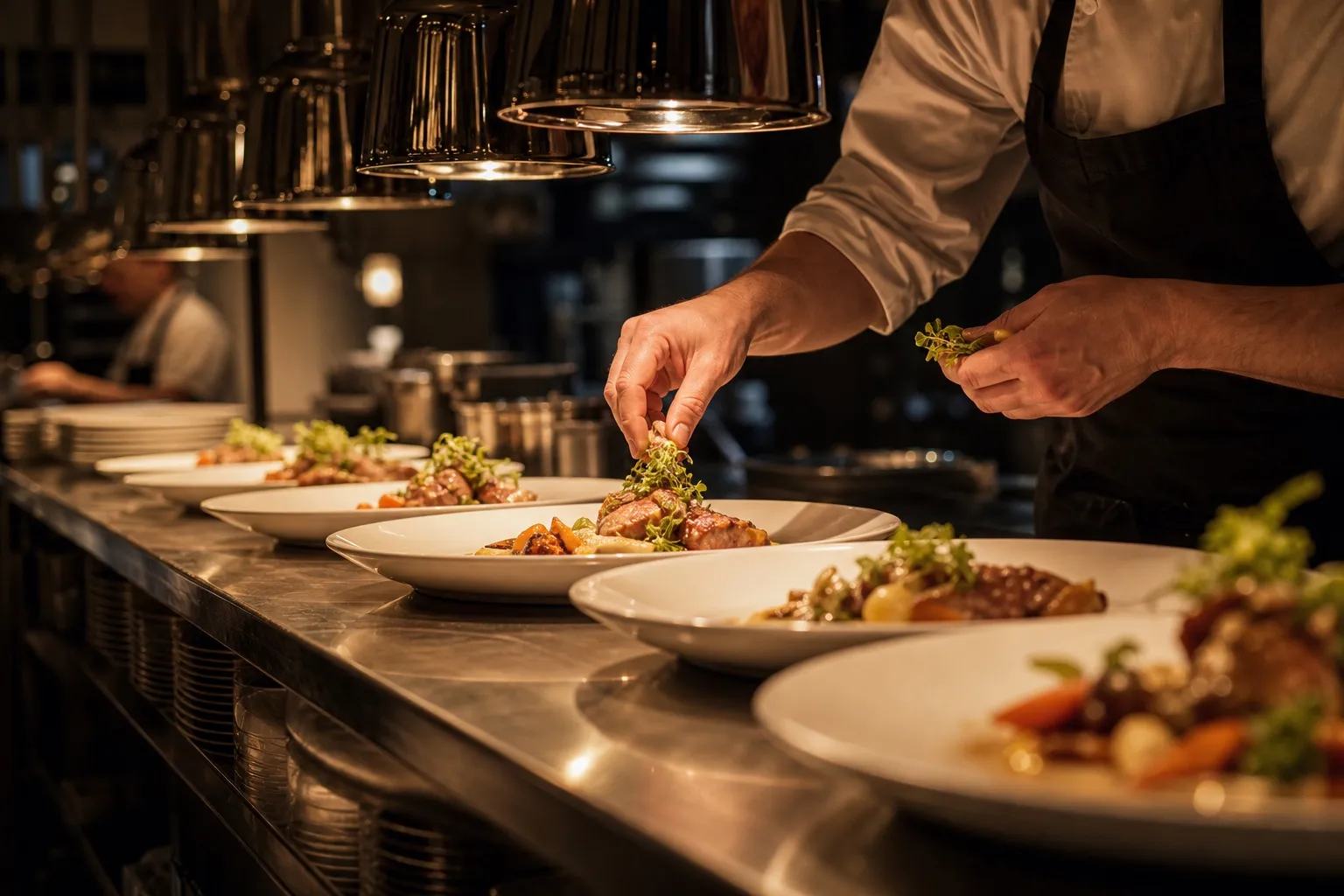
Marriott has 8,500-plus properties, a $1.1 billion 2026 tech budget, and a public AI rollout that spans Winnow food-waste cameras, Preferabli's wine concierge, the SevenRooms restaurant stack, IRIS mobile dining, and a natural-language search agent. We read the earnings transcripts, the press releases, and the trade press, and pulled out what's actually deployed today versus what's still slideware.
The hotel-industry AI conversation has, for two years, been a slide-deck conversation. Every brand has an AI strategy. Every CEO has an AI line in the earnings call. Every analyst report has a paragraph about agentic mesh and unified guest data. Almost none of it tells you what is actually running in the kitchen, the dining room, the room-service line, or the loyalty stack today.
I spent the last three weeks reading every public document I could find on the largest US hotel chain’s AI rollout — earnings transcripts, press releases from the brand and its vendors, trade-press coverage in Skift, Hotel Dive, Hospitality Net, Hotel Technology News, the Drinks Business, the Press Democrat, the Restaurant Business — to assemble a case study of what’s actually deployed today versus what is still on a roadmap slide. I picked Marriott because the documentation is, by a long margin, the densest, and because the F&B-specific deployments are the most concrete. Hilton’s story is roughly the same shape, and shows up at the edges of this piece for comparison.
A note on methodology before I start. Every number, vendor name, executive name, and property in this case study comes from a public source — a press release, an earnings transcript, a trade-press report, or a vendor case study. Where I’m describing what’s deployed, I cite the source inline. Where I’m reading between the lines — about operator implications, about what’s missing, about what F&B leaders should take from this — I say so. There is no “Sarah at an unnamed property” anywhere in this piece. The point of a case study is that every fact is verifiable, and the place I want operators to push back is on my interpretation, not on the underlying facts.
The shape of the chain
Marriott operates roughly 8,500 properties globally under a predominantly franchise model, which matters for how AI gets deployed (you cannot mandate every kitchen tool the way you can in a corporate-owned chain — you have to make the tool worth the franchisee’s money) (Hotel Technology News, February 2026). The Marriott Bonvoy loyalty programme has approximately 210 million members, which is the core data asset that every guest-facing AI initiative is built on top of (Hotel Technology News, February 2026).
The investment number is the one to anchor on. Marriott guided to $1 billion–$1.1 billion in investment spending for 2026, with roughly 40% of that — up to $440 million — earmarked for digital and technology transformation and corporate systems (PhocusWire, February 2026). That money is funding three replatforming projects in parallel — property management system, central reservations system, loyalty platform — which is unusual in the industry because most chains stagger the three to avoid simultaneous disruption (Hotel Technology News, February 2026).
CEO Anthony Capuano framed the strategic stakes on the Q4 2025 earnings call: “We see AI as an opportunity to potentially redefine the customer acquisition paradigm that has governed our industry for the past several decades” (Hotel Technology News, February 2026). That is the most ambitious public statement any major hotel CEO has made about AI in the last two years. It is also a statement about distribution — about who controls the guest acquisition funnel — and the F&B implications cascade out from there.
Naveen Manga, Marriott’s Global Chief Information Officer, has been more measured in his framing. Manga told CIO Dive that the company is in “deep discovery with agents” and is prioritising “approximately 10 high-value AI use cases” before scaling globally (CIO Dive, 2025). The exact phrase he used was “ruthless prioritization,” which is a useful counterweight to the more ambitious slide-deck language elsewhere.
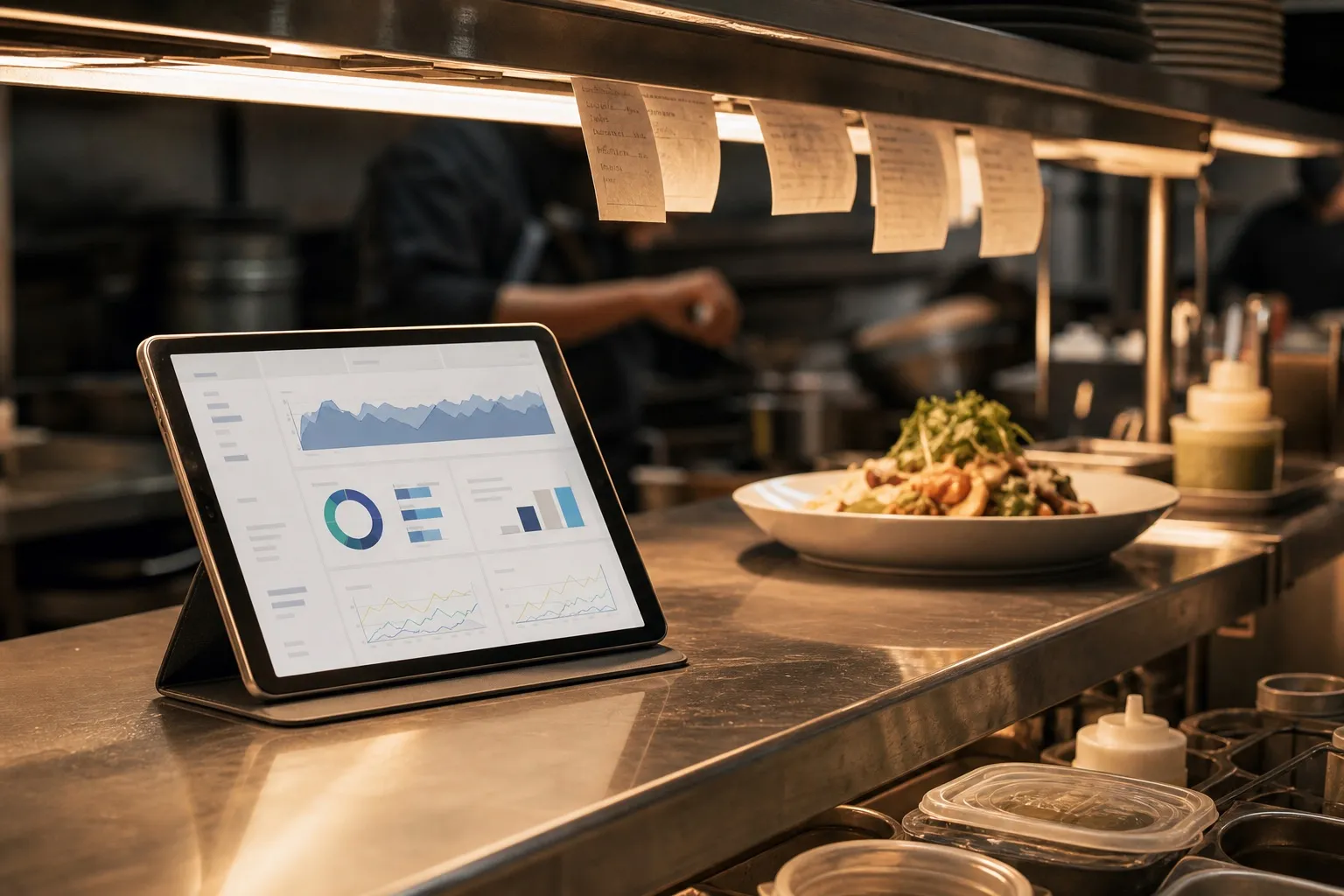
So: $440 million in 2026 tech spend, three replatformings, agentic mesh as the unifying frame, ten use cases under active development, and a public framing that AI will redefine customer acquisition. What is actually deployed?
What’s actually deployed today
Five deployments are clearly live based on the public record. I’m listing them in order from most-mature to least-mature.
1. IRIS mobile dining (1,500+ properties)
IRIS, a UK-based mobile-dining vendor, is deployed at over 1,500 Marriott hotels and is integrated directly into the Marriott Bonvoy native app (IRIS, marriott-mobile-dining). The platform handles in-room dining orders, pool-deck and lobby ordering, restaurant and bar mobile ordering, and local catering across Marriott’s 30-brand portfolio. In 2024 Marriott and IRIS extended the relationship into a 10-year exclusive partnership for F&B mobile dining (Hotel Online, 2024).
The publicly-reported results are property-level, not chain-level. The Kansas City Marriott Downtown reported “reducing customer wait times by over 30 minutes, with an 87% year-on-year increase in order volumes and 94% increase in F&B revenue” after deploying IRIS (IRIS). The chain-wide claim from IRIS is that properties using their platform “increase ancillary revenue by over 20% on average,” though this is a vendor claim across IRIS’s full customer base, not Marriott-specific (IRIS).
IRIS is not, on its own, an “AI” deployment in the foundation-model sense — it’s a digital-ordering platform with personalisation features. But it is the substrate on top of which generative AI features get layered, and it is the most-deployed F&B technology in Marriott’s stack today.
2. SevenRooms (preferred restaurant technology partner)
Marriott named SevenRooms its preferred restaurant technology provider in May 2023, with the platform already live across 25 countries at the time of the announcement at brands including W Hotels, Ritz-Carlton, St. Regis, Sheraton, JW Marriott, Le Méridien, Westin, Renaissance, EDITION, The Luxury Collection, and Gaylord (Hotel Dive, May 2023). The “preferred” status opened the platform to an additional 8,500 properties.
SevenRooms provides reservations, CRM, on-premise table management, waitlist, email marketing, and review aggregation. Matthew Von Ertfelda, Marriott’s Senior Vice President of Food and Beverage at the time of the deal, framed the integration as a way to deliver “a 360-degree view into the guest journey to foster deeper guest loyalty” (Hotel Dive, May 2023).
The 2025 development: DoorDash acquired SevenRooms for $1.2 billion all-cash in May 2025 (AlleyWatch, May 2025). Marriott’s preferred restaurant-tech vendor is now owned by a delivery-and-marketplace platform. Whether that creates conflicts is a question every operator running SevenRooms on a Marriott property should be asking.
3. Winnow AI food-waste monitoring (53 hotels, UK/Ireland/Nordics)
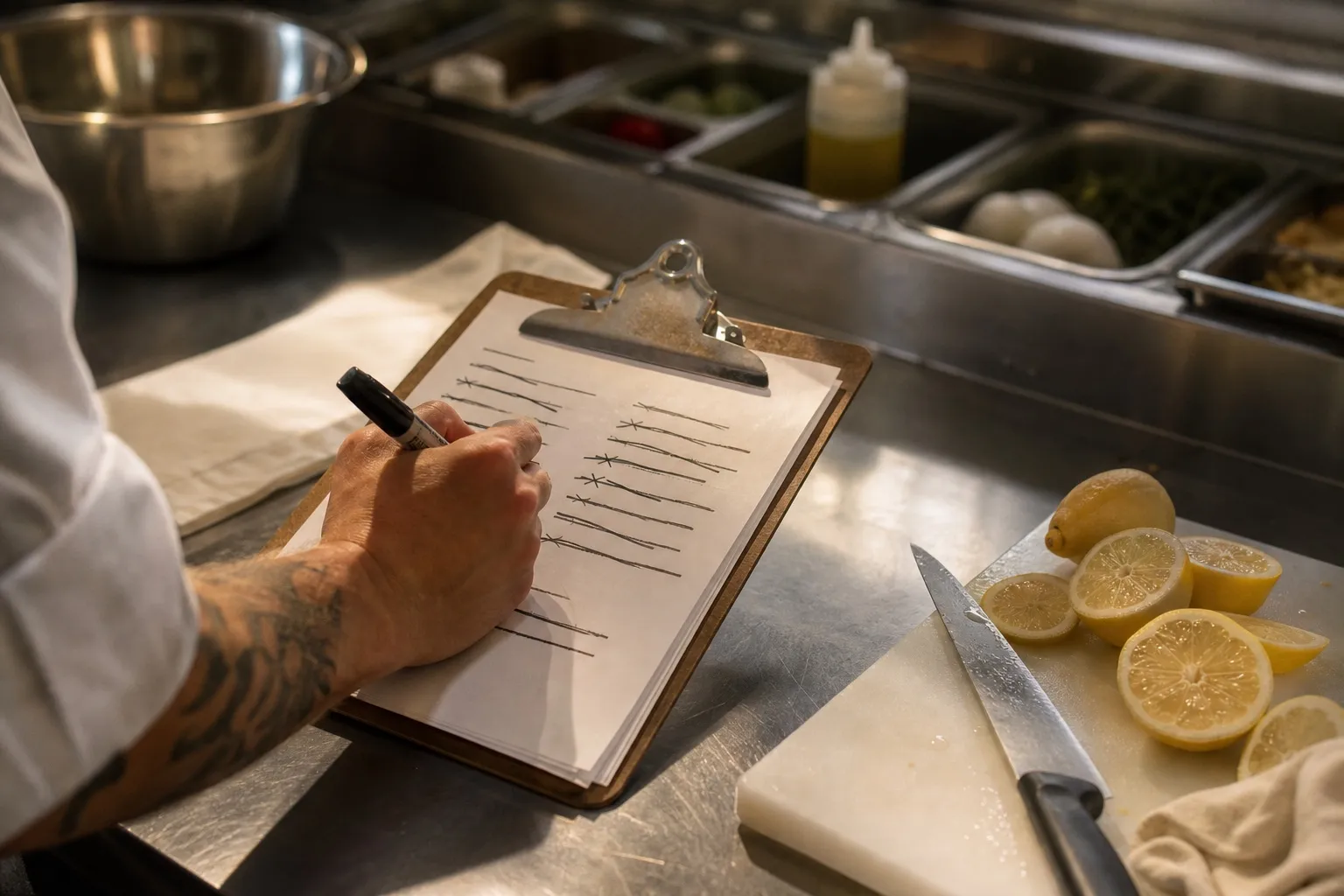
This is the cleanest AI-with-real-numbers deployment in the Marriott portfolio. Winnow’s platform uses cameras and AI-trained scales in kitchen bin areas to identify discarded food, document waste reasons, and produce real-time reports for chefs and F&B teams (Winnow blog, 2025).
The rollout, launched in early 2024, covered all 53 Marriott managed hotels in the UK, Ireland and Nordics and was deployed across all 53 properties in under two months (Winnow blog, 2025; Marriott press release, October 2024). The first-six-months result was a 25% reduction in food waste, equivalent to 486 tonnes of CO2 prevented from atmosphere; the twelve-month result was a 50% reduction by weight, putting the region five years ahead of the UN Sustainable Development Goal 12.3 target (Winnow blog; Food Digital, October 2024).
The property-level numbers are where the case study gets interesting. The London Marriott County Hall reported £47,000 in annual savings through service redesign driven by Winnow’s waste data; the chef redesigned the service from a buffet to à la carte with smaller portions (Winnow blog). The London Marriott Canary Wharf, under chef Sanjay Jadhav, hit a 67% reduction in six months through buffet redesign and ingredient-level analysis (Winnow blog). Anna Pazdera, Executive Chef at the London Heathrow Marriott, embedded daily Winnow reviews into kitchen operations and ran a banana-peel “pulled pork” burger as a zero-waste menu item (Winnow blog).
The chain-level quote, from Joanna Chugh, Area Vice President for UK, Ireland and Nordics: “We’ve already achieved a 25% reduction in food waste within six months” (Food Digital, October 2024). Over 3,000 culinary, kitchen-steward and F&B team members participated.
The competitive context: Hilton has Winnow deployed at “nearly 200 hotels globally” — 170 hotels across 29 countries — and reports $2 million in annual savings across the portfolio as of end of 2023, plus over 1 million meals saved from landfill and 2,050 tonnes of CO2e avoided (Hilton EMEA newsroom, 2025; Hilton stories). Hilton’s Green Breakfast pilot across 13 UAE properties hit a 62% reduction (Winnow blog). Marriott’s 53-property regional deployment is one third the scale of Hilton’s. Hilton is the public-disclosure leader on food-waste AI; Marriott is catching up.
4. Preferabli AI wine concierge (Napa Valley Marriott Hotel & Spa)
This is the newest deployment in the public record, and the most useful for F&B operators thinking about how guest-facing AI can sit on top of the dining and beverage programme. On December 2, 2025, the Napa Valley Marriott Hotel & Spa announced a partnership with Preferabli, an AI recommendation platform with 15 patents that operates across wine, spirits, beer, sake, craft cocktails and food (Drinks Business, December 2025; Press Democrat, December 2025).
The deployed product is Preferabli’s Tastefuli app, which uses what the company calls “Preferabli Sensorial AI” — a taste-profile system built on sensory characterisation of hundreds of wines and spirits, originally catalogued by master sommeliers and wine experts from the recently-acquired Libation Labs (Drinks Business, December 2025). The platform supports both the concierge team’s experience recommendations and the hotel’s F&B operations, specifically wine and spirits pairing tied to a guest’s taste profile.
Pam Dillon, CEO of Preferabli, framed the design intent: the software was “built to work like a human expert at scale in a way that is accurate, unbiased and calibrated across products” (Press Democrat, December 2025). Rachel Wilson, General Manager of the Napa Valley Marriott, is the property-side executive named in the announcement.
The deployment is single-property today. The question for operators: is this the prototype for a chain-wide taste-personalisation layer bolted onto the SevenRooms guest profile, or a Napa-specific concierge add-on? Its integration into F&B operations, not just concierge, suggests the former. We’ll know in 2026.
5. Microsoft 365 Copilot and contact-centre AI coaching
The unglamorous deployments. Per CIO Dive, Marriott has rolled out Microsoft 365 Copilot across the organisation (meeting summaries, transcriptions, document drafting) and is using AI coaching for contact-centre agents (CIO Dive, 2025). The contact-centre piece is the one I’d watch for F&B implications: it’s the same architecture that gets repurposed for voice ordering and guest-services-call routing. The voice-agent curve lands in hospitality on a 12-to-18-month lag from QSR, and contact-centre AI is the on-ramp.
What’s on the roadmap but not yet deployed
Three things show up in Marriott’s public statements as imminent rather than live.
Natural-language search on Marriott.com and the Bonvoy app. Public timeline is “first half of 2026” for an initial deployment letting guests search by natural-language query (“a beach hotel for a family of four under $300 in July”) rather than conventional filters (PhocusWire, February 2026). Marriott is also a launch partner with Google on Google’s forthcoming AI Mode travel product, and is in OpenAI’s ad pilot programme (PhocusWire, February 2026).
Agentic mesh — the shared intelligence layer. This is the architectural piece that, if Marriott pulls it off, becomes the moat. The framing from Manga is that Marriott is building a “model-agnostic technology chassis with an agentic layer” — meaning the company wants to be able to swap underlying foundation models without rewriting its agentic capabilities, and reuse those capabilities across marketing, operations, customer service and revenue optimisation (CIO Dive, 2025). No pilots, per Manga, are currently in production. The frame is “deep discovery.”
Bonvoy-integrated AI-driven personalisation. This is the slide-deck phrase that has not yet been translated into a deployed feature. Marriott has 210 million Bonvoy members. The promise is that the loyalty data plus the F&B data (from SevenRooms, IRIS, and Preferabli) plus the stay data (from the new PMS) plus the search data (from natural-language search) becomes a single unified guest profile that drives “next best action” recommendations across every channel. The plumbing is being built. The deployed product is not yet there.
What’s not deployed at all (and probably should be)
Two F&B-adjacent categories are conspicuously absent from Marriott’s public AI inventory.
Banquet-operations AI. Marriott is one of the largest banquet and events operators in the world. AI-assisted BEO parsing, prep forecasting, and concurrent-service capacity planning would deliver outsized returns at a convention-hotel property. None of this shows up in the public Marriott AI inventory. The likely explanation is that this is property-level operator work, not corporate-IT work, and the corporate stack is not yet down at that level of granularity. The vendor opportunity here is large.
AI-assisted scheduling for unionised-labour properties. Marriott has substantial unionised-labour exposure in major US markets. The labour-rules complexity in those contracts is, on the public record, beyond what most off-the-shelf AI schedulers can handle. The vendor that cracks union-labour-rules-aware AI scheduling owns a category. Its absence from Marriott’s deployment list suggests the vendor doesn’t exist yet, or Marriott hasn’t found one it trusts.
F&B-specific implications
If you run hotel F&B at a Marriott-managed or franchised property, here is the read of where Marriott’s AI deployment lands for you specifically.
Winnow is essentially a free lunch on the food-waste line. The technology is deployed at scale, the results are documented, and the property-level economics (the £47,000 at County Hall) work even at mid-size F&B operations. If your property is in the UK, Ireland or the Nordics, you are almost certainly already on the Winnow rollout. If you’re in the US, the question to ask your area F&B director is whether the regional rollout is on the 2026 plan. Hilton has 200 properties live and reports $2 million in annual savings; Marriott has no public 2026 commitment to expand Winnow beyond Europe, which is the largest gap in the chain’s AI inventory.
The IRIS-plus-SevenRooms substrate matters more than any single AI feature. Preferabli at the Napa Valley Marriott is interesting not because the Tastefuli app is itself transformative, but because the property already has an IRIS mobile-dining stack, a SevenRooms reservations stack, and a Bonvoy profile for every guest. Layering a taste-personalisation API on those three substrates is a multi-week project. If you have IRIS and SevenRooms deployed and configured, you are pre-positioned for the next wave of guest-facing AI. If you don’t, you’ll be doing substrate work and the AI deployment at the same time, which is how AI projects fail.
The DoorDash acquisition of SevenRooms is the under-discussed risk. Marriott’s preferred restaurant-tech provider is now owned by a company whose business model partly relies on disintermediating restaurants from their guests. The contract terms Marriott negotiates with DoorDash-owned SevenRooms over the next 18 months will shape whether the platform stays a hospitality CRM or becomes a customer-acquisition channel for DoorDash. Ask your SevenRooms account manager about data residency, marketing-opt-out, and aggregation rights. Now, not in 12 months.
The natural-language search rollout matters for F&B discovery. When Marriott.com starts answering queries like “a hotel in Mexico City with a great rooftop bar that has live jazz on Friday nights,” the F&B programme at every property becomes part of the search-discovery layer. Invest in what makes your F&B distinctively searchable. The AI search will surface what makes you different.
The personalisation slide is still a slide. There is no deployed Bonvoy-integrated F&B personalisation product at the chain level today. F&B leaders being told that “AI personalisation is coming for your menu” should ask, kindly, for the public timeline and the named pilot property. If neither exists, the timeline is longer than the slide deck suggests.
Operator takeaways
If you are an F&B leader at a Marriott property and you read this far, here is the operator-level distillation.
-
Get on Winnow if you aren’t already. It is the highest-ROI F&B AI deployment in the chain’s documented inventory, and Hilton’s $2 million annualised savings number across 200 hotels is the realistic upper bound of what’s available. The fastest property-level rollout is two months.
-
Audit your IRIS and SevenRooms deployment. If both are live and configured well, you are positioned for the next wave of guest-facing AI. If either is partial or unconfigured, fix that first. The substrate matters more than the model.
-
Track the SevenRooms-DoorDash integration. Specifically, track whether guest data acquired through SevenRooms reservations is being made available to DoorDash for its own marketing purposes. Read the contract.
-
Watch the Napa Valley Preferabli deployment for chain-wide signals. If Preferabli shows up at a second Marriott property — particularly a non-Napa property — that is the signal that taste-personalisation is moving from a single-property experiment to a chain capability. That is the moment to start thinking about how your beverage programme integrates with a guest taste profile.
-
Push back on personalisation slideware. Most of the AI promised in the public framing is not yet deployed. Hold the corporate conversation accountable to the timeline. Ask for named pilot properties and named pilot dates.
The QSR side of the Sweetgreen and Chipotle rollouts gives you the comparison: QSR’s AI conversation has moved past discovery into operations. Hotel F&B is at the substrate-and-pilot stage. That gives operators time, which is the rarest thing in hospitality. Eitan’s four margins of a restaurant is the right lens — most of Marriott’s roadmap targets revenue and labour margins; very little touches the food-cost margin where Winnow actually delivers. Marcus’s Bottom Line on hotel F&B as an acquisition target is the buy-side companion read. The Voice Agent Curve piece is the right one if you’re wondering how QSR voice-AI lands in hotel room service over the next 18 months.
The largest hotel chain in America is in year one of a multi-year, $440-million-per-year AI deployment. The first wave is real, narrow, and operationally useful — food-waste cameras in 53 European kitchens, a wine concierge at one Napa property, mobile dining across 1,500 hotels. The second wave is slideware. Tell the difference, and you can run an F&B programme that is ahead of the chain rather than running to catch the deck.
— Naomi covers the Hotel F&B beat for The Operator. Tips and intros: [email protected].
Featured
More
Browse all 494 posts
The Voice Agent Maturity Curve
mise
·12 min read
The Four Margins of a Restaurant
mise
·14 min read
The AI Premium in Hospitality M&A: Broker Story or Real Number?
the bottom line
·9 min read
What the DoorDash/SevenRooms Deal Actually Buys
the bottom line
·11 min read