Earnings Week Unpacked: Where the AI-and-Hospitality Multiples Expand From Here

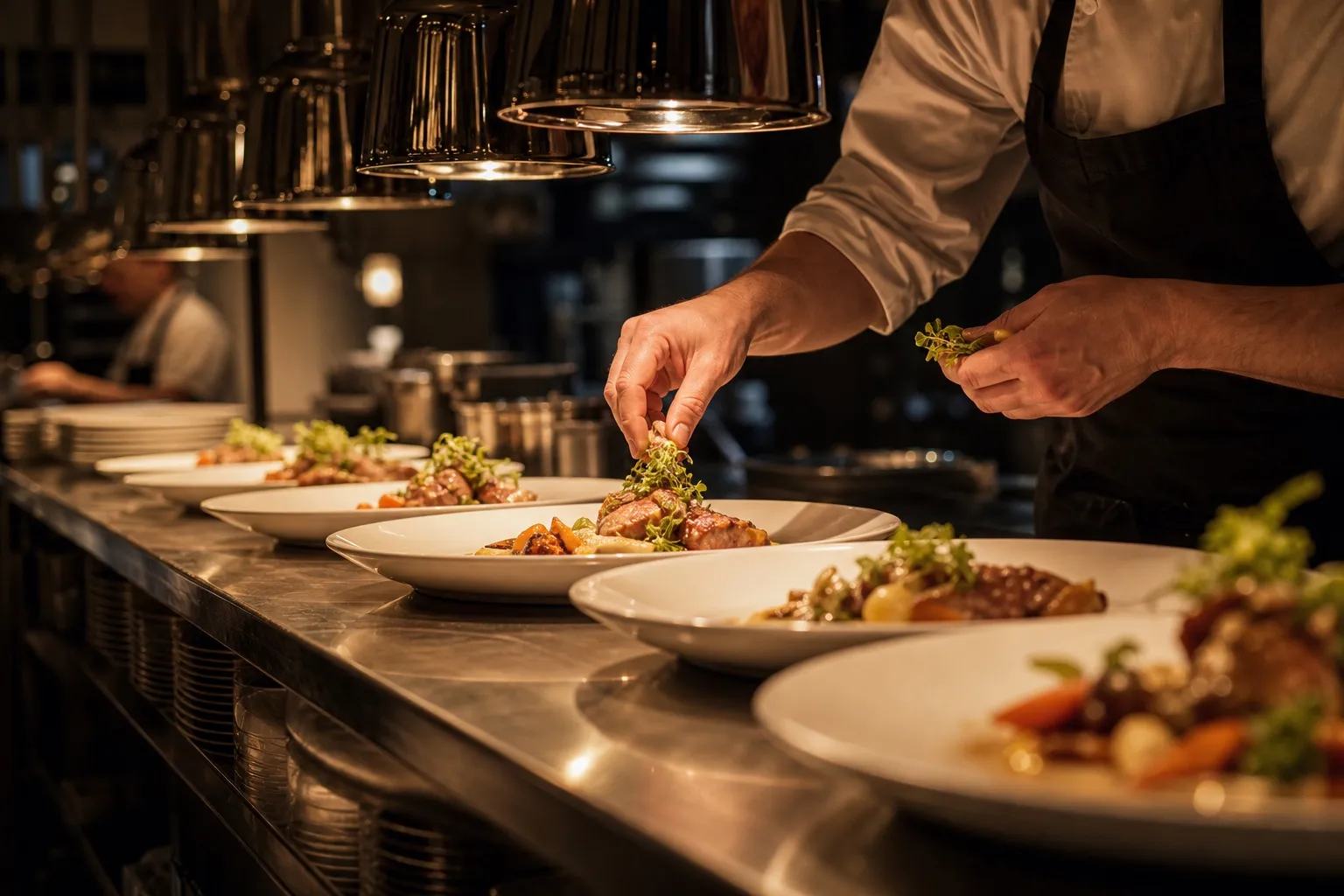
Read Toast, Olo, PAR, US Foods, Sweetgreen and RBI together and a thesis emerges: software multiples compress, but vertical-AI optionality is the only thing that holds them up.
It is Friday afternoon, the windows are open, and I have five Q1 prints stacked on my desk in the order I want to read them. Toast on top, then Olo, then PAR, then US Foods, then Sweetgreen, with the Restaurant Brands International release I pulled earlier in the week tucked underneath as a control. The market has spent the week trying to decide whether restaurant technology is a defensible category or a crowded one, and whether the operators those vendors sell into are about to spend or about to flinch. My read, after going line by line through each release, is that the answer is both — and that the only thing holding the multiples up on the software side is vertical-AI optionality. Strip that out and the comps compress meaningfully from here.
That is the contrarian thesis I want to walk through, because it explains why Toast is being rewarded for an Applebee’s signature it has not yet shipped, why PAR keeps grinding higher despite mid-cap illiquidity, why Olo trades like a dying SaaS business when the ARPU print said the opposite, and why Sweetgreen and Bloomin’ are the cautionary tales investors are going to underwrite the rest of the year against.
What this week priced in
The shape of the week was simple enough. Software vendors who could point at a credible AI roadmap and a marquee enterprise win expanded. Software vendors who could not contracted. Operators with pricing power and a buyback held the line. Operators with negative traffic got punished. The distributor in the middle did what distributors do in a soft real economy, which is grind out a low-single-digit organic top line, an EBITDA print slightly ahead of the Street, and a billion-dollar buyback that does most of the work the income statement cannot.
Run the numbers in order. Toast posted $133 million of adjusted EBITDA on the way to a $1.7 billion ARR run rate (Toast Q1 2025 release), and announced on May 8 that Applebee’s, the largest casual-dining brand in the country by unit count, had selected Toast for an enterprise rollout. Olo did $80.7 million of revenue, up 21 percent, with average revenue per unit climbing to $911 (Olo Q1 2025 exhibit), and on the same day disclosed Chipotle Catering Plus going to its platform. PAR Technology’s release the following morning showed annualized recurring revenue at $282 million, up 52 percent in total and 18 percent on an organic basis (PAR Q1 2025 release). US Foods produced $389 million of adjusted EBITDA, up 9.3 percent, and authorized a $1 billion share repurchase. Sweetgreen managed $166.3 million of revenue, up 5.4 percent, but same-store sales fell 3.1 percent. Restaurant Brands International, the control, reported adjusted EPS of $0.75 against a $0.78 consensus (RBI Q1 2025 release).
What the tape priced in across those five days is that the dispersion inside restaurant technology is now wider than the dispersion inside restaurant operations. That has not been true at any point in the past three years. The implication for capital allocation, for both public investors and the strategic buyers I spend most of my time on, is that the next wave of consolidation in this space is going to be vendor-on-vendor before it is operator-on-operator. The Toast/Applebee’s signal and the PAR organic print are both telling you the same thing from opposite ends of the market cap spectrum.
The Toast / Applebee’s rerate
Start with the obvious one. Toast at 140,000 locations and $1.7 billion of ARR has been treated by the market as a graduated SaaS business for about a year now, but the underlying multiple was still capped by a fair question, which was whether the company could meaningfully penetrate enterprise. The Applebee’s announcement on May 8, paired with a $133 million adjusted EBITDA print, settles that argument. Applebee’s runs roughly 1,600 units in the US under Dine Brands. Even at a conservative ARPU assumption well below Toast’s existing blended fleet — and enterprise typically discounts to mid-market — the contract is a referenceable logo with implied ARR in the low double-digit millions on a fully ramped basis. The dollar number is not what matters. The signal does.
The signal is that the largest casual-dining franchise system in the country is willing to commit to a single front-of-house and payments stack, and that the stack it chose is Toast. Every enterprise procurement organization at every multi-brand operator in the country read that release on Thursday morning. My base case is that we see at least one more nine-figure-unit casual or family-dining enterprise win for Toast by the end of Q3, and that the consensus FY26 ARR estimate moves up by something between 4 and 7 percent over the next two quarters as the sell-side catches up.
That is the multiple-expansion case. It is also, importantly, the case that justifies Toast continuing to trade at a premium to the broader vertical SaaS comp set. Without Applebee’s, the bears had a real argument that growth would have to come from a saturated SMB channel and that the AI roadmap — Toast IQ, the dynamic pricing work, the labor optimization tools — was just a story. With Applebee’s signed, the AI roadmap becomes the wedge into the rest of enterprise, and the multiple has air above it again. We will return to the structural divergence between the vendors who can sell into enterprise and the ones who cannot in our subsequent Bottom Line on the structural divergence (see also).
PAR is the catch-up trade
PAR is the position I have been adding to all week, and Friday morning’s release is the reason. Annualized recurring revenue at $282 million, growing 52 percent in total and 18 percent organic, is a print that on a pure-play SaaS scorecard should trade closer to where Toast trades than where PAR currently does. The total-versus-organic spread is being driven by the Stuzo and TASK acquisitions, both of which are now showing up in the comparable base, and what you are watching is a roll-up that has, against the odds, actually integrated. PAR Retail is doing what management said it would do. PAR Government continues to throw off cash that subsidizes the software platform, which the bulls have always treated as an optionality argument and the bears have always treated as a complexity tax.
My read is that the bulls are right for the next two quarters and the bears are right thereafter, which is exactly the window where the catch-up trade lives. The numbers PAR put up on the organic line — 18 percent in a quarter when the operator end market is decidedly mixed — are a referendum on Brink, on the Punchh loyalty platform, and on the fact that the company has finally stopped pricing like a hardware vendor and started pricing like a software vendor. Burger King’s stadium-and-arena rollout, which PAR called out earlier in the year, is now visible in the ARR. The Burger King US system is a Carrols-and-RBI overhang that will get resolved one way or another over the next several quarters, and PAR is the embedded technology vendor for whichever side of that table wins.
Here is the catch-up math. If PAR exits the year at roughly $330 million of ARR and trades at the same EV/ARR multiple that Toast does on a forward basis — and there is no defensible reason it should not, given the organic growth comparable and the gross margin trajectory — the implied equity value is materially above where the stock sits today. The risk to that thesis is execution at PAR Government and a single bad quarter on Stuzo, neither of which I rate as high probability. My base case is that PAR closes the multiple gap to Toast by roughly half over the next two earnings cycles.
Olo is mispriced
Olo did $80.7 million of revenue, up 21 percent, and announced Chipotle Catering Plus on May 8. The ARPU print — $911 — is the number nobody is talking about and the number that matters most. ARPU at Olo has been the bear case for two years. The pitch from the shorts has always been that the platform was commoditizing, that the take rate was compressing, and that the move from per-location pricing to a platform pricing model would not happen quickly enough to outrun the SMB headwinds at Toast and Square. The Q1 print refutes that. ARPU at $911, paired with 21 percent revenue growth and the Chipotle catering win, is the configuration of a vendor moving up-market and pricing into platform breadth, not a vendor losing per-location economics.
Catering is the wedge here and is being undervalued by the market. Chipotle Catering Plus is the kind of product that, once integrated, creates a switching cost that did not previously exist. It is also the kind of product that materially expands the contract value at every enterprise customer that adopts it. If I run a simple sensitivity — 50 percent of Olo’s enterprise base adopts catering at a modest uplift to existing ARPU over the next 18 months — the revenue line gets to a number that the current multiple does not reflect.
The Olo bear case, to be fair to it, is that the company is structurally smaller than Toast and PAR, has less of an enterprise sales motion, and is more exposed to enterprise concentration risk. All true. But the trade is not whether Olo is as good a business as Toast. The trade is whether Olo is mispriced relative to the trajectory it just printed. My base case is that it is, and that the multiple closes a non-trivial portion of the gap over the next two quarters.
Where the cautionary tales sit
Sweetgreen is the cautionary tale on the operator side that anchors the rest of this week’s read. Revenue grew 5.4 percent to $166.3 million, but same-store sales fell 3.1 percent. The translation in plain English is that growth is now being delivered by new-unit count rather than by underlying brand strength. That is a structurally lower-quality top line and the market knows it. Sweetgreen has spent two years selling investors a story about Infinite Kitchen, throughput economics, and a premium-fast-casual moat. The Q1 print does not refute the throughput story — the Infinite Kitchen units do appear to be hitting their margin targets — but it does refute the demand story, at least for this quarter.
The implication for everyone else in fast-casual premium is meaningful. If Sweetgreen is comping negative, the read-through to Cava, which reports May 15, is the question every consumer-discretionary desk is going to be asking on Monday morning. My base case is that Cava prints a positive comp but at a decelerating rate, and that the market will discount that print against the Sweetgreen tape rather than treating it on its own merits. That is a setup the longs in Cava have not had to deal with for the better part of a year. The AI-premium thesis becomes harder to argue when the underlying operator end market is showing this kind of dispersion, as our later coverage argues (see also).
The other cautionary tale, which I will only touch on briefly here because it deserves its own write-up, is Bloomin’ Brands. Outback has been one of the most-watched casual-dining names of the year for the wrong reasons, and the Q1 commentary did nothing to change that. Traffic is the problem, the value-menu repositioning is the half-measure, and the franchising conversion is the optionality the market is hoping for. None of it changes the read this week, which is that operators with negative traffic and no obvious tech-driven cost takeout are going to keep paying a discount to operators who have either pricing power or a credible labor-AI roadmap.
US Foods sits in between, and is worth its own paragraph. Adjusted EBITDA up 9.3 percent to $389 million is a quality print in a quarter where most distributors would have been pleased with mid-single-digit EBITDA growth. The $1 billion buyback authorization is the capital allocation signal, and it is the right signal. US Foods is not a software story. It is a scale-and-density story with a real AI angle on routing and merchandising that is being underwritten quietly. The print does not move the multiple, but it does protect it. Restaurant Brands International missing by three cents on EPS — $0.75 versus $0.78 — is the other side of that coin. Burger King US comps were soft, Tim Hortons held, and the international portfolio carried the quarter. The miss was not large, but the market is correctly more sensitive to franchise health than it was six months ago.
What to size into next
So how do I size this into the next four weeks. My base case is that Toast holds the rerate and grinds higher into the next print as the sell-side catches up to the Applebee’s signal. PAR is the higher-beta catch-up trade and I am sized up. Olo is the asymmetric trade where I have a smaller position and a higher conviction in the direction. US Foods is the holdable defensive name with a buyback tailwind. Sweetgreen is a name I am content not to own, and Cava on May 15 is the print that will tell us whether the cautionary tale is contained to one brand or whether it has spread.
The forward calendar matters here. Cava reports on May 15, six days from now. The NRA Show runs May 17 through May 20, and historically that event sets the tone for enterprise procurement conversations for the back half of the year. If Toast, Olo, and PAR all walk into NRA carrying the marquee wins they just announced, the second half of 2025 is going to feature a meaningfully different competitive landscape than the first half did. That is the thesis underneath everything I just said.
The vertical-AI optionality argument is going to be tested at NRA. Vendors who can demonstrate, in a hands-on environment with real operator buyers, that their AI roadmap is shipping product — labor optimization, dynamic pricing, predictive ordering, voice — are the ones whose multiples expand from here. Vendors who can only show slideware compress. That is the rule I am underwriting against for the rest of the quarter, and it is the rule I think the market will impose whether or not the management teams want it.
The five prints this week were the setup. The next four weeks are the test. My desk is staying long the vendors that can demonstrate ship velocity on AI, neutral on the distributors and the franchise majors, and short the operators whose growth is now being delivered entirely by new-unit count. That is where I think the multiple expansion lives, and that is the trade I am running into Cava and NRA.
— Oliver writes The Bottom Line on M&A and valuations. Tips: [email protected].
Featured
More
Browse all 494 posts
The Voice Agent Maturity Curve
mise
·12 min read
The Four Margins of a Restaurant
mise
·14 min read
The AI Premium in Hospitality M&A: Broker Story or Real Number?
the bottom line
·9 min read
What the DoorDash/SevenRooms Deal Actually Buys
the bottom line
·11 min read
Related posts

the bottom line
·11 min read
Darden trades like a tech company. It shouldn't.
the bottom line
·12 min read
Applebee's just became its own franchisee. The territory math is the trade.
the bottom line
·12 min read