Restaurant SaaS Valuations After May: How the Rerating Actually Works

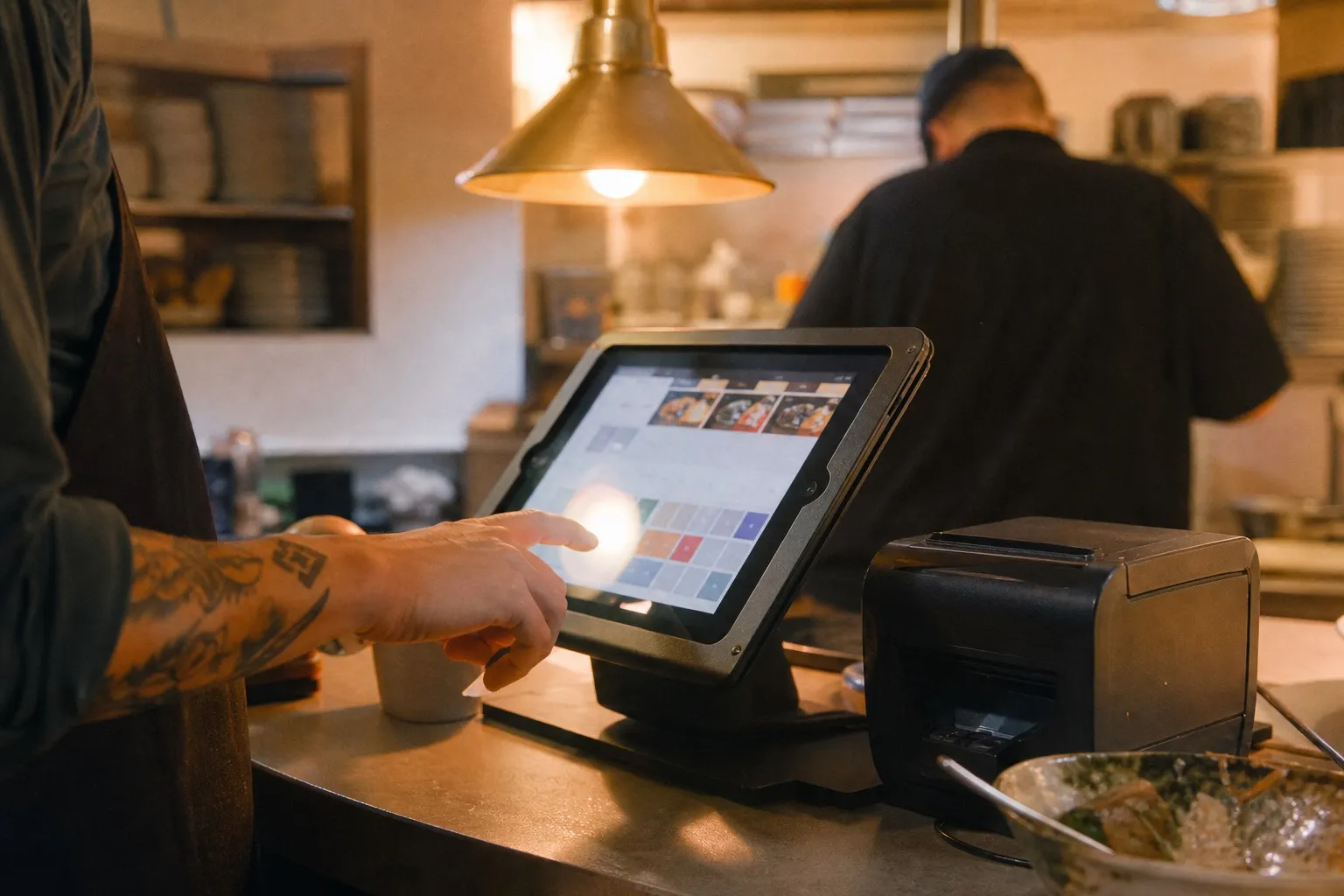
After Lightspeed's impairment and Toast's enterprise win, the right framing for restaurant SaaS multiples is not 'growth-adjusted' but 'verticalization-adjusted.' Here is the rerating roadmap.
It is Friday afternoon and I am doing the thing every restaurant-tech analyst does the day after a Lightspeed print: rebuilding the SaaS-multiple spreadsheet from scratch. The coffee is cold, the model is open, and the cell I keep coming back to is the one that compares Toast’s enterprise-value-to-ARR ratio to Lightspeed’s. I have been running this spread for years. I have never seen the gap this wide. And after staring at it for an hour, I have decided that the framing I — and most of the sell-side — have been using is wrong.
The conventional way to explain a multiple gap between two vertical-SaaS names is “growth-adjusted.” You take revenue growth, you take NRR, you draw a line, and you call the residuals “execution.” That story has done a lot of work for a lot of years. It is not the story the May prints are telling. The story the May prints are telling is about verticalization — specifically, about which companies have crossed the threshold from “POS with software attached” to “operating system the restaurant cannot rip out.”
Lightspeed printed its FY Q4 on Thursday, May 22, and inside the release (SEC filing) is a $556.4M goodwill impairment. That is not a rounding error. That is the auditor and the board agreeing, in the most legible accounting language they have, that the cash-generating units underneath that goodwill are no longer worth what the company paid for them. The market knew the strategic review was coming. The market did not fully price the impairment. The gap between what Lightspeed thought it bought and what it actually owns is now on the balance sheet in black and white.
Two weeks earlier, on May 8, Toast printed Q1 (SEC 8-K exhibit) with ARR of $1.7B and — the line that mattered for the rerating — Applebee’s signed as an enterprise customer. Applebee’s is roughly 1,600 locations of Dine Brands franchise muscle. It is the kind of logo the bull case on Toast has been pricing for two years and the bear case has been saying will never come. It came. And it came in a quarter where Toast also pushed its enterprise GTM motion hard enough that the call transcript stopped sounding like an SMB pitch and started sounding like a Workday pitch.
Then PAR printed on May 9 (Business Wire release) with $282M ARR and a Brink + Punchh + Stuzo + Data Central stack that is, finally, starting to be priced as one thing — Engagement Cloud — rather than four acquired things bolted together. The Olo overhang on the loyalty/ordering layer is real, but Olo’s last reported ARPU sits around $911 per location, which tells you the per-site economics in this category are very real and the consolidation game is far from over.
Three prints. Two weeks. One thesis: the market is rerating restaurant SaaS not on growth, but on how far each name is down the verticalization curve. Let me explain what I mean.
Growth-adjusted is the wrong axis
If you regress restaurant-tech SaaS EV/ARR multiples against revenue growth, you get a positive slope and a lot of noise. The R-squared is fine. The residuals are huge. Toast trades at a premium to its growth-implied multiple. Lightspeed trades at a discount that has now widened to something the regression cannot absorb without throwing the line off entirely.
The reason the regression breaks is that “growth” in restaurant SaaS is not a single thing. There is location growth, ARPU growth, attach-rate growth on payments, attach-rate growth on adjacent modules (capital, payroll, loyalty, ordering, scheduling, inventory), and enterprise logo growth. Each of these has a different multiple in the market’s head, even if the analyst community has not written it down. Toast’s growth is increasingly enterprise-logo growth and attach-rate growth. Lightspeed’s growth, until the strategic review, was a blend that included a lot of legacy retail POS that the market does not want to underwrite at SaaS multiples.
So when I say “verticalization-adjusted,” I mean: how much of the company’s revenue base is in a workflow the operator cannot turn off without breaking the restaurant? Payments processing is the lowest rung — sticky, but commoditizing. Above that is core POS, then labor and inventory, then capital and payroll, then the customer-facing layer (loyalty, ordering, marketing). The further up the stack you go, the more the revenue looks like the operating system of the business rather than a feature of it. And operating-system revenue trades at operating-system multiples.
My base case is that by year-end the EV/ARR gap between Toast and Lightspeed will be the widest the sector has ever recorded. I would not be surprised to see Toast hold a 6-7x ARR handle while Lightspeed compresses into the low-2s on a clean-of-impairment basis. The midpoint of the sector — which is where PAR, Olo, and a handful of private names live — will be the interesting trade.
The Applebee’s signal is bigger than the logo
Enterprise logos in restaurant tech have always been the white whale. The reason is structural: enterprise chains have IT departments, custom integrations, and three-year RFP cycles. They do not buy POS the way a 12-unit cafe group buys POS. They buy POS the way a Fortune 500 buys ERP — committee, pilot, phased rollout, executive sponsor, board-level signoff.
Toast signing Applebee’s matters for three reasons that the headline does not capture.
First, it is a validation that the platform survives the enterprise procurement gauntlet. Applebee’s IT did not pick Toast because Toast is cheap. They picked Toast because Toast cleared a security review, an integration review, and a franchisee-economics review that most of the competitive set would not survive. Every analyst who has been quietly skeptical that Toast can clear enterprise procurement now has an answer they did not have a month ago.
Second, it gives Toast a reference customer for the next ten Applebee’s-shaped deals. Enterprise restaurant tech is a reference business. Chains call other chains. Dine Brands’ CIO will take calls from peer CIOs for the next eighteen months and tell them what the implementation actually looked like. That is worth more than the contract itself.
Third — and this is the one that should make Lightspeed’s strategic-review banker nervous — it compresses the addressable enterprise white space for the rest of the field. There are not that many 1,000+ location chains in the U.S. that have not picked a modern POS. Every one Toast takes is one that Lightspeed, Square, PAR, and the private names cannot. The category is consolidating at the top in real time.
In our later coverage of the structural divergence, we argue (prior column) that the market reads each of these enterprise wins as a derivative on the next ten. I think that read is correct, and I think Q1 made it more correct.
What the Lightspeed impairment is actually telling you
$556.4M of goodwill written down is a specific number with a specific story. Goodwill impairments happen when the carrying value of a cash-generating unit exceeds its recoverable amount. In plain English: the auditor walked through Lightspeed’s acquired businesses, ran a discounted cash flow on what they expect those businesses to generate, and came back with a number lower than the price Lightspeed paid.
This is not a write-down of the consolidated business. It is a write-down of specific acquired CGUs — and that specificity matters. The market has been asking, since the strategic review was announced, whether Lightspeed would split itself into a hospitality pure-play and a retail pure-play, and what the value of each piece would be. The impairment is the company’s own answer, in IFRS-mandated language, to part of that question. Some of what was bought is not worth what was paid. The strategic review will decide what to do about it.
For the multiple conversation, the impairment matters because it resets the denominator. Lightspeed’s EV is now being measured against a smaller book of goodwill and — critically — against an ARR base where the market has more clarity on what the hospitality-only number actually looks like. When the dust settles, I expect the bull case to be a hospitality pure-play with a credible attach-rate story on payments and capital, sold at a premium to a retail-only stub. The bear case is that the strategic review produces a sale at a discount to today’s price, and the multiple gets reset by a strategic acquirer who is not paying for SaaS growth at all.
My base case is somewhere in the middle: the hospitality business gets re-marketed as a vertical-SaaS asset, the retail business gets a private-equity bid, and the consolidated multiple stops being the right way to think about the name by Q3.
PAR’s Engagement Cloud is the catch-up trade
If Toast is the leader and Lightspeed is the restructuring story, PAR is the most interesting position in the sector right now. $282M ARR is not enormous, but the composition is what matters. Brink is the POS, Punchh is loyalty, Stuzo is convenience/c-store, Data Central is back-of-house. Bundled, this is an Engagement Cloud — a customer-facing and operator-facing stack that, if it executes, becomes the second credible verticalized platform in the category.
The market has not fully priced this. The reason is partly structural — PAR is smaller, less liquid, and historically a hardware story — and partly because the cross-sell motion across the four acquired pieces has been a “trust me” pitch for two years. The Q1 print started to put numbers on that motion in a way the prior prints did not.
The Olo overhang is the obvious objection. Olo owns a chunk of the ordering and loyalty surface area at large enterprise chains, and at $911 ARPU it is a real business with real switching costs. But Olo’s strategic position is increasingly that of a feature in someone else’s platform, not a platform in its own right. PAR’s bet is that the next-generation enterprise chain wants one vendor for POS, ordering, and loyalty, and that “one vendor” will not be the smaller-than-PAR pure-play.
My base case on PAR is that the Engagement Cloud framing reprices the name over the next two quarters, and that the multiple compresses the gap to Toast more than it widens the gap to Lightspeed. The catch-up trade is cleanest here because the optionality on the cross-sell is the part the market is most likely to underwrite once one or two enterprise wins land. As our subsequent Bottom Line argues (M&A coverage), the M&A path here is at least as interesting as the organic path.
What this means for the operator side
The reason these multiples matter for anyone outside the public-market trade is that they determine what the next eighteen months of restaurant-tech competition looks like at the unit level. Toast’s premium multiple lets it spend on enterprise GTM, on capital products, on integrations, on R&D, and on price competition where it needs to. Lightspeed’s compressed multiple does the opposite. PAR’s potential rerating, if it happens, funds the next round of Engagement Cloud build-out.
The operator running a 12-unit cafe group is not reading the SEC filing. The operator is, however, reading the email from their account manager about new modules, new pricing, and new bundling — and the shape of that email is downstream of the multiple. In our later coverage of the operator-side comp (12-unit cafe Bottom Line), we walk through what this looks like at the table.
The shorthand for the next eighteen months: Toast spends, Lightspeed restructures, PAR pitches, and the private names either get acquired or get squeezed. Verticalization is not a metric on a slide. It is the lens through which the sector is now being priced.
My base case for year-end
To put numbers on it: I expect Toast to hold a 6-7x EV/ARR handle, Lightspeed to compress into the low-2s on a clean basis (and to be in active M&A discussions, public or otherwise), and PAR to rerate toward 4-5x as the Engagement Cloud story gets credit. The midcap private names get acquired or recapitalized by Q4. Olo continues to be a feature-in-a-platform debate that the market resolves one way or the other in the next two prints.
The risk to the call is enterprise execution at Toast. Applebee’s is one logo. If the implementation slips, or if the next two enterprise logos do not sign on the Toast-friendly terms, the premium compresses fast. The risk on the Lightspeed side is that the strategic review produces no deal and the market loses patience. The risk on PAR is the obvious one: cross-sell that does not materialize.
But the framing — verticalization-adjusted, not growth-adjusted — is the one I am going to keep using until the data tells me to stop. Friday afternoon, model open, coffee cold, and the spreadsheet has a new column header.
— Oliver writes The Bottom Line on M&A and valuations. Tips: [email protected].
Featured
More
Browse all 494 posts
The Voice Agent Maturity Curve
mise
·12 min read
The Four Margins of a Restaurant
mise
·14 min read
The AI Premium in Hospitality M&A: Broker Story or Real Number?
the bottom line
·9 min read
What the DoorDash/SevenRooms Deal Actually Buys
the bottom line
·11 min read
Related posts

the bottom line
·11 min read
Darden trades like a tech company. It shouldn't.
the bottom line
·12 min read
Applebee's just became its own franchisee. The territory math is the trade.

the bottom line
·12 min read