Sysco AI360: The Distributor Side of the AI Story

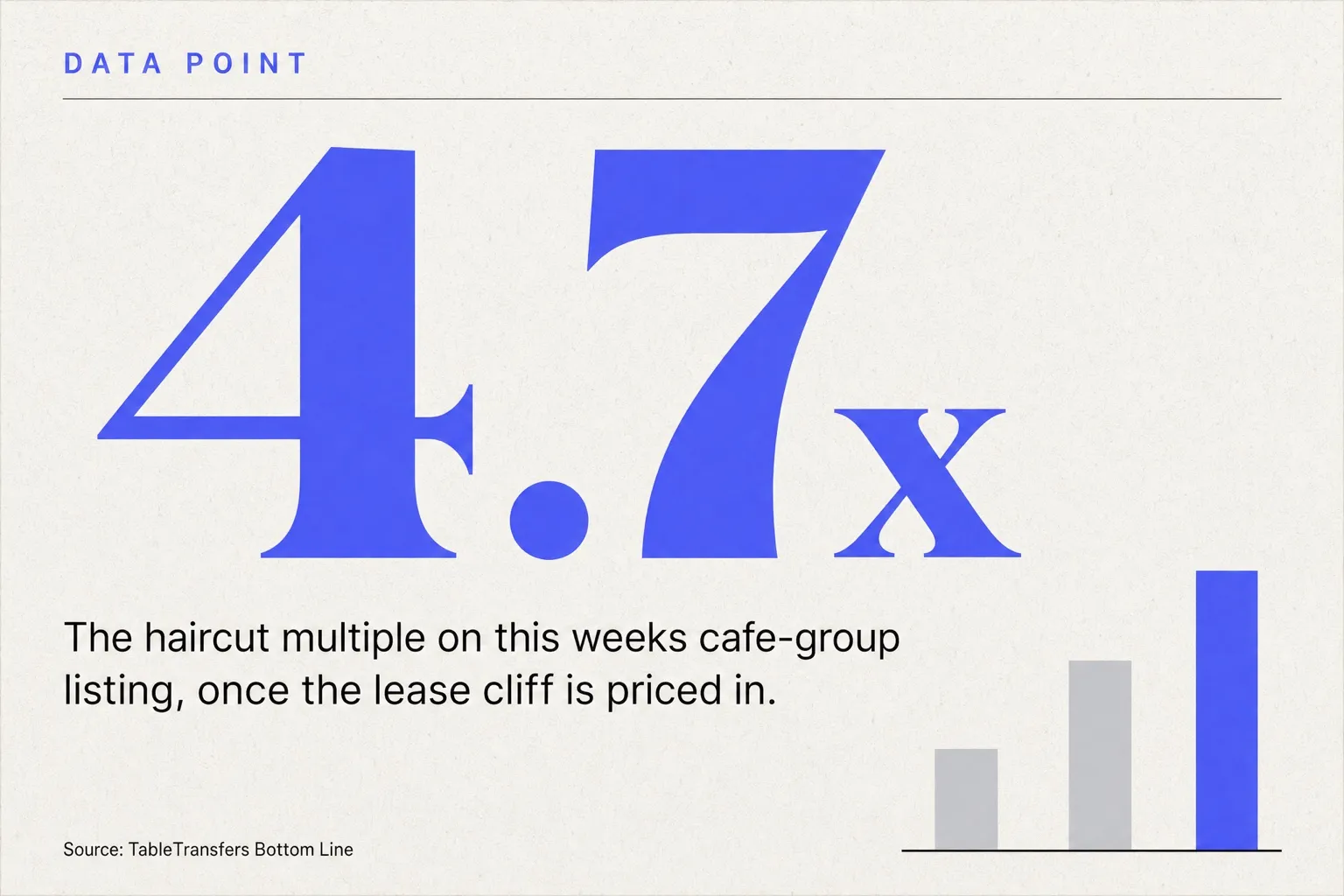
On the Q1 FY26 call, Kevin Hourican said ~90% of Sysco sales consultants now use AI360 — and US Broadline local case growth inflected positive for the first time in two quarters. For operators on Sysco contracts, your supplier's rep is becoming an LLM-augmented account manager. The pricing implications are not subtle.
I was on a video call with Maya Lin — a three-unit independent in Houston who runs full-service Vietnamese — when Sysco’s earnings call cut over the financial wire. She had AI360 on the brain already, because her rep had walked her through a “category opportunity” deck on Friday that he could not possibly have built himself. “He showed me a margin analysis on my pho program,” she said. “Down to the ingredient. He’s a nice guy, but he’s not running regression on my COGS in Excel.” She paused. “Something’s behind him.”
Then Kevin Hourican said it out loud on the Q1 FY26 call: roughly 90% of Sysco’s US sales consultants are now using AI360. And US Broadline local case growth — the number that matters more than anything else in the print, the one Wall Street had been beating Sysco over the head about for two quarters — inflected positive at +0.4%, a 130 bps swing.
Here’s the thesis, and I’ll defend it for the next four thousand words: your supplier’s sales rep is becoming an LLM-augmented account manager, and the productivity gain Sysco is now capturing on that headcount is going to show up in your contract economics, your case pricing, and the speed at which your DSR can out-quote any competitor who comes through your back door. The Wall Street story today is volume inflection. The operator story is asymmetric information.
Mark interpretation: When a distributor with $80B in revenue moves from “AI pilot” to “90% adoption” in the same fiscal year, the bargaining surface between supplier and operator changes. Not next year. Now.
What Sysco actually reported
The headline numbers from Sysco’s Q1 FY26 press release are clean and unsurprising. Sales up 3.2% to $21.1B. Adjusted EPS up 5.5% to $1.15. Gross profit up 3.4%. Operating income up 4.4%. The kind of quarter you file under “execution” and move on.
But Sysco’s been having a problem nobody on the buy-side wanted to put a polite name to, which is that the US Broadline local case business — the high-margin, independent-restaurant volume that is the actual flywheel of the company — had been negative for two consecutive quarters. Local volume is what justifies Sysco’s price premium versus US Foods and Performance Food Group. If it keeps shrinking, the whole thesis on Sysco-the-stock starts to wobble.
This quarter it didn’t shrink. Per the GlobeNewswire release, US Broadline local case volume came in at +0.4%, a 130 basis-point sequential improvement. USFS volume — the broader US Foodservice segment — was +0.1%. Both positive, both inflecting. And management reiterated full-year FY26 guidance: total sales +3% to +5%, adjusted EPS +1% to +3%.
I want to flag one thing about that EPS range that operators should hear: 1-to-3% adjusted EPS growth on 3-to-5% sales growth is a deliberately modest operating leverage assumption. That’s the company telegraphing that it’s going to plow a lot of the topline gain back into the business — into tech, into people, into the things that produced the +130 bps swing. The investment isn’t pausing.
Which brings us to AI360.
”Ninety percent of sales consultants are using AI360 today”
The number came out of Hourican’s prepared remarks. I went back to the Motley Fool transcript of the Sysco Q1 2026 earnings call to make sure I had it right, because in distributor world this is the kind of disclosure that gets buried under the “deepening customer relationships” boilerplate and lost. He said AI360 is now in the hands of approximately 90% of US sales consultants. He framed it as a productivity tool. He linked it directly — directly, on the call — to the local volume inflection.
I want to walk through what that means in practice, because the trade press is going to file this as “Sysco does AI, news at eleven” and miss the point.
A Sysco sales consultant — what the industry calls a DSR, district sales representative — historically managed a book of fifty to a hundred independent accounts. The job was call-cycle management, order capture, dispute resolution, new-product introduction, and what reps euphemistically call “category penetration,” which is the work of getting an account to buy more lines from you and fewer lines from your competitor. The job has not fundamentally changed in forty years. The tools have: paper to laptop to tablet to mobile app. But the cognitive workload — knowing your accounts, knowing the catalog, knowing the margin, knowing what to pitch on Tuesday — was carried in the rep’s head.
AI360 takes that cognitive workload out of the rep’s head and puts it in a model. The system ingests Sysco’s transactional history on every account, every SKU substitution, every margin curve, every price elasticity Sysco has observed for that customer cohort, and surfaces what to pitch, to whom, at what price, on what day. It pre-builds the talking points. It pre-flags the lost lines. It pre-quotes the substitution. The rep walks into Maya Lin’s restaurant with a tablet that already knows her pho margin is leaking through a ginger SKU that Sysco can underprice by 11 cents a pound.
Ninety percent adoption means this is no longer a pilot. This is the way Sysco sells.
Why local case volume inflected — and what it tells you
Local case volume is the cleanest signal you’ll get on the question of whether AI360 is actually working, because local is the segment where rep effort matters most. Multi-unit chain accounts are managed by national account teams on long-tenor contracts where pricing is essentially decided in advance. Local independents — Maya Lin, the bistro three doors down, the dosa joint nobody’s heard of — are the segment where a good rep with a good pitch can win a category in one visit and lose it in the next.
For local volume to go from negative to +0.4% in a single quarter, something about the rep-to-account interface had to change. Hourican is telling you it was AI360.
I’m not a victim of the company’s framing — I’ll caveat in a minute — but I want to acknowledge first that the timing is suggestive. AI360 rollout accelerated meaningfully through FY25. Adoption hits ~90% by the start of FY26. Local volume — the number AI360 is theoretically designed to move — inflects positive in Q1 FY26. The chronology fits the causal story.
Now the caveat. Local foodservice traffic improved sector-wide through summer and into early fall. Some of that 130 bps swing is the tide rising, not Sysco rowing harder. Comparing Sysco’s local growth to US Foods’ local growth over the next two prints will tell you how much of it is AI360 and how much is the macro. But the direction of the disclosure — Hourican voluntarily attributing a topline inflection to a tooling rollout, on a call where he could have credited a dozen other things — is unusual. Distributor CEOs don’t typically give their tech credit unless the tech is genuinely doing work.
What changes for the operator
Here’s where this gets pragmatic. If you buy from Sysco — and statistically, if you’re an independent operator in the US, you probably do, even if you split your wallet — you need to internalize three operating realities that didn’t apply twelve months ago.
First: your rep now knows more about your purchasing pattern than you do. Not metaphorically. Literally. AI360 surfaces your case mix, your substitution behavior, your seasonal curves, your category share-of-wallet, and your price elasticity in a single pane. You almost certainly do not have a tool that aggregates this data on your own purchasing — most independents look at it once a quarter through whatever invoice-scan or AP-automation tool they’re running. Your rep sees it before every visit.
The asymmetry is real and structural. It is not unethical — Sysco has always known your purchasing pattern; the data was always there — but it was previously locked in a warehouse no rep could effectively query in the time they had to prep a call. Now it’s not. Now they walk in pre-armed.
The defensive move for the operator is to close the asymmetry. There are operator-side tools — I’ll come back to a forthcoming May piece on Sysco’s broader software stack — that can replicate roughly 70% of what AI360 tells your rep, but using your own invoice data. If you’re spending more than $30K a month with Sysco, you should be running something. The cost is trivial relative to the negotiating leverage you get back.
Second: substitution pitches are going to feel uncannily well-targeted. This is the AI360 capability that operators will notice first and articulate last. A substitution pitch — “switch from Brand X tortilla to our Sysco Imperial line, save 14 cents a unit, same spec” — is a high-frequency, low-margin sales motion. Historically it was rep-judgment driven and roughly half the substitutions a rep pitched were either obvious or wrong. With AI360, the model has already calculated which substitutions you’ll accept based on accounts that look like yours, which ones improve Sysco’s margin without breaking your kitchen, and which ones you’ve already rejected before. The hit rate goes up. Your rep looks smarter. The conversion rate to “yes” climbs.
What you should do, mechanically, is treat every substitution pitch with the suspicion you’d treat a software upsell. Get the spec sheet. Run a kitchen test. Compare COGS over a four-week period. Don’t accept the substitution because the rep is suddenly batting .800. Accept it because the math works for you.
Third: contract economics tighten. This is the one operators least want to hear and the one the CFO segment of the audience will care about most. AI360 is, fundamentally, a margin-optimization engine on the supplier side. It is designed to identify the price you’ll pay before you’ll switch, and to hold the line on margin at that point. The rep’s latitude to discount narrows because the model is suggesting what to hold and what to give. Aggregate that across a sales force the size of Sysco’s and the impact on gross-margin-per-case is non-trivial.
You will see this most clearly at contract renewal. The rep who used to fold on three categories to keep the account is now going to fold on one, because AI360 has flagged the other two as defensible. If you don’t bring competitive bids to renewal, the renewal will not bring savings to you.
How this maps to the broader distributor competitive set
US Foods has its own version of this. PFG has its own version of this. None of them, as of today, has disclosed a 90% sales-consultant adoption number. That disclosure — that specific number, on that specific date — is a competitive flag that Sysco’s planted in the ground.
There’s an upcoming May piece on the recent foodservice distribution M&A that’s worth reading in this context, because the consolidation playbook the big three are running is increasingly justified by tech leverage of exactly the AI360 kind. If you can compress a hundred reps’ worth of cognitive work into a tablet that any one rep can carry, you can absorb a regional distributor’s book without absorbing their rep payroll. M&A math gets easier. And the squeeze on the regional independents — the Reinhart-shaped, Performance-Mason-shaped, Maines-Paper-shaped middle of the market — gets harder.
For an operator, the practical effect is that the bench of credible alternative distributors keeps thinning. Which makes the AI360 negotiating asymmetry harder to escape. You can run a multi-supplier strategy — most operators of any scale do — but the number of national-coverage suppliers worth running against Sysco is two. Maybe three on a generous day.
What Sysco didn’t tell you about AI360
I want to spend a beat on what was not in the prepared remarks, because it tells you something about the maturity of the product.
Hourican didn’t quantify AI360’s ROI per rep. He didn’t break out productivity gains by segment. He didn’t disclose the case-mix shift attributable to AI360-surfaced substitutions. He didn’t talk about new-account win rates from AI360-prepped prospecting. He didn’t break out gross-margin-per-case by AI360-touched vs. AI360-untouched accounts.
Some of that omission is competitive caginess — you don’t hand US Foods the playbook. Some of it is that the numbers aren’t clean yet. Some of it is that 90% adoption is recent enough that the financial signal is still bleeding through into the headline P&L rather than separable from it.
But the absence of those disclosures is itself information. A company that had two-year data on AI360’s effect on contribution margin would disclose it. A company that had one quarter of clean data and three quarters of contaminated data would do exactly what Sysco did: attribute the local volume inflection to AI360 directionally, in prepared remarks, without putting a number on it.
The interpretation: AI360 is working, the company believes it’s working, and the financial bridge from “tool adoption” to “EPS contribution” is being built now in real time. Watch the Q2 FY26 print for the first quantification. If Sysco names a number — even a soft one like “AI360 contributed X bps to local margin” — you’ll know the data has firmed up. If they don’t, you’ll know they’re still building the bridge.
The software-on-distributor angle
The broader software stack — the tools Sysco is building or buying alongside AI360 to serve the operator directly rather than only their own reps — is its own story. It matters because the most interesting strategic move a distributor can make with AI is not to weaponize it for the rep but to ship it to the customer. That’s the move that builds switching costs.
Sysco isn’t there yet. AI360 is, today, a sales-side tool. The operator-facing surfaces — the Sysco Shop ordering portal, the order-guide management — are getting smarter, but they’re not where the AI investment is going. AI360 is the priority because the rep is the choke point in Sysco’s go-to-market and the rep is, frankly, easier to upgrade than the operator.
But the next phase of this is going to be the operator-facing version. Some flavor of “your menu engineering recommendations from Sysco, powered by the data your DSR sees.” When that ships — and it will ship, because the strategic logic is too obvious — it’ll be the moment Sysco crosses from “AI-augmented sales force” to “AI-mediated supplier relationship.” That’s a different thing. And it raises the switching costs by another full order of magnitude.
Operator playbook: what to do this quarter
I’ll close with the operationally useful part. If you buy from Sysco, here’s what I’d be doing between now and the end of the calendar year.
Audit your last twelve months of Sysco spend by category. Most of you have this data in your AP system or your invoice-scan tool. If you don’t have it aggregated, get it aggregated. You’re trying to identify the three to five categories where your share-of-wallet to Sysco is over 80%, because those are the categories where your rep — armed with AI360 — has the most leverage to hold pricing at your next review.
Get a competitive bid on those three to five categories. Not the whole book — that’s exhausting and unrealistic. Just the categories where the asymmetry is widest. Use a regional distributor if you have one in your market. Use a specialty distributor — a produce house, a seafood house, a specialty meat purveyor — for the categories that bleed through that lane. The point isn’t to switch. The point is to have credible alternatives on the table when your rep walks in.
Ask your rep, by name, what AI360 tells him about your account. This sounds confrontational. It isn’t, if you frame it right. Ask: “What categories are flagged as opportunity? Where am I above the cohort median on price? Where am I below it? What’s the rep view on my substitution potential?” A good rep — and most of them are good — will share most of this. AI360’s data is technically Sysco’s, but it’s about you, and a rep with a good relationship will read the analysis to you out loud. You just have to ask.
Renegotiate your contract on a shorter cycle. If you’re on a 24-month or 36-month locked-rate agreement, you’re going to be sitting on a pricing baseline set before AI360 had finished propagating. Sysco’s pricing logic is going to get more precise — not less — over the next two years. The shorter your lock, the more often you get to reset.
Build internal cost-of-goods analytics that don’t depend on Sysco showing them to you. This is the long-term move. It’s not a quarter project. It’s a year project. There are several operator-facing platforms that aggregate invoice data across distributors and surface category-level COGS trends. If you don’t have one, get one. The capital cost is roughly one full-time line cook for six months. The ROI shows up in your second negotiating cycle.
What I’ll be watching on the Q2 FY26 call
A few things, in order of importance.
First, whether US Broadline local volume holds or accelerates. If it stays at +0.4% or fades, AI360 looks like a one-quarter pop. If it accelerates to +1% or +2%, the productivity story has legs.
Second, whether Hourican puts a number on AI360. As I said above, the first hard ROI disclosure will be the moment we know the bridge is built.
Third, whether USFS volume holds. The +0.1% USFS print this quarter was the broader-than-Broadline cut and it’s a slightly different mix of accounts. If USFS slips while Broadline holds, the AI360 story narrows to the segment where it was always going to work best.
Fourth, whether Sysco discloses any operator-facing AI tooling. The strategic logic is too obvious for them not to be building it. The question is when it ships and how aggressively they bundle it.
Fifth — and this is the meta-question — whether the FY26 guidance gets raised. The reiteration this quarter is a holding pattern. A raise would tell you the company believes the productivity gains are running ahead of the budgeted plan. A reiteration in Q2 with continued volume strength would tell you the same thing, more cautiously.
The bottom line for operators
The Sysco AI360 story today is not a tech story. It’s an asymmetry story. Your supplier has spent two years building a tool that closes the cognitive gap between the rep and the institutional knowledge of the distributor. That gap, historically, was operator-favorable: a tired rep on a hundred-account book missed things, forgot things, gave you margin you didn’t have to ask for. That margin is now being captured by the machine.
You are not powerless. The defensive moves are clear and they aren’t expensive. Audit, bid, ask, renegotiate, instrument. None of these require a CIO. All of them require an operator who’s paying attention.
Maya Lin called me back the day after the earnings call. She’d run her own numbers on the pho program after her rep’s visit. The ginger SKU substitution was real — the savings were eleven cents a pound, which over her annual volume worked out to about $2,400 a year. She took the substitution. But she also pulled together a request for proposal for her produce business from two regional houses, because if her rep was that prepared on ginger, he was that prepared on everything else.
That’s the move. Match the asymmetry. Don’t lament it.
The supplier got smarter. So can you.
— Priya covers operators for TableTransfers. Tips: [email protected].
Featured
More
Browse all 494 posts
The Voice Agent Maturity Curve
mise
·12 min read
The Four Margins of a Restaurant
mise
·14 min read
The AI Premium in Hospitality M&A: Broker Story or Real Number?
the bottom line
·9 min read
What the DoorDash/SevenRooms Deal Actually Buys
the bottom line
·11 min read