The Voice-AI Restaurant Stack Just Got Crowded — A Buyer's Playbook

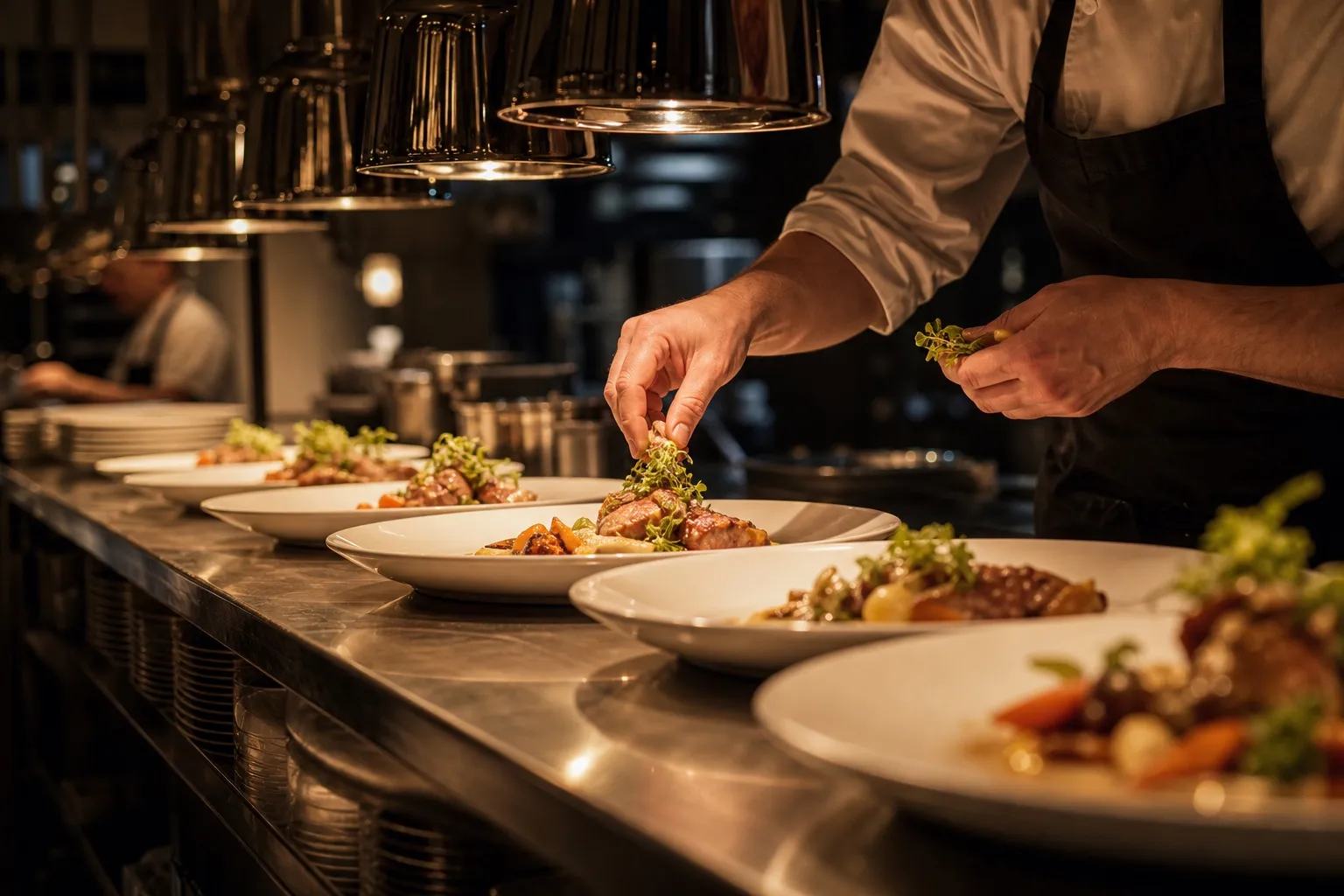
Three competing voice-AI approaches surfaced this month: Yelp Host for indie call-answering, Loman AI for POS-integrated phone ordering, and Vox AI for drive-thru. Operators should buy on integration depth and language coverage, not the demo. A Vibe Check vendor review.
I spent last Friday at a friend’s twelve-table neighborhood spot in Sunset Park, watching her teenage host stand fielding takeout calls during the dinner push. She missed four in a row. Two were regulars. One was a four-top trying to walk in. The fourth — and I only know this because the caller texted her later — was a delivery driver who couldn’t find the side entrance and gave up. That phone, sitting six feet from a $4,200 POS terminal and a $1,100 KDS, is still the leakiest pipe in the restaurant.
It is also, finally, the part of the stack everyone wants to sell you software for. In the last two weeks, three different voice-AI plays have moved into view, each with a sharply different theory of where the wedge is: Yelp’s new Host feature, which began answering calls for independent restaurants on August 7, Loman AI’s anticipated $3.5M seed for POS-integrated phone ordering in pizza, and Vox AI’s anticipated $8.7M seed for drive-thru-native, multilingual voice. Each is real. Each will probably ship something. Only one is right for your restaurant, and the demo will not tell you which.
My contrarian thesis, stated up front so you can argue with it before paying for it: operators should buy voice AI on integration depth and language coverage, not on the demo conversation. The demo is the most rehearsed three minutes of any vendor pitch. What matters is whether the agent can write into your POS, whether it can hand off cleanly when the menu is 86’d, and whether it can take an order from a customer whose first language is not English. The crowded part of the market is the demo. The contested part is the plumbing.
Why this month is the inflection point, not the launch
Let me back up. Restaurant voice AI is not new. It is, depending on how you count, the third or fourth wave of capital that has tried to automate the phone since the McDonald’s IVR experiments of the 2010s. What changed this month is that the venture-funded layer and the platform-incumbent layer arrived at the same operator at the same time.
PYMNTS, citing CB Insights data via the Wall Street Journal, notes that voice AI startups raised $2.1 billion last year, up eightfold from 2023. That number includes a lot of non-hospitality use cases — call centers, healthcare scheduling, B2B sales — but the restaurant slice is now large enough that you can read industry coverage and find five seed rounds in a single news cycle. Restaurant Business’s own framing of the market this month was, bluntly, that “the restaurant voice AI market is getting crowded”, and the piece names six or seven plausible vendors before it stops listing.
The inflection is not that voice models got good. They were good a year ago. The inflection is that distribution unlocked. Yelp is rolling Host into a product surface that millions of independents already use for reservations and discovery. Loman is pre-integrating with the major pizza POS systems. Vox is going where the labor cost of a missed order is highest — the drive-thru lane. The competitive question is no longer “can the model take an order.” It’s “can your vendor reach into the seat your existing software already sits in.” Hold that thought.
I covered the underlying model-quality question in a forthcoming May framework piece on voice-agent maturity — the short version is that for transactional restaurant calls, the model is no longer the bottleneck. The bottleneck is everything around it.
The three live theories, sketched
Before I get to the buyer’s checklist, here are the three theories competing for your phone right now. I’m characterizing them, not advertising them. Each has a real flaw I’ll name.
Theory 1: Distribution-led (Yelp Host). Take the listings audience you already own, layer a call-answering agent over it, and convert missed calls into bookings or takeout orders directly inside Yelp’s existing operator surface. The advantage is reach — Yelp already has the indie restaurant on the hook for reviews and reservations, so adding Host is a cross-sell, not a new procurement. The risk is that the agent is necessarily generic. It does not know your POS. It does not know your menu state. It is a front door, not a kitchen line.
Theory 2: Vertical-led (Loman AI). Pick one vertical — in Loman’s case, pizza — pre-integrate with the POS systems that vertical actually uses, and turn the phone into a true ordering channel that writes into the ticket system without a human in between. Loman is anticipated to close a $3.5M seed led by Next Coast Ventures in the coming week, and the pitch deck claim circulating with that round is a 22% revenue lift in pilots, framed as anticipated until the round closes. I’d treat the lift number the way I treat any single-vendor case-study percentage — directionally interesting, not bankable — but the architectural choice is the right one for pizza. Pizza orders are templated, the menu is bounded, and the phone is still the dominant channel in many markets.
Theory 3: Format-led (Vox AI). Don’t start with the phone. Start with the drive-thru speaker, which is a fundamentally different acoustic environment, a fundamentally different latency budget, and a fundamentally different labor-cost calculus. Vox AI is anticipated to announce an $8.7M seed in the coming week, with Headline as lead, and the company is positioning around 90+ language support and an “up to 17x ROI” headline number — both of which I’d ask hard questions about, and which I’ll come back to. The anticipated Vox raise is being framed around drive-thru and quick-service operations specifically, which puts Vox in the lineage of the McDonald’s IBM experiment I dug into in an upcoming May piece.
Three theories, three wedges, three buyer profiles. If you are a 24-seat full-service indie, you are a Yelp Host buyer or you are nobody’s buyer. If you are a four-unit pizza chain on Toast or Square, you are a Loman buyer or you are running the phone yourself. If you are an eighty-unit QSR with a drive-thru, you are a Vox buyer or a McDonald’s-in-2018 cautionary tale. The mistake — and I’ve watched operators make it twice this year — is to evaluate all three against the same demo and pick the one that sounded smoothest.
What the demo is hiding
Every voice-AI demo I have sat through in the past six months has been built around four or five known-good utterances. The agent greets you. You ask for a table. The agent confirms. You ask to change the time. The agent confirms. You ask for the address. The agent reads it back. End scene.
Here is what the demo almost never shows you, and here is what you should make every vendor walk you through on a real recorded call:
The 86 handoff. You order the eggplant parm. The kitchen ran out at 7:42. The agent does not know. What happens? In the worst implementations, the order books anyway, the ticket prints, and a server has to call the customer back. In the best, the agent is reading menu availability state from the POS in something close to real time and offers a substitute. The gap between those two behaviors is the entire integration story.
The modifier collision. You order a pizza with extra cheese, light sauce, and no garlic. Then you change your mind on the sauce. Then you add an allergy note. Then you ask the agent to repeat the whole order. Every voice agent I’ve stress-tested in 2025 still bungles this at least one time in twenty. Whether one in twenty is acceptable depends on your check average and your willingness to comp.
The non-English caller. Demos are in English. Calls are not. I sat in on a Vietnamese-language call at a pho shop in Houston last month where the host stand could not understand the caller and the caller could not understand the host stand and the order eventually came through because someone in the back came forward and translated. Vox’s anticipated 90+ language pitch sounds like marketing, but for that pho shop it is the entire product. The Vox raise framing emphasizes multilingual capability as core to the drive-thru pitch, and I take that seriously even before I see the round close.
The angry-customer escalation. The car is in your drive-thru lane, the order is wrong, the customer is escalating, and the agent has to decide whether to keep talking or hand the call to a human. In Vox’s positioning, the agent owns the lane until a human chooses to intervene. In Loman’s, the agent owns the call until the order finalizes. In Yelp Host’s, the agent’s job is to capture intent and pass it back. Three different escalation models, three different operational implications.
The post-call write-back. This is the one I care about most. Whatever the agent agrees to with the caller — a reservation, an order, a callback request — has to land in a system you and your team actually look at. The agent that books a reservation into a calendar nobody opens has, operationally, done nothing. Ask each vendor to draw you the data flow. Ask which system of record gets the write. Then go look at whether your staff would notice.
My checklist for evaluating a voice-AI vendor in August 2025
I am, on net, bullish on this category. I think every restaurant with more than fifty takeout calls a week will be running some kind of voice agent by mid-2026. The question is which one, and at what depth.
Here is the checklist I’m giving to operator friends who ask. It is unsexy on purpose. The sexiness is what gets you sold a wrong-fit product.
1. Integration depth, in writing. Which POS systems does the vendor have a live, bidirectional integration with — not a roadmap, not a partnership announcement, a working connector? Loman’s bet is that pizza POS coverage is the moat. Yelp Host’s bet is that you don’t need POS integration to be useful for front-of-house intent capture. Vox’s bet is that drive-thru order-entry systems are the integration target. Make the vendor name the specific POS version they have shipped against. If they cannot, you are buying a roadmap.
2. Language coverage, with proof. “Multilingual” is a marketing word. Ask which specific languages the agent has been tuned and tested on for restaurant-domain vocabulary, not generic conversation. If your neighborhood has a significant Spanish, Cantonese, Vietnamese, or Arabic-speaking customer base, ask the vendor for a recorded sample call in that language at a real restaurant. If they will not produce one, assume the language is not production-ready, regardless of what the count on the deck says.
3. Menu-state freshness. How often does the agent re-read your menu? Once a day? On every call? When the kitchen 86’s the salmon, what is the latency before the agent stops trying to sell it? Anything more than five minutes is a problem at peak. Anything more than fifteen minutes is, in my view, disqualifying for full-service.
4. The handoff protocol. When the agent gives up — and it will give up — where does the call go? To a designated phone? To a Slack message? To a missed-call queue that nobody checks? The single biggest source of voice-AI disappointment I’ve seen this year is calls that the agent thinks it has handled and the operator thinks have been handled and that, in fact, no human ever touched.
5. Pricing transparency on per-call versus per-minute versus seat. This is the variable that is going to bite operators hardest. Per-call pricing aligns with order economics — you pay when the agent does its job. Per-minute pricing punishes long calls, which are exactly the calls the agent should be best at. Seat or location pricing is predictable but tends to be priced for the maximum-volume operator, which means the small operator subsidizes the large one. Yelp’s likely play here is to bundle Host into existing subscriptions. Loman’s likely play is per-order, given the pizza vertical’s order-density. Vox’s likely play is per-location, given the drive-thru context. None of these has been confirmed publicly as of today, and I’d push every vendor hard on the pricing model before signing.
6. The training-data question. Is your call audio being used to train the vendor’s model? Is it being used to train models for your competitors? Does the contract let you opt out? This is a question nobody asks at the demo and everybody asks six months in. Ask it on day one.
7. The escalation latency. When you ask for a human, how long until you get one? In drive-thru, sub-fifteen-second escalation is table stakes. On the phone for takeout, sub-thirty is acceptable. For reservations, where the call can be queued, sub-two-minute might be fine. Vendor demos rarely show you the worst-case escalation path. Ask.
What I’d do, by operator size
For the indie operator with one location: start with Yelp Host. It is the lowest commitment, the lowest integration ask, and the highest distribution match. You are already on Yelp. If Host works, you save twenty calls a week. If it doesn’t, you turn it off. The downside risk is contained and the upside is real. I’d run it for sixty days, log every call the agent handles, and pull a 10% sample for human review at end-of-week. That is a $0-incremental-spend pilot that actually tells you something.
For the regional pizza chain on a major POS: wait two weeks, watch the Loman round close, then ask for a pilot location. The architectural choice — pre-integrated to your POS — is the right one for your vertical, and the 22% revenue lift claim is exactly the kind of number you should validate against your own data before believing it. Anticipate that the price will be aggressive at the pilot stage and that contract terms will tighten if the pilots work. Get language about menu-state freshness and post-call write-back into the pilot agreement. If you cannot, walk.
For the QSR or drive-thru operator: watch Vox closely. The McDonald’s-IBM cautionary tale is real, and the drive-thru is the highest-stakes voice surface in the industry — get it wrong and you have cars stacked on Lincoln Boulevard at 8 p.m. on a Friday. But Vox’s anticipated raise is being led by a credible firm, the multilingual pitch is operationally meaningful in U.S. drive-thru contexts, and the “fully autonomous” framing — while I’d discount it — at least names the right ambition. Do not pilot at your highest-volume location. Pick a mid-volume store with an ops team you trust, and instrument the comparison against a control store before you flip the switch.
What I am watching over the next thirty days
Three signals will tell us whether this crowded month becomes a real category or another wave of half-shipped seed-stage products.
Signal one: does the Vox round actually close at $8.7M with Headline lead? The anticipated number is large for a seed in this space, and the lead matters. If it closes as described, expect a sharp pull-forward in drive-thru voice spend across the rest of QSR. If it slips or down-rounds, expect operators to defer.
Signal two: does Loman publish customer data, not just pilot data? The 22% revenue lift number, if it survives third-party scrutiny, would be the most credible operator-level proof point for restaurant voice AI to date. If Loman puts a named chain on the record, the category gets a flywheel. If the number stays in pitch decks, the category does not.
Signal three: does Yelp expand Host beyond the initial test? Yelp’s footprint is the lever that could decide whether voice AI becomes a default for indies or stays a curiosity. The August 7 launch was a test. The November rollout — if there is one — is the actual story.
I’ll be back to mark all three. For now, do not buy on the demo. The demo will sell you. Buy on the plumbing — the integration depth, the language coverage, and the handoff protocol — because those are the parts that will decide whether the agent answers the call the night your host stand is in the weeds and the four-top is on the line.
Mark interpretation. The numbers I am most willing to be wrong about: Loman’s 22% revenue lift (vendor claim, single-vertical, small sample — directionally interesting, not bankable) and Vox’s “up to 17x ROI” framing (the “up to” is doing a lot of work; the real number for your operation will be a small multiple of labor cost, not 17x, unless your missed-call rate is catastrophic). The number I am most willing to be right about: Yelp Host will be the highest-adoption product of the three by end of 2025, and the lowest-revenue. Distribution wins the install base. Integration wins the wallet.
— Sofia leads Vibe Check vendor reviews for TableTransfers. Tips: [email protected].
Featured
More
Browse all 494 posts
The Voice Agent Maturity Curve
mise
·12 min read
The Four Margins of a Restaurant
mise
·14 min read
The AI Premium in Hospitality M&A: Broker Story or Real Number?
the bottom line
·9 min read
What the DoorDash/SevenRooms Deal Actually Buys
the bottom line
·11 min read
Related posts
vibe check
·16 min read
Desk Review: Lightspeed Restaurant, the Quiet Half of the Duopoly
vibe check
·18 min read
Desk Review: OpenTable's 'System of Record' — what restaurants are actually agreeing to on April 16
vibe check
·18 min read