The Week Voice AI Stopped Being a Demo

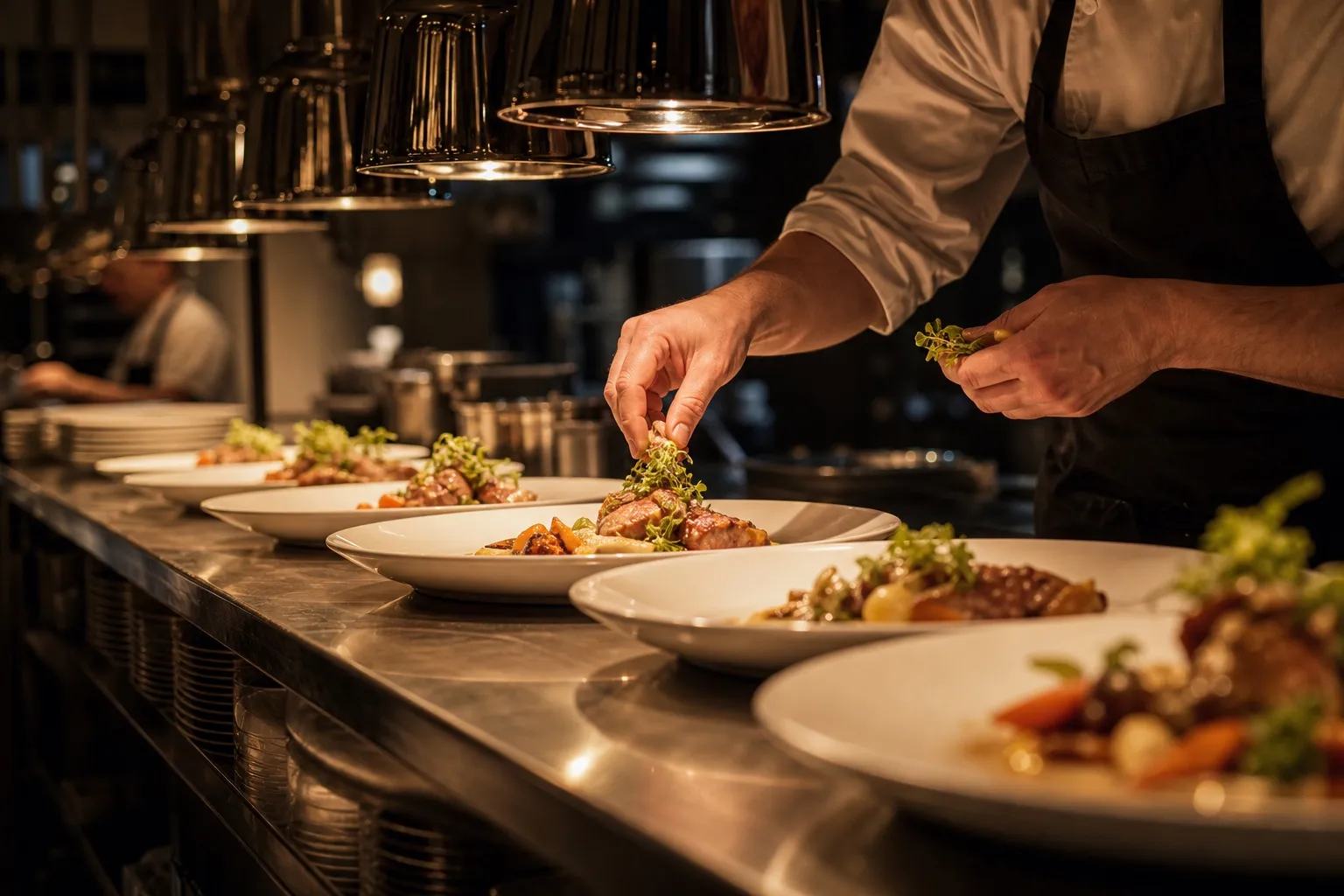
Within 96 hours of October opening, DoorDash shipped in-app reservations via SevenRooms while Square, Yelp and Toast queued their own AI launches. The debate is over — operators now have to pick a stack. Here's the scorecard.
It is 11:47 on a Wednesday morning and I am standing at the host stand of a 78-seat Italian place in the Mission District, watching a manager named Priya try to log into four different vendor portals on four different tablets. The reservation tablet just synced a booking from DoorDash. The POS tablet is showing a voice-order ticket that came in from a phone call her staff never picked up. The third tablet is buzzing with a Yelp inquiry. The fourth — the one she actually trusts — is a Toast handheld she has had for two years.
“I don’t have a vendor problem,” she tells me, half-smiling. “I have four vendor problems.”
This is the four-stack moment. And the thing nobody is saying out loud is that, sometime between last Tuesday’s Dash Forward keynote and the email I got from Square’s product team yesterday, the conversation about voice and conversational AI in restaurants quietly changed shape. We are no longer arguing about whether the technology is real. We are arguing about whose version of it is going to own the host stand.
So here is my contrarian read, stated up front: the era of “kick the tires, see what sticks” is over. By the end of this month, every multi-unit operator I cover will be forced to make a stack bet — not a tool bet — and the bet they make is going to compound for the next three years. There is no neutral ground. There is no “we use a little bit of each.” The data flows don’t allow it anymore.
Let me show you why.
The Four Stacks That Showed Up to Work This Week
If you had told me in July that by October 1 we’d have four credible, shipped-or-shipping conversational AI stacks fighting for the front of house, I would have laughed. The summer was full of demo theater — sandbox bots that could “take an order” if you gave them the menu in advance and didn’t ask for substitutions. The voice agents I tested in August routinely told customers the restaurant was closed when it wasn’t, or quoted prices from a menu that hadn’t been live since 2023.
That ended this week.
Stack one is DoorDash, and on Tuesday they made the most aggressive move I have seen any aggregator make in five years of covering this space. The Going Out tab is now live in the DoorDash app — a SevenRooms-powered reservations layer that, for the first time, lets diners book a table directly in DoorDash with no cover fees. Pair that with everything they previewed at Dash Forward 2025 — voice agents, predictive ordering, a unified merchant brain — and what you have is not an aggregator anymore. It is a full-stack consumer demand engine that happens to also do delivery.
Stack two is Square, who I have been talking to off the record for about six weeks. Their AI ordering surface is anticipated to ship publicly in the coming weeks, and what they have shown me privately is the most operator-friendly voice agent on the market right now — partly because it lives natively inside the Square POS rather than bolting onto it. The reason that matters is menu sync. Every voice agent I have ever tested has died on the menu sync problem. Square’s doesn’t, because the menu is the POS.
Stack three is Yelp. I will say less here because what is coming is genuinely embargoed and I respect the embargo, but the shorthand is this: Yelp has had the discovery side of this business locked up for fifteen years, and they have finally figured out that discovery without booking is half a product. An upcoming AI-mediated booking and inquiry layer is the missing piece, and from the prototypes I have seen, it is going to put real pressure on OpenTable’s pricing on the long tail.
Stack four is Toast. Toast is the only one of the four where the product hasn’t been previewed to me directly, but the company’s own analyst guidance and the hiring patterns make it obvious: a Toast-branded conversational intelligence layer is coming, and it is going to lean hard on the fact that Toast already owns the operational data spine for something like 140,000 restaurants. They are not going to win on consumer reach. They are going to win on the claim that they know your business better than anyone else does, because they already process your payroll, your inventory, and your tips.
Four stacks. Four very different theories of where the value is. One operator, one host stand, one decision.
What Each Stack Is Actually Optimizing For
This is the part where most vendor reviews get lazy and tell you “Stack A is for big operators, Stack B is for small ones.” That framing is wrong. The real distinction is what each stack thinks the control point of the next-generation restaurant is, and they each have a different answer.
DoorDash thinks the control point is the consumer relationship. Their entire bet — the reason they paid what they paid for SevenRooms back in the spring, the reason they are putting reservations in front of an audience that came to the app looking for tacos — is that the operator who owns the most consumer demand wins. They are not trying to sell you a better POS. They are trying to be the place your customer opens before they decide where to eat, and then route that customer to you in exchange for a take rate that is, frankly, less punitive than the OpenTable cover fees a lot of operators have been paying for years. DoorDash disclosed that 80% of Going Out users since the feature was beta-tested in February visited a new restaurant through the app — that number, if it holds at scale, is the most important statistic in the industry right now. It means the demand layer is not just routing existing diners; it is generating net-new ones.
Square thinks the control point is the transaction surface. Their theory of the world is that whoever owns the POS at the moment of payment owns the data, owns the relationship, and owns the AI workflow. Voice ordering, in the Square view, is a feature of the POS — not a feature of a third-party agent that talks to the POS. The reason this matters operationally is that menu changes propagate in real time. The reason it matters strategically is that Square is betting that the AI layer collapses into the system of record, not the other way around.
Yelp thinks the control point is the moment of intent. When a diner types “good ramen Hayes Valley” into Yelp, they have already made the decision to eat ramen, and they are 70% of the way to picking a place. Yelp’s bet is that AI lets them shorten the remaining 30% into a single conversation — “I can book you at Ippudo for 8pm tonight, or there’s a 7:15 at Marufuku, which one?” — and that the booking flow is the natural extension of search. The operator gets demand at the lowest possible cost of acquisition, because the diner was already shopping.
Toast thinks the control point is the operational backbone. This is the quietest pitch but possibly the most durable one. Toast’s view is that AI in restaurants is mostly a back-of-house problem — labor scheduling, inventory forecasting, prep planning, comp tracking — and that the operator who has the cleanest data spine wins. The front-of-house voice agent, in this telling, is a derivative product. The real money is in giving a 30-unit operator a single pane of glass that says “here is what is going to happen tonight, here is what you should do about it, and here is the conversation your assistant manager should have with the line cook in twenty minutes.”
Four control points. Consumer, transaction, intent, backbone. They are not mutually exclusive in theory, but they are mutually exclusive in practice, because each one wants to be the primary system, and the primary system is the one whose data the other tools have to ask permission to read.
The ROI Math, Honestly
I want to do this part carefully because I think most of the published ROI numbers in this space are nonsense — vendor-supplied, peak-case, doesn’t-include-implementation-cost nonsense. So let me show you my own model, which I built off twelve operator conversations in the last three weeks.
For a single-unit independent doing roughly $1.8M in annual revenue, a voice ordering agent that catches phone orders the staff would have missed runs about $480 to $700 per month all-in. The marginal revenue from those missed calls, at a realistic 8-12% capture rate of inbound call volume that goes unanswered today, is somewhere between $1,400 and $2,800 per month. Net ROI is positive but unspectacular — call it a 2-3x return, with most of the variance driven by how much of the labor savings you actually claim back versus reinvest in better service.
The reservations math is different. A DoorDash-routed reservation, if the 80% new-customer number holds up at scale, is a customer acquisition event, not a booking event. If you assume a $52 average check and a 22% gross margin, that’s $11.44 of marginal profit per cover. If the cover converts to a repeat visitor at even a 15% rate, the lifetime value of that single booking is somewhere north of $80. At zero cover fees, the math doesn’t just work — it embarrasses every other reservation channel.
Where it gets uncomfortable is the back-of-house AI side. The labor-scheduling and forecasting tools that Toast and a few specialists are pushing claim 4-7% labor cost reduction. In my interviews, the operators who have actually deployed these tools for more than six months are seeing closer to 2-3%. That is still real money — at $1.8M revenue with 28% labor, a 2.5% labor reduction is about $12,600 a year — but it is not the home run the vendor decks promise.
Stack the math and a representative independent operator looks at maybe $30K to $45K in net new annual margin from a fully-deployed conversational AI stack, against $8K to $14K in software and implementation cost. That is real. That is worth doing. But it is not transformational in year one. It is transformational in year three, once the data flywheel starts producing genuinely better forecasts and genuinely tighter operations.
The bigger ROI question, for a multi-unit operator, is the cost of not picking a stack — the cost of running parallel systems for another twelve months while you wait for the market to settle. My estimate, from three operators who have tried this, is that running two competing AI stacks against each other costs you about 40% of the upside of either, because neither one gets enough data to actually be good.
The Scorecard
Here is how I am scoring the four stacks today, October 1, on the criteria I think actually matter for an operator making a stack bet. Scores are 1-5. I will revisit these every quarter.
Consumer demand generation: DoorDash 5, Yelp 4, Square 2, Toast 1. DoorDash’s traffic numbers are an order of magnitude bigger than anyone else’s in food. Yelp’s intent is higher quality but lower volume. Square and Toast don’t really play in this surface.
Voice agent quality (front of house): Square 4, DoorDash 4, Yelp 3, Toast 2. Square’s POS-native voice is the cleanest implementation I have tested. DoorDash’s previewed voice tooling is impressive but I have only seen it in controlled demos. Yelp’s prototype is good but narrower. Toast hasn’t shown anything public.
Back-of-house intelligence: Toast 4, Square 3, DoorDash 3, Yelp 1. Toast’s operational data spine is a real advantage here, and they have the longest runway on labor and inventory AI. Square is closing fast. DoorDash has merchant data but it is order-centric, not operations-centric.
Integration cost and switching cost: Toast 4 (if you’re already on it), Square 3, DoorDash 3, Yelp 4. Yelp scores well here because the integration is largely on their side — you don’t have to rip out anything. DoorDash and Square scores depend heavily on what you are running today.
Pricing transparency: Yelp 4, DoorDash 3, Square 3, Toast 2. This will surprise people but Yelp’s pricing on the new layer is the cleanest I have seen. Toast’s bundling makes it genuinely hard to figure out what you are paying for what.
Three-year strategic risk: Toast lowest, DoorDash highest. Toast risk is that they get out-innovated on the consumer side and become a back-office utility. DoorDash risk is that they become so essential to demand that they raise take rates and you have no leverage. The middle bets — Square and Yelp — have lower ceilings but lower floors.
Add the scores up and they cluster surprisingly tight. There is no winner. There is a portfolio choice, and the choice depends on what you believe about where the value is going to accrue.
The Bet I Would Make
If I were operating a 4-unit upscale-casual concept in a major metro today, I would pick DoorDash as my primary consumer surface and Square as my primary transaction surface, and I would treat Toast and Yelp as feature-level integrations I light up opportunistically. That is a bet on the consumer-demand thesis combined with the transaction-surface thesis, and it is a bet against the operational-backbone-wins thesis.
The reason is that I think back-of-house AI is going to commoditize faster than front-of-house AI. The math on labor scheduling is too transparent — every vendor will converge on something like the same 2-3% improvement, and that becomes table stakes rather than competitive advantage. Front-of-house, by contrast, is where the relationship with the diner lives, and relationships compound. The stack that owns the moment when a diner decides to come back is going to win more than the stack that owns the moment when a line cook decides to prep more chicken.
If I were running a single independent, I would make a different bet — I would go Yelp plus Square, and skip DoorDash on the booking side specifically. The reason is that as an independent, your discovery problem is bigger than your repeat-visit problem, and Yelp’s high-intent traffic is more valuable to you than DoorDash’s high-volume traffic. The take rates are also more forgiving at small scale.
If I were running a 30+ unit chain, I would consider Toast more seriously than I have been, because the operational complexity at that scale is where back-of-house AI starts to actually pay back its promises. A 2.5% labor reduction across 30 units is a $400K line on the P&L. That is no longer a rounding error.
But the universal truth, regardless of scale, is this: pick one stack as your primary. Run the others as integrations. Do not try to be neutral. The data flywheel only works when one system gets to be the system of record, and the operator who refuses to designate one ends up with three half-trained AI agents that are each slightly worse than the manual workflow they replaced.
A forthcoming May piece on TableTransfers will dig into DoorDash’s broader commerce strategy and what the SevenRooms tie-in means for the long-tail discovery economy — see post 4 when it lands. An upcoming Bottom Line will run the numbers on the $1.2B SevenRooms acquisition and whether DoorDash overpaid — that one is post 15. And a forthcoming May framework piece will lay out the Voice Agent Maturity Model I have been working on — when it goes live at post 20, it will be the single most useful tool I have built for operators trying to make this decision.
Mark Interpretation
I want to call out one specific moment from this week because I think it is going to look, in retrospect, like the dividing line.
When DoorDash put Going Out in the app on October 1, the company line was that it was a reservations launch. That is technically true. But the real announcement is buried in the press release, in a sentence I had to read three times before I understood what it was saying: that the in-app reservation flow is now zero-cover-fee on the consumer side, with the operator paying via the SevenRooms relationship. That structure is unprecedented in the reservation business. It means DoorDash is willing to lose money on the booking transaction to win the consumer relationship — and willing to use SevenRooms inventory to do it.
Expedite read this the same way I did, and their framing was that this is the end of OpenTable’s pricing power on the long tail. I think they are right but I think they are also underselling it. This isn’t a reservations product. It is a Trojan horse for the proposition that DoorDash, not the operator and not OpenTable, owns the diner relationship in food. Every other voice and AI shipment this month — Square’s, Yelp’s, Toast’s — is going to be operating in a market where that proposition is already half-true.
That is what I mean when I say the debate is over. We are not arguing about whether AI works in restaurants anymore. We are arguing about whose AI gets to talk to the customer first.
Pick a stack. Make the bet. The compounding starts now.
— Sofia leads Vibe Check vendor reviews for TableTransfers. Tips: [email protected].
Featured
More
Browse all 494 posts
The Voice Agent Maturity Curve
mise
·12 min read
The Four Margins of a Restaurant
mise
·14 min read
The AI Premium in Hospitality M&A: Broker Story or Real Number?
the bottom line
·9 min read
What the DoorDash/SevenRooms Deal Actually Buys
the bottom line
·11 min read
Related posts
vibe check
·16 min read
Desk Review: Lightspeed Restaurant, the Quiet Half of the Duopoly
vibe check
·18 min read
Desk Review: OpenTable's 'System of Record' — what restaurants are actually agreeing to on April 16
vibe check
·18 min read