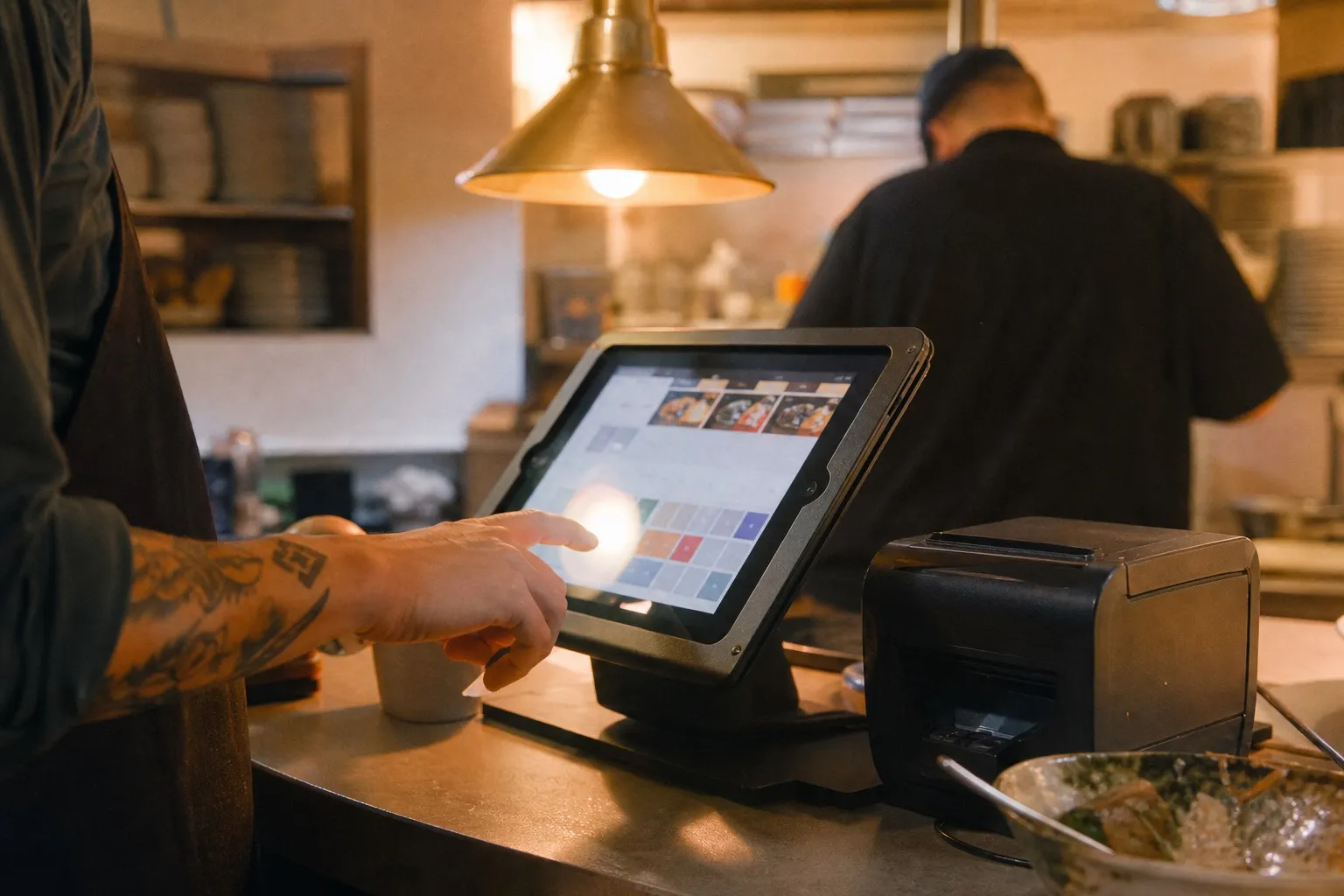
Burgerbots Opens in Los Gatos at $18 a Burger and 27-Second Assembly

Two ABB Robotics arms (Flexpicker and YuMi) assembling a burger in 27 seconds, priced at $18 — Burgerbots is California's $20 minimum-wage law's mascot. The answer to 'would diners actually pay for robot food?' is 'yes, but for the wrong reasons.'
I am on a southbound Caltrain at 10:14 a.m. on a Monday, and my phone will not stop. Three different group chats — one operator, one VC, one ex-line-cook now in robotics PR — are all sending me the same fifteen-second loop: a stainless-steel counter, a glass partition, an ABB Flexpicker arm pirouetting over a bun while a YuMi reaches in from stage left with a patty. The video has been cut to a Daft Punk track. Somebody has added a counter that ticks up to 27 seconds and freezes on the word “DONE.” The caption: “the future of fast food just opened in Los Gatos.”
The restaurant is Burgerbots. It opens this week. The burger is $18. And before I have even cleared Diridon, I have decided I am going to write the contrarian take, because the consensus take is already wrong.
The $18 number, decoded
Here is the math everyone is doing in their head. California’s fast-food minimum wage went to $20 an hour in April 2024. A year on, every operator in the state has spent twelve months re-pricing combo meals, trimming labor schedules, and quietly closing the third register. So when a Los Gatos storefront opens with two ABB Robotics arms — a Flexpicker for the high-speed pick-and-place, a YuMi for the dual-arm fiddly bits — assembling a burger in 27 seconds, the obvious headline writes itself. Robot beats $20 worker. Capital beats labor. The minimum-wage law has produced its own mascot.
The headline is wrong in a specific way. It treats the $18 burger as a labor-cost output. It is not. $18 is not what it costs Burgerbots to make this burger after replacing a $20 worker; $18 is what Burgerbots has decided it can charge while the robot is still the point of the restaurant. The price has nothing to do with the wage floor and everything to do with the queue outside.
My read: the $18 is a novelty tax. You are not paying for the burger. You are paying for the fifteen-second loop you are going to post on the way out the door, which is the same loop that landed in my group chats this morning. The restaurant is, functionally, a content studio that also serves food. The glass partition is not a hygiene feature; it is a camera lens.
This matters because the unit economics of a novelty restaurant and the unit economics of an automation restaurant are not the same business. One is priced to the social ceiling. The other is priced to the marginal cost. Burgerbots, today, is the first.
Why this is a tourism play, not a labor play
Co-creator Elizabeth Truong is on the record predicting that robotics-assisted assembly will be standard in quick service within five years. I think she is probably right on the trend and wrong on the venue. The Los Gatos store will not be the proof. The Los Gatos store is the marketing.
Consider the ingredient list of “diners pay for robot food.” It requires three things: a robot, diners, and a willingness to pay a premium for the robot rather than a discount for the absence of a human. Burgerbots clears all three, but only because the robot is, this week, novel. A second Burgerbots in San Jose next year clears two of three. The fifth one in Fresno in 2027 clears one. By the time the technology is standard — Truong’s five-year horizon — the novelty tax goes to zero, and the $18 burger becomes a $9 burger, which is the price point at which the labor math the headlines are doing this morning actually starts to matter.
So the answer to the question every operator I know has been asking for eighteen months — “would diners actually pay for robot food?” — is yes. But for the wrong reasons. They will pay because the robot is rare. The day the robot stops being rare, they will stop paying the premium, and the business will have to stand on the labor math alone. Which it might! But that is a 2028 conversation, not an April-2025 conversation.
My read: treat the Los Gatos opening as a theme-park ribbon-cutting, not a labor-market signal. The serious operators I have talked to this morning are not asking whether to copy Burgerbots. They are asking whether to send a buyer down on a weekday to take photos of the kitchen layout. That is the right question.
(There is a thread here about the broader category of guest-facing AI as experience-rather-than-efficiency, which I think is the more honest frame for a lot of what is being marketed as “automation” right now — in a piece we later publish on guest-facing AI experiences, I want to come back to where the dividing line actually sits.)
Where the serious automation actually is
If you want to see real restaurant automation in April 2025, do not look at a glass-partitioned storefront in Los Gatos. Look at a commissary in an industrial park outside Sacramento, or a ghost kitchen in Vernon, where a Chef Robotics arm is portioning bowls into 30,000 trays a shift for an airline caterer or a meal-kit company, and no diner ever sees it. The unit economics there are not novelty-tax economics. They are direct-labor-replacement economics, on tasks (portioning, scooping, repetitive plating) that are genuinely miserable for humans and genuinely well-suited to machines.
The Burgerbots story and the Chef Robotics story are both real, and they are both interesting, and they are not the same story. One is a $18 selfie. The other is a $0.14-per-tray line item on a B2B invoice. The press loves the first. The P&L lives in the second.
This is, in passing, the same mistake operators make about a lot of new technology: they confuse the demo with the deployment. As the framework piece we publish later on the Four Margins of Mise argues, the gains in this industry compound in the boring places — prep, par, waste, throughput — not in the camera-ready ones. Burgerbots is camera-ready. Chef Robotics is throughput. Bet accordingly.
My read, end of train ride: in five years, Truong is going to be right that robotics-assisted assembly is standard. She is also going to be wrong that Burgerbots was where it happened. Burgerbots will be where it got photographed. The Restaurant Technology News writeup (recap, week of April 27) will, I suspect, frame it this way too once the trade press catches up.
The Caltrain is pulling into Diridon. I am going to go eat an $18 burger. I am going to take the video. I am going to post it. And I am going to know, while I do, that I am the product.
— Hana edits The Pass. Tips: [email protected].
Featured
More
Browse all 494 posts
The Voice Agent Maturity Curve
mise
·12 min read
The Four Margins of a Restaurant
mise
·14 min read
The AI Premium in Hospitality M&A: Broker Story or Real Number?
the bottom line
·9 min read
What the DoorDash/SevenRooms Deal Actually Buys
the bottom line
·11 min read