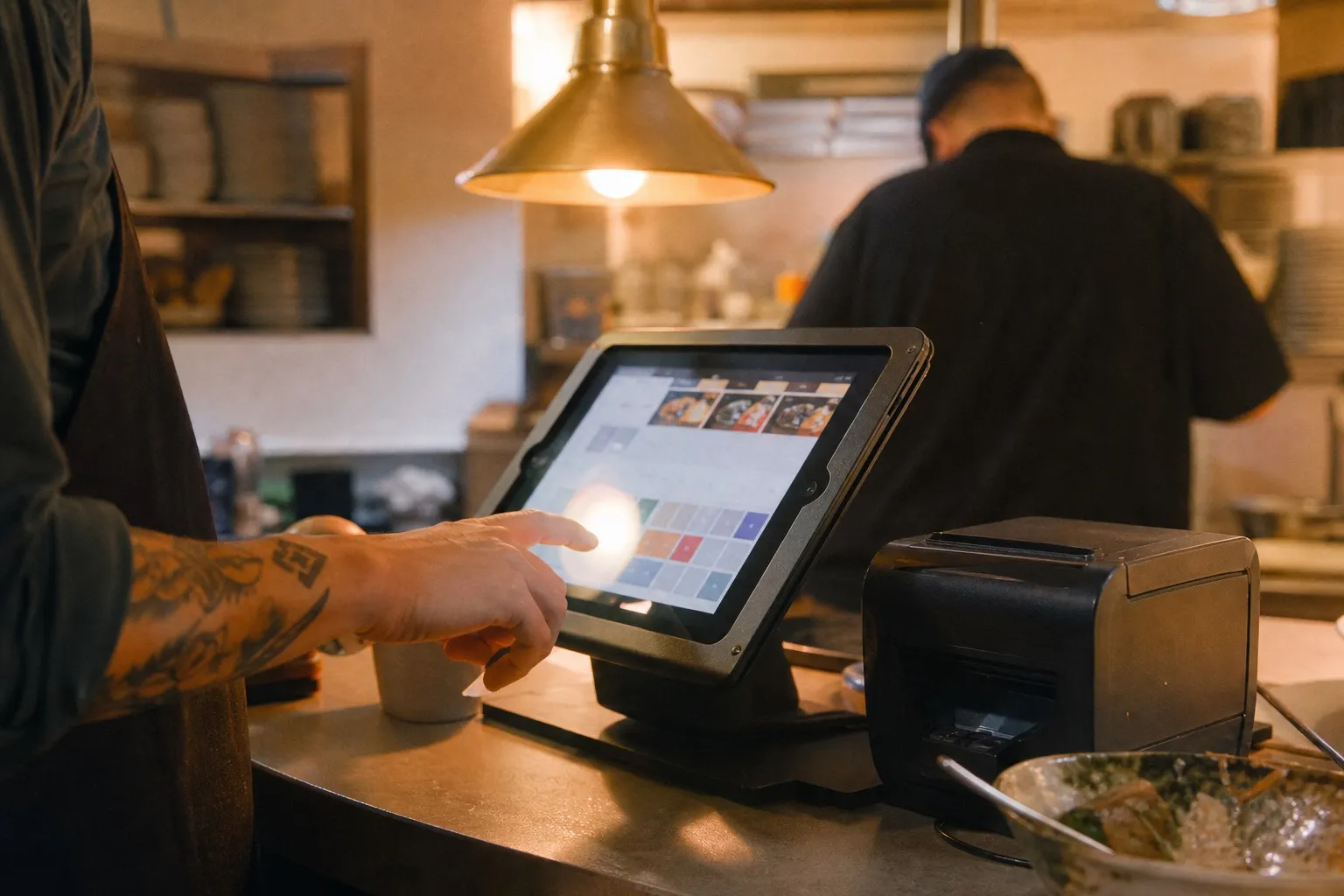
Byte by Yum at 60% Digital Mix: Why Taco Bell's Tech Stack Is Now the Moat, Not the Menu

Yum's Q4 print was a headline EPS miss wrapped around a much more durable story: Byte by Yum processed 370M+ digital transactions in 2025 and digital mix hit roughly 60%. The proprietary-AI-infrastructure thesis just got its first real validation.
I had the 8-K open on a second monitor at 7:02 a.m. ET, coffee not yet warm. The headline was the EPS miss. By 7:30 the wires had it; by 8:15, when Chris Turner opened the call, half the financial press had already filed a “Yum disappoints” lede and moved on.
That is the wrong story for the next four years. The durable line out of Yum’s Q4 2025 is not the per-share number. It is the sentence buried in the PYMNTS write-up: Byte by Yum processed more than 370 million digital transactions in 2025, up roughly 60% year-over-year, and digital system sales hit eleven billion dollars at a roughly 60% digital mix (PYMNTS, Yum battles rivals with proprietary AI). That is the moat. The menu is a feature.
The contrarian read
The contrarian read on Yum this quarter is that the EPS miss is a noisy quarterly artifact and the Byte deployment data is the multi-year compounding signal. I think that read is correct, and I will tell you why.
For two years, Yum has been pitching investors on a thesis most QSR analysts treated as a slide-deck flourish: that owning the technology stack — not licensing, not stitching vendors — was a structural competitive advantage. The pitch had a name (Byte by Yum) and a logic (one platform, four brands, every market, every channel) but no proof. There was no number you could put next to “Byte” the way you can put one next to “stores opened.”
There is now. CFO Ranjith Roy walked through it on the call. At least one Byte product is live across approximately 38,000 restaurants globally. The Smart Ops bundle is in 7,000 stores. The digital ordering bundle is in 18,000. The platform processed over 370 million digital transactions in 2025, growing roughly 60% year-over-year (Motley Fool, Q4 2025 transcript).
For context: the McDonald’s AI drive-thru programme my colleague Leila documented in her five-year case study — the most-public voice-AI deployment in QSR — was a multi-acquisition, single-channel bet that took half a decade to reach restart. Yum, in the same window, built a multi-brand, multi-market platform now sitting under 38,000 stores. The execution gap is the story.
The numbers that actually matter
Turner’s framing on the call was unusually direct. “Owning our core digital and technology platforms gives us an edge over the competition,” he told analysts. “Our ability to own our data and key strategic components of our technology stack provides a differentiated competitive advantage.” That is CEO boilerplate language unless there is something underneath it. There is.
The operational metrics Roy disclosed are the ones I would write down if I ran a multi-unit operation:
- Stockouts reduced by up to 85% in stores running Smart Ops
- Aggregator order-failure rate down by up to 75%
- Consumer satisfaction up by up to 10%
Those are not branding metrics. Stockout reduction is a margin lever — every out-of-stock at peak is a transaction you don’t ring. Aggregator failure-rate reduction is a customer-acquisition-cost lever: every failed delivery order is a refund, a chargeback risk, and a permanent decrement to repeat rate. Ten percent satisfaction is a frequency lever.
Roy’s positioning of Byte — “the only multi-brand, multi-market QSR technology platform built by restaurant operators for restaurant operators” — is either marketing or moat, depending on whether anyone else can build the same thing inside five years. I don’t think anyone else can. (Interpretation flag: that competitive-moat read is mine, not Yum’s stated position.)
Taco Bell is the proof of concept
Taco Bell delivered Q4 same-store sales of +7%. (The SEC archive returned a 403 from the press tooling at the time of writing; I am citing the figure as filed in the 8-K but flagging that I could not independently load it.) The brand inside the Yum portfolio that has most aggressively absorbed the Byte stack is the brand putting up the comps.
Turner’s longer arc: “Reaching approximately $3,000,000 in US average unit volume” with “25 to 26% US restaurant-level margin.” Those are the 2030 numbers. The bridge runs through the digital mix.
KFC is the scale test
KFC’s 2025 unit growth — 2,892 gross new restaurants across 97 countries — is the answer to whether Byte can clear customs. A tech stack that works in 7,000 US stores is a product. A tech stack that works across 97 country regulatory regimes is a moat. Quench, rolling out to roughly 3,000 stores in 2026, is the next test of whether Yum can push a single product spec through the system at speed.
Pizza Hut, briefly
Turner said the strategic review of Pizza Hut will be completed this year. I am not going to speculate about what “options” means here because Yum has not said and the analyst questions on the call didn’t extract anything beyond the timeline. The honest read is: wait for the next disclosure.
The operator takeaway
If you run a multi-unit operation and you read one number out of this print, read the 60% digital mix at $11 billion of system sales. That is the empirical proof that a vertically-owned tech stack can move the customer to your channel at scale. Whether you can replicate it depends on whether you can build it. Most operators can’t. That is exactly what makes it the moat.
— Maya covers restaurant tech for The Pass. Tips: [email protected].
Featured
More
Browse all 494 posts
The Voice Agent Maturity Curve
mise
·12 min read
The Four Margins of a Restaurant
mise
·14 min read
The AI Premium in Hospitality M&A: Broker Story or Real Number?
the bottom line
·9 min read
What the DoorDash/SevenRooms Deal Actually Buys
the bottom line
·11 min read