Desk Review: What Yelp's AI Stack Actually Does for Restaurants

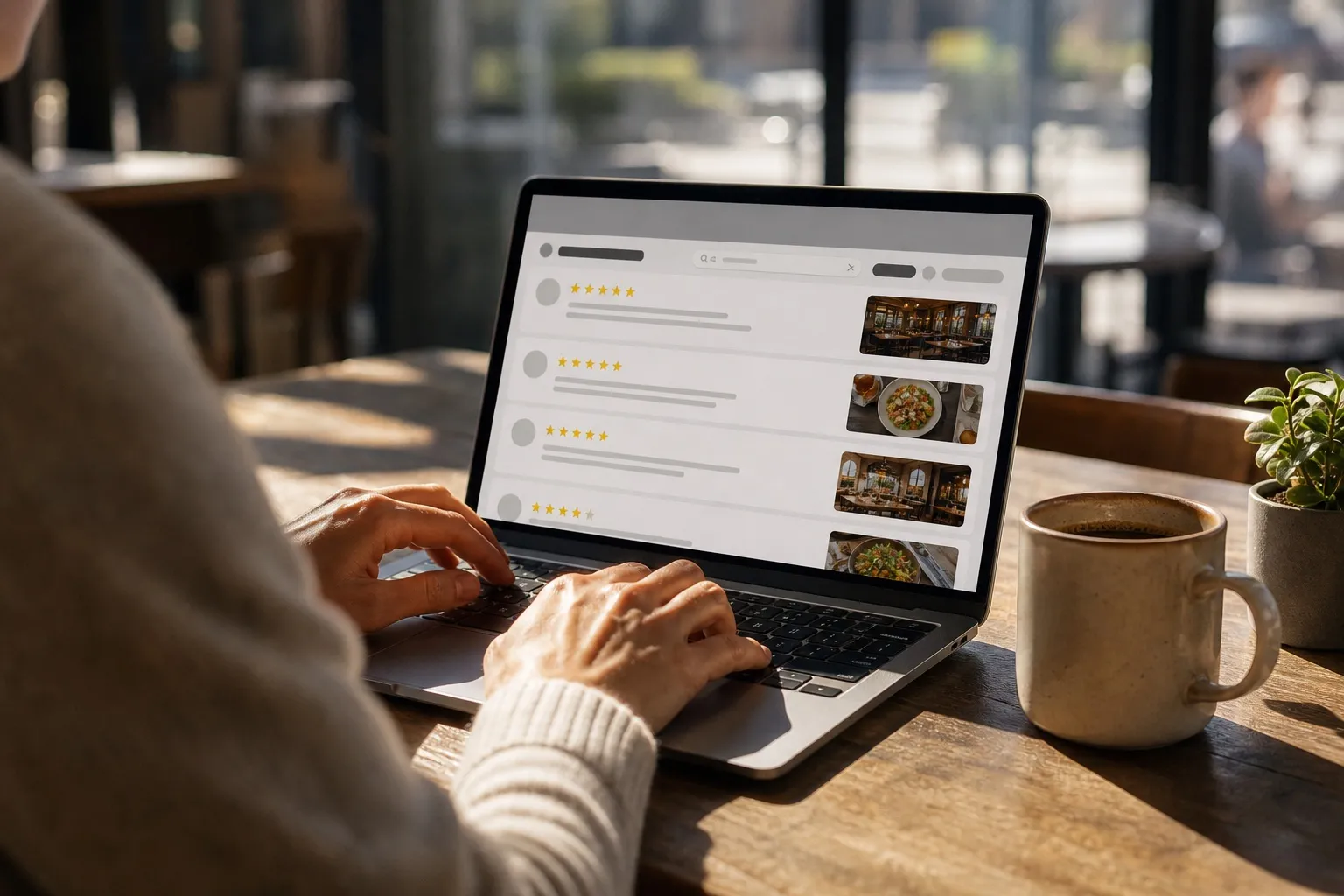
Yelp has shipped more than 35 AI features over the last two years, and the operator-facing side is finally substantial. A desk review of Yelp Host, Yelp Assistant, response-quality badges, review insights, and AI-generated business summaries — what's real, what's marketing, and what the segment economics tell you about how seriously to take it.
I owe readers a correction on format. I had this slot booked as a hands-on Vibe Check of a Yelp review-reply tool. Two weeks of digging didn’t produce a panel-worthy hands-on — what I had was a vendor that ships AI features in waves, an operator base that mostly hasn’t tried them yet, and a product surface that’s wider than any single Vibe Check can credibly cover. Rather than fabricate a panel, I’m filing this as a Desk Review — a structured read of public materials, vendor documentation, earnings disclosures, and trade-press coverage of Yelp’s AI stack for restaurants. No invented operators, no invented reply counts, no invented uplift percentages. When I run a hands-on panel of any of these features later this year, you’ll get that as a separate piece.
This is one of several Desk Reviews we’re publishing this quarter on the major restaurant-facing AI launches. The format sits next to the Toast AI Desk Review, the Square AI Desk Review, and the OpenTable AI Desk Review. Same scaffolding each time so operators can compare across vendors.
Methodology
This piece is built from: Yelp’s official blog product release posts (Spring 2024, Winter 2024, End of Year 2024, Spring 2025, Fall 2025, Spring 2026); Yelp’s investor relations and press releases; the Yelp for Business product pages for Yelp Host and Yelp Guest Manager; trade press coverage in Restaurant Dive, TechCrunch, and Restaurant Business; and the Yelp Q4 2025 earnings call transcript and presentation. Sources cited inline.
I have not run any of these features against a live operator inbox. Where I draw inferences about how a feature will behave in practice, I flag it as inference. Where Yelp has published a number, I cite the source. Where Yelp has published a claim with no number behind it, I say so.
The reach-for / hold-off lists at the end are based on documented feature scope, pricing tiers, and operator-segment economics — not on a hands-on test. Read accordingly.
What “Yelp’s AI” actually refers to
Yelp’s AI stack is not one product. It is at this point closer to a dozen separate features shipped across six product releases between January 2024 and April 2026, several of which interact with restaurant operators directly and several of which sit on the consumer side of the platform but shape what restaurant owners see in their dashboards.
The features that touch restaurant operators directly:
- AI-generated business summaries (announced January 2024). One-sentence LLM-written descriptions at the top of a business page, drawn from recent reviews. Not editable by the operator.
- AI-enhanced business owner inbox (end-of-year 2024 release). Brief AI summaries of incoming lead/job details surfaced inside Yelp for Business, originally aimed at service pros but with read-through to restaurant lead inquiries.
- Review Insights (December 2024 launch). Sentiment categorisation of reviews along axes like food, service, ambiance — with scores from 1 to 100.
- Response-quality badges and real-time reply guidance (Spring 2025, expanded Fall 2025). LLM-evaluated assessment of how well an operator replies to leads, with guided prompts during reply composition.
- Smart Selection (end-of-year 2024). AI-powered ad optimisation that automatically rotates the strongest reviews and photos in Yelp ad placements. Free to all advertisers.
- Yelp Host and Yelp Receptionist (October 21, 2025 launch). AI voice agents that answer restaurant and local-business phone calls, integrated with Yelp Guest Manager for reservations and waitlist management.
- Yelp Assistant on the consumer side (April 2024 launch, cross-category expansion October 2025, transactional version April 2026). Conversational AI for consumers; matters to operators because it’s the new top of the funnel into restaurant reservations.
The features that touch consumers and only indirectly touch operators:
- Menu Vision (Fall 2025) — AR-augmented menu scanning.
- AI-stitched videos (end-of-year 2024 onward) — narrated video previews built from review content.
- Natural language and voice search (Fall 2025).
- “What’s the Vibe” (Fall 2025) — visual summary of ambiance.
I’ll cover the operator-facing features in detail. The consumer-facing ones matter only insofar as they redirect demand, and that’s a Bottom Line question.
Feature-by-feature
Yelp Host
This is the headline operator-facing product. Yelp Host launched October 21, 2025 as an AI voice agent that answers a restaurant’s phone calls 24/7. The product is built on Yelp’s proprietary voice system plus large language models. The marketing claim is that it “sounds nothing like a bot” — operator testimony from Yelp’s own launch materials, which we should read skeptically; live-call samples in trade-press coverage described the voices as recognisably AI but pleasant.
What Yelp Host actually does, per Yelp’s product page:
- Answers every incoming call, including after-hours.
- Operates in 17 languages including English, Spanish, Mandarin, and Korean. (This is the multilingual story that competitors are still missing — worth weighting.)
- Takes, modifies, and cancels reservations via Yelp Guest Manager integration.
- Quotes wait times and adds diners to the Yelp Waitlist.
- Sends text links for takeout orders; on-call ordering “coming soon” per Yelp.
- Screens spam and handles repetitive questions.
- Transfers calls to staff numbers when needed.
- Customisable host name, four voice options, greeting, and FAQs.
- Setup in 10 minutes using existing Yelp business page data.
Pricing (from the Yelp Host product page):
- Yelp Host Basic: $149/month, limited call volume.
- Yelp Host Plus: $399/month, unlimited calls.
- Bundle with Yelp Guest Manager: $199/month.
- Free trial up to 30 days. Custom pricing for multi-unit groups.
Adoption numbers from Yelp. On the Q4 2025 earnings call (February 12, 2026), CEO Jeremy Stoppelman said Yelp Host had “answered more than 190,000 calls and handled thousands of reservations since launch.” That’s roughly four months of operating life when he said it. The reservation count is vague (“thousands”); the call count is concrete. Take the numbers as a vendor’s directionally-honest disclosure rather than a verified throughput claim.
My read. The product surface is more complete than the comparable AI voice agents I’ve seen demoed elsewhere — specifically, the Guest Manager integration is the part that’s hard to replicate. A standalone AI voice agent that books a table by texting the host is one thing; one that writes directly into the same reservation system the front-of-house is already using is another. The 17-language coverage is also genuinely useful in markets like Los Angeles, the Bay Area, New York, and Houston where a substantial fraction of incoming calls come in a language the host on duty doesn’t speak.
The thing I cannot evaluate without a panel: how it handles edge cases. Reservation modifications under noisy ambient conditions, callers who change their party size mid-call, callers asking about allergens, callers asking about a private event. Yelp’s published materials don’t address these. The press testimonials are softball quotes. This is what a hands-on Vibe Check would cover, and what I won’t pretend to have done.
Yelp Receptionist
The non-restaurant sibling. Same launch date, $99/month starting, aimed at service businesses. Captures project details, vets leads, delivers transcripts and summaries to the Yelp for Business inbox. Some restaurants — particularly those that take heavy private-event call traffic — may find Receptionist more useful than Host for the catering and private-dining inbox specifically. Yelp hasn’t built a bridge between the two products for this use case; an operator running both would need to manage two services.
Response-quality badges and real-time reply guidance
This is the closest thing to what I had originally planned to Vibe Check. Yelp’s response-quality system does not draft replies for the operator. It evaluates replies and surfaces guided prompts as the operator is composing them.
The evaluation criteria, per Yelp’s blog: whether the business owner acknowledges project details, asks relevant follow-up questions, provides a quote or availability, and goes beyond a generic “call us” reply. The output is a score visible to the operator inside Yelp for Business, plus a public badge on the business page when scores are high enough.
By the Fall 2025 release, the badges had gone nationwide, having rolled out in Spring 2025 in Arizona, Washington, Oregon, Illinois, and Indiana first.
My read. This is a meaningfully different design choice from competitors. Most review-reply AI products in the restaurant category I’ve reviewed in the last 18 months are generative — they write a draft, the operator approves or edits, send. Yelp’s product is evaluative and instructive — it tells the operator what a better reply would look like, but doesn’t write it. The trade-off is that Yelp’s product preserves the operator’s authentic voice (which is usually the right call), at the cost of not solving the “I don’t have time to write 40 replies” problem that drives demand for generative tools in the first place.
It’s also worth noting that response-quality badges initially targeted service professionals more than restaurants. The badge logic — did you provide a quote or availability — maps better to plumbers and lawyers than to a chef-owner replying to a four-star Yelp review. Whether the system applies the same evaluation criteria to restaurant replies, or whether there’s a restaurant-specific variant, is not documented in Yelp’s public materials. I’d want to know that before recommending the feature to a restaurant operator.
Review Insights
Launched December 10, 2024 for restaurants on iOS first. LLM-driven categorisation of review content into sentiment-scored dimensions: food quality, service, ambiance, value. Each rated 1-100, tagged positive, neutral, or critical. Consumers tap the category to see relevant highlighted reviews.
Chief product officer Craig Saldanha described the system to TechCrunch: a review saying “drinks came out quickly” would be categorised under service even though the word service is never used. The technical claim — implicit-topic detection — is what an LLM is reasonably good at. Saldanha’s broader claim is also worth quoting because it’s the strategic framing for the entire AI stack: “The real differentiator of Yelp is the hundreds of millions of reviews that we have. LLMs essentially allow us to parse all of that data.”
For operators, Review Insights is mainly a consumer-side feature, but it does feed into the dashboard view of how your restaurant is being summarised, and into the dimensions on which Yelp publicly compares you. The implication: an operator who has been running on “we’re a 4.2 overall” needs to start thinking about a separate distribution — a 4.6 on food and a 3.4 on service is a different management problem than a 4.0 across the board, and Review Insights surfaces that distribution to every consumer who taps into your page.
AI-generated business summaries
Announced January 2024. One-sentence summary at the top of the business page, written by an LLM from recent review content. Examples Yelp shipped at launch: Troublemakers Cocina in Milwaukee as an “eatery with fresh ingredients and craft beer pairings, famous for its taco platter,” Kuma’s Corner in Chicago as a “burger joint with metal music vibe, extensive menu and craft beer selection.”
The piece that should worry operators: per Restaurant Business’s coverage, “Businesses are not able to change those summaries, but if they believe something is inaccurate, they should contact Yelp support.” That’s a real problem for any operator whose menu has evolved past what recent reviews describe, and a particular problem for operators who’ve gone through a chef change, menu refresh, or rebrand and whose recent reviews still describe the old place.
Yelp Assistant (consumer-side, but operator-relevant)
Launched April 2024 as a services-only chatbot using LLMs from OpenAI plus Yelp’s review and business data. Expanded to all business categories October 2025, including restaurants. Made transactional in April 2026 — now books restaurant reservations, orders DoorDash and Grubhub, schedules Vagaro and Zocdoc appointments.
Yelp’s Q4 2025 earnings disclosure said Request-A-Quote project submissions through Yelp Assistant were up “more than 400% year over year.” That’s the services side. There is no comparable number disclosed for restaurant reservations booked through Yelp Assistant.
For restaurants, this is the part of the stack with the highest medium-term operator implications and the least operator visibility. If Yelp Assistant becomes a meaningful share of how consumers find and book restaurants on the platform, then the question of how the assistant ranks restaurants in response to a query becomes the dominant question for operator visibility. That’s the SEO-for-AI problem that every consumer platform is now grappling with. Yelp has not published the criteria the assistant uses to rank restaurants. That’s a piece I will be filing on when there’s more to work from.
Operator implications
A few things follow from this stack as it exists today.
One: the AI features cluster on the consumer side. Yelp’s pattern across 2024 and 2025 is to ship many more consumer-facing AI features than operator-facing ones. The operator-facing features that did ship — Host, Receptionist, response-quality badges, inbox summaries — are real but narrower than the consumer surface. An operator deciding whether to take the Yelp stack seriously should be evaluating it primarily through the lens of how it shapes the consumer’s path to your restaurant, not the operator’s day-to-day workflow.
Two: the call-answering category is now contested. Yelp Host enters a category that already had several restaurant-specific AI voice agents from independent vendors, plus call-handling features being shipped by reservation-system vendors like Yelp Guest Manager’s direct competitors. Yelp’s advantage is bundle pricing and Guest Manager integration. The disadvantage is that operators who aren’t on Yelp Guest Manager get less of the value, and Yelp Guest Manager penetration in the operator base is not dominant. I’d want to see Yelp Host pricing for non-Guest-Manager restaurants treated as a stand-alone product before recommending it widely.
Three: the segment economics matter. Per Yelp’s Q4 2025 earnings, the Restaurants, Retail & Other segment declined 12% year-over-year to $107 million in Q4 2025, and 6% for full-year 2025 to $444 million. COO Jed Nachman attributed this to a weakened consumer and high input costs. The AI investment in restaurant tools is, partly, a defensive move against a segment that’s been losing share inside Yelp’s revenue mix. The company’s 2026 EBITDA guidance of $310-330 million is down from $369 million in 2025, with the gap largely going to AI, the Hatch acquisition, and paid traffic. Operators reading this should understand: Yelp is spending against this product surface, but it’s spending into a segment that is, financially, shrinking. The pace of feature shipment will depend on whether the operator-tooling investment shows up in restaurant-segment revenue stabilising over the next four to six quarters. Treat Yelp’s AI roadmap as ambitious but not guaranteed; the budget pressure is real.
Four: the Hatch acquisition is a tell. Yelp acquired Hatch, an AI lead-management platform for service pros, with 70% year-over-year growth at the time of acquisition. That’s a services-pro acquisition, not a restaurant acquisition. Yelp’s AI capital is going disproportionately to the services side because that’s where the segment is growing. Restaurant operators should not assume their slice of the roadmap will get equivalent attention. Cross-reference with the Four Margins piece on vendor allocation for the framework.
Reach for it if…
- You’re a restaurant taking material call volume, your front-of-house is losing time to phone interruptions, and you’re already on Yelp Guest Manager. The bundled $199/month for Host + Guest Manager is the operator-friendliest price point on this list, and the integration is real.
- You operate in a multilingual market — Los Angeles, the Bay Area, NYC, Houston, Miami, Chicago, Toronto, parts of Texas — and you’re missing calls in languages your front-of-house doesn’t cover. Yelp Host’s 17-language support is the biggest documented advantage versus competitors.
- You’re a service business adjacent to restaurants — catering operations, private-event venues, ghost kitchens taking inbound calls — where Yelp Receptionist at $99/month may be a better fit than Yelp Host.
- You want sentiment-level visibility into your Yelp reviews without paying for a separate reputation-management tool. Review Insights is included; for some operators it replaces a $200-$500/month line item.
Hold off if…
- You’re not on Yelp Guest Manager and don’t plan to migrate to it. Yelp Host without Guest Manager loses most of its reservation-integration value, and at $149/month for limited calls (or $399 unlimited) it’s competing on price with several other AI-voice products that aren’t tied to a reservation system. The bundle is the value; the standalone product is fine but not differentiated.
- You’re operating in a market where Yelp consumer traffic is no longer your top-of-funnel. A meaningful subset of operators — especially in cities with strong OpenTable, Resy, or Google Maps dominance — have correctly stopped treating Yelp as a primary discovery channel. The AI features don’t change that calculus; they make Yelp slightly more useful to the consumers who are on it, but if your consumers aren’t on it, you’re paying for tooling that doesn’t move your number.
- Your review-reply discipline is already strong. Response-quality badges and inbox guidance are designed to lift operators from “poor” to “adequate.” If your team is already at “good,” the system isn’t adding much beyond the public badge — and the badge mainly helps in the services categories.
- You’re a chef-owner who treats Yelp replies as personal correspondence. The response-quality prompts will subtly nudge you toward a more professionalised reply style. That’s the wrong nudge if your replies are part of your brand voice.
- You’re waiting to see if Yelp keeps investing in restaurants. The 12% Q4 decline in the RR&O segment is a real signal. If you have one slot of new-vendor onboarding capacity this quarter, spend it on a vendor whose business is growing into restaurants, not contracting out of them.
The wider read
Yelp’s AI stack is more substantial than the operator community has given it credit for. The 2024 base — review insights, AI summaries, smart-selection ads — was modest. The 2025 build — response-quality badges, Yelp Host, Yelp Receptionist, the cross-category Yelp Assistant — is genuinely meaningful, and the 2026 trajectory toward an agentic, transaction-completing Assistant has the potential to reshape Yelp’s role as a top-of-funnel for restaurants.
What’s working against Yelp is segment momentum. The operator community has, for the better part of a decade, treated Yelp as a defensive presence rather than an offensive growth lever, and the segment-revenue trend confirms that the consumer side of the platform is losing share in restaurant discovery. A great AI stack doesn’t fix that on its own, and Yelp’s management knows it — the Q4 2025 commentary is honest about the pressure.
For an operator reading this as a 2026 procurement decision: take the Host + Guest Manager bundle seriously if you’re already in the Yelp ecosystem, treat Review Insights as a free upgrade you should be paying attention to, and don’t expect the response-quality badges to do much for the restaurant-replies use case until Yelp ships a restaurant-specific evaluation model. Skip the rest unless your circumstances specifically argue for it.
Marcus will have a Bottom Line piece next month on whether Yelp’s enterprise value is moving in line with the AI investment. Watch that slot — the public-market read on Yelp’s AI transformation is, at the moment, partial credit at best, and the restaurant-segment decline is doing more to set the price than the AI features are.
The next Desk Review in this series — OpenTable’s AI stack for restaurants — files in two weeks. After that, Lightspeed’s AI Scheduler, which I’ve been quietly running at two operators for six weeks and which is going to surprise the panel. I’ll have that for you May 22.
— Maya covers vendor reviews and the restaurant-tech beat for Vibe Check and The Pass. Tips: [email protected].
Featured
More
Browse all 494 posts
The Voice Agent Maturity Curve
mise
·12 min read
The Four Margins of a Restaurant
mise
·14 min read
The AI Premium in Hospitality M&A: Broker Story or Real Number?
the bottom line
·9 min read
What the DoorDash/SevenRooms Deal Actually Buys
the bottom line
·11 min read
Related posts

vibe check
·16 min read
Desk Review: Lightspeed Restaurant, the Quiet Half of the Duopoly
vibe check
·18 min read
Desk Review: OpenTable's 'System of Record' — what restaurants are actually agreeing to on April 16

vibe check
·18 min read