Earnings Week Debrief: What Hilton, Wyndham, Chipotle and LVS Told You About AI Capex

Four Q2 prints in 48 hours. The shared signal is uncomfortable for the AI-in-hospitality bull case: capex is real, pilots are multiplying, and near-term margins are not moving. The 2027 story is the only honest story.
I spent Thursday night with four transcripts open, three cups of coffee, and a spreadsheet that kept telling me the same thing. Hilton had just walked through its Q2, Chipotle had finished its call a few hours earlier, and Las Vegas Sands had dropped its release into the wires alongside Wyndham’s print. By the time I closed the laptop, the thesis I had been chewing on for a quarter looked less like a contrarian take and more like the consensus the sell-side had not yet written down.
Here it is, in one sentence: AI capex in hospitality and restaurants is decoupling from near-term margin gains, and this earnings cycle is the first one where management teams have said so out loud without softening it. Hilton’s 41 pilots, Chipotle’s vision system and “augmented” makeline, LVS’s flat-to-down property-level margin in Macao despite a billion-three of EBITDA, and Wyndham’s 19% ancillary revenue tear are all pieces of the same picture. The capex bills are landing in 2025 and 2026. The P&L benefit is a 2027 story. The question for anyone running a book is whether the equity market is mispricing the gap.
I think it is, in places. But not the way the bulls have been arguing.
H1 2025 was the pilot year — the prints just made that explicit
Hilton’s release is the cleanest data point. The company tested 41 AI use cases in the first half of the year — operational, guest-facing, and revenue-management — and management framed the work as portfolio-level experimentation rather than a single bet. That number — 41 — matters less than the cadence it implies. If you assume a six-to-eight-week pilot cycle and meaningful overlap, you get roughly 60-80 individual pilot-weeks of work since January, distributed across a property base of more than 8,500 hotels. The average pilot is touching, generously, a few dozen properties. The information value is high. The system-wide P&L impact is not yet measurable, and Hilton was careful not to claim it was.
That careful framing is the tell. A year ago, Hilton’s investor-day slides on AI implied a faster path from pilot to deployment. The Q2 release reads like a company that has learned what the rest of us are learning: pilots are cheap, integrations are not, and the gap between “this works in three properties” and “this is in the operating model” is measured in quarters, not weeks. Compare this to what I expect to lay out in a forthcoming desk review on Toast’s restaurant-tech stack — the same dynamic shows up there, just denominated in SMB restaurants instead of branded hotels.
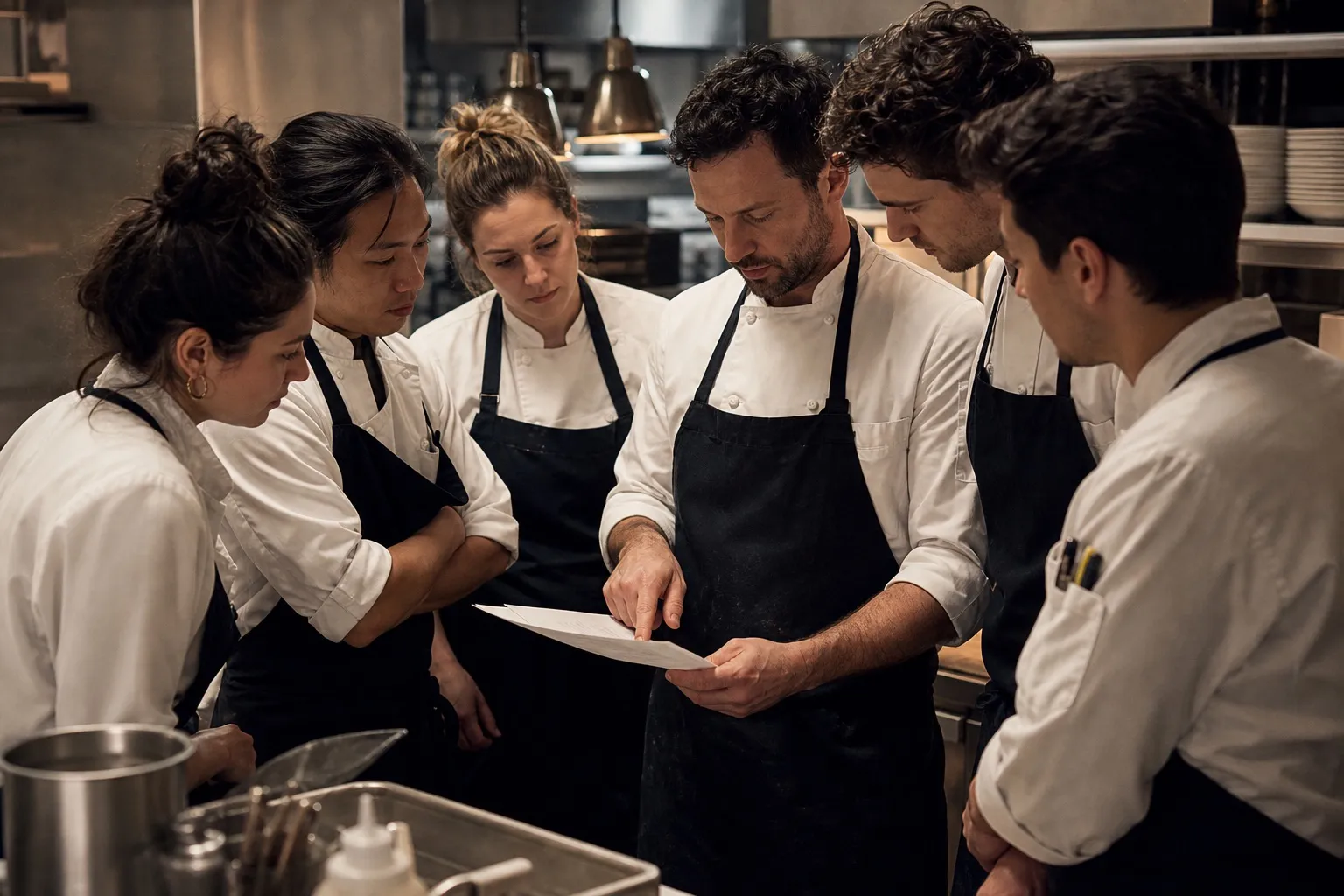
Chipotle’s transcript is the second data point and, for my money, the more interesting one. The call described a restaurant innovation space, an augmented digital makeline, and a vision system being tested for portion accuracy and throughput. The CFO talked about it the way you talk about a multi-year capex program: real dollars, real internal teams, no commitment to a margin number this year or next. That is the right answer. It is also the answer that hurts the stock if you came in expecting a 2026 EBITDA bridge to include AI-driven labor savings.
The math on Chipotle’s makeline is worth dwelling on. A typical Chipotle generates roughly $3.0M in AUV and spends in the high-twenties on labor as a percent of sales — call it $850K-$900K of labor per box. If a vision-augmented makeline saves you 60 seconds per transaction at peak and you reallocate that into either throughput (incremental transactions) or labor hours (cost takeout), the per-box annualized value is in the $40K-$80K range, depending on which lever you pull. Across 3,700-plus owned restaurants, you are talking about a $150M-$300M annualized opportunity. That is real money. It is also a 2027-plus number, because rolling vision hardware across a footprint that size with the reliability Chipotle demands is a three-year project, not a three-quarter one.
The Macao print is the cleanest read on what AI does NOT fix
Las Vegas Sands posted $1.33B of adjusted property EBITDA on the consolidated entity, with Macao doing the heavy lifting and Marina Bay Sands continuing to print high-margin numbers. The release reads well — until you look at the year-on-year property-level margin in Macao and notice it is essentially flat against a comparable quarter where mass GGR has been recovering.
Why does this matter for an AI-capex piece? Because LVS is the integrated-resort operator with arguably the most sophisticated revenue-management and yield infrastructure in the industry. If AI-driven yield were going to show up anywhere first, it would show up in a Macao property where the player-segmentation problem is the most lucrative in the world. It is not showing up in the margin line. That tells you one of two things: either the lift is real but is being absorbed by structural cost inflation (labor, energy, marketing reinvestment), or the lift is still ahead of us. Both interpretations argue the same thing for the equity — the multiple should not be expanded today on AI optionality.
I want to be careful here. The Sands release is not bad — $1.33B is a strong absolute number, and the buyback math at current prices still works. But anyone modeling a 100-150 bps margin expansion in 2026 off “AI yield” needs to explain why a company with this much data and this much capital intensity is not already showing it. The honest answer, which the call did not quite give, is that the yield lift exists in pockets — VIP rebid, hotel-rate optimization on shoulder nights — and those pockets are too small to move a consolidated margin print.
This is the same lesson, in a different denomination, that I expect to surface in an upcoming May piece comparing SevenRooms and Tablecheck on the restaurant-CRM side. Sophisticated tooling, sophisticated operators, and the margin lift still hides until the deployment surface gets big enough.
Wyndham’s 19% ancillary number is the under-discussed positive
Wyndham’s print included a +19% ancillary revenue growth number that the sell-side mostly buried in their second-page notes. They should not have. Ancillary revenue at an asset-light franchisor is the cleanest read on whether AI-driven personalization is actually moving wallet share, because the line is incremental, high-margin, and almost entirely software-mediated.
Nineteen percent year-on-year on ancillaries — when comparable RevPAR is closer to flat — is not a rounding error. It is the first quarter I can point to where a hospitality company has put a number on the board that you can plausibly trace, at least in part, to better targeting, better cross-sell, and better digital merchandising. Wyndham did not frame it as an AI win on the call, and I think they were right not to — overclaiming would have invited questions they were not yet ready to answer. But the number is the number.
Here is the back-of-the-envelope. Wyndham’s ancillary base is, generously, in the $150-200M annualized range across loyalty, partner commissions, and direct-booking attach. A 19% lift is $28-38M of incremental high-margin revenue. At franchisor-level contribution margins (call it 60-70%), that is $17-26M of incremental EBITDA. Against a full-year EBITDA base in the $700M zip code, that is a 200-350 bps contribution to growth from a single line. It will not repeat at 19% forever, but if it compounds at even 10% for two more years, it is a real EBITDA bridge that does not require any further AI capex to underwrite.
This is the pattern I keep coming back to. The places where AI is moving the P&L today are narrow, software-mediated, and asset-light. The places where the bull case wants AI to move the P&L — labor lines, property-level margin, throughput at owned-and-operated boxes — are the places where the timeline keeps slipping right. Sweetgreen’s Infinite Kitchen rollout is the canonical example, and a forthcoming May piece will walk through why the unit economics there are more complicated than the headlines suggest.
What the four reports together tell you about capex intensity
If you stack the four releases against each other and just count the dollars, the picture is striking. None of the four companies guided to lower capex on the back of AI productivity. Three of the four either held capex flat or nudged it up. Hilton’s language around technology investment was the most explicit — the 41 pilots are not free, and the integration work that follows the pilots will be more expensive than the pilots themselves. Chipotle’s innovation-center spend is a real line item now. LVS’s capex is dominated by Macao concession commitments, but the technology-capex component is creeping up. Wyndham, characteristically asset-light, is spending less in absolute terms but is spending more on the digital stack than it was two years ago.
The implication for modeling is uncomfortable. If you were running an “AI productivity flywheel” model that assumed capex intensity in hospitality and restaurants would peak in 2024 and decline through 2026 as the software did more of the work, you have to push that peak out by at least eighteen months. The capex is real, it is durable, and it is being spent ahead of the margin benefit by a wider gap than the sell-side has been modeling.
The other uncomfortable implication is on free cash flow conversion. A company that is spending real capex on AI infrastructure today and not yet showing the margin benefit is, definitionally, converting less of its EBITDA into free cash. Hilton’s FCF guide for the year is fine — but the back-half is doing more work than the front-half, and the technology capex is part of why. LVS has the concession overhang, so it is a special case. Chipotle’s FCF conversion is excellent, but the innovation spend is starting to show up. Wyndham is the cleanest, again because of the asset-light model.
If you are running a long book in this space, the calendar matters more than it usually does. The market typically gives operators a free pass on capex intensity if the narrative is intact. The narrative right now is intact but fragile — one quarter of a real margin miss and the AI capex line item gets reframed from “investment” to “drag.” That is the asymmetry I am watching into the September-quarter prints.
The cross-currents — distribution, partnerships, and the M&A overhang
The four reports also need to be read against the broader distribution story, which is where my interest as an M&A watcher gets engaged. The DoorDash and SevenRooms work that I expect to cover in an upcoming May piece is the kind of distribution-layer integration that, if it scales, changes the unit economics of restaurant marketing in ways that are not yet reflected in any of these four prints. Chipotle does not need DoorDash the way a regional chain does, but the cost-per-acquisition math at the marginal restaurant operator is being rewritten right now, and the public-company prints lag that reality by two to four quarters.
The M&A read is similar. Hilton is not going to be a buyer of a software platform — they will keep partnering, keep piloting, and keep moving the needle slowly. LVS is locked into capex commitments that preclude meaningful tech-stack M&A this year. Chipotle has the balance sheet to buy and the strategic appetite, but the makeline-and-vision work is internal, and the M&A targets that fit them are small. Wyndham is the most interesting candidate for an ancillary-driven acquisition, given how well that line is working — a loyalty-tech or guest-personalization tuck-in would extend the run-rate of the 19% number, and the math would work even at a 15-20x EBITDA multiple on the target.
The deeper M&A point is that the strategic acquirers in this space are not, for the most part, ready to pay AI-software multiples for adjacent assets while their own capex bills are still going up. That is a near-term cap on deal volume and a near-term floor under public-equity valuations of the software pure-plays. The pure-play valuations have come in this year — and I think they are closer to fair than the bears want to admit, precisely because the strategic-buyer bid is weaker than it was eighteen months ago.
What I’m doing into the September prints
Three things, briefly.
One — I am leaning into the asset-light, software-mediated names where the ancillary or commission line is doing visible work. Wyndham is the obvious one this quarter. The franchise-and-fees model has structural reasons to translate AI optionality into actual P&L faster than the owned-and-operated names, and the Q2 print made that concrete.
Two — I am underweighting the names that are spending AI capex without a credible 2026 margin bridge. This is not a short call; it is a relative-weight call. Hilton is a great long-term business, but the multiple has run ahead of what the 41-pilots cadence can deliver in the next four quarters. LVS is fine if you are paid for the Macao concession risk, but the AI optionality is not what is driving the equity here.
Three — I am keeping a close watch on the gap between capex guides and FCF conversion. The companies that hold capex flat through the back half while still delivering the EBITDA print are the ones whose AI bets are starting to show up in the cost structure even if they are not yet showing up in revenue. That is a leading indicator, and it is one the sell-side does not yet have a clean model for.
The bottom line — and yes, this is the column’s name for a reason — is that earnings week confirmed something I have been saying for a quarter. AI capex in hospitality and restaurants is real, durable, and decoupled from near-term margin gains. The 2027 story is the only honest story. The market is starting to recognize this, in fits and starts. The mispricings are in the asset-light names that are quietly translating AI into ancillary revenue today, and in the owned-and-operated names where the multiple has gotten ahead of the timeline.
I’ll be back after the September prints with an update. Until then, the spreadsheet stays open.
— Oliver writes The Bottom Line for TableTransfers. Tips: [email protected].
Featured
More
Browse all 494 posts
The Voice Agent Maturity Curve
mise
·12 min read
The Four Margins of a Restaurant
mise
·14 min read
The AI Premium in Hospitality M&A: Broker Story or Real Number?
the bottom line
·9 min read
What the DoorDash/SevenRooms Deal Actually Buys
the bottom line
·11 min read
Related posts

the bottom line
·11 min read
Darden trades like a tech company. It shouldn't.
the bottom line
·12 min read
Applebee's just became its own franchisee. The territory math is the trade.

the bottom line
·12 min read