Inside Toast IQ's First 30 Days: What Narang Is Selling to 156,000 Operators
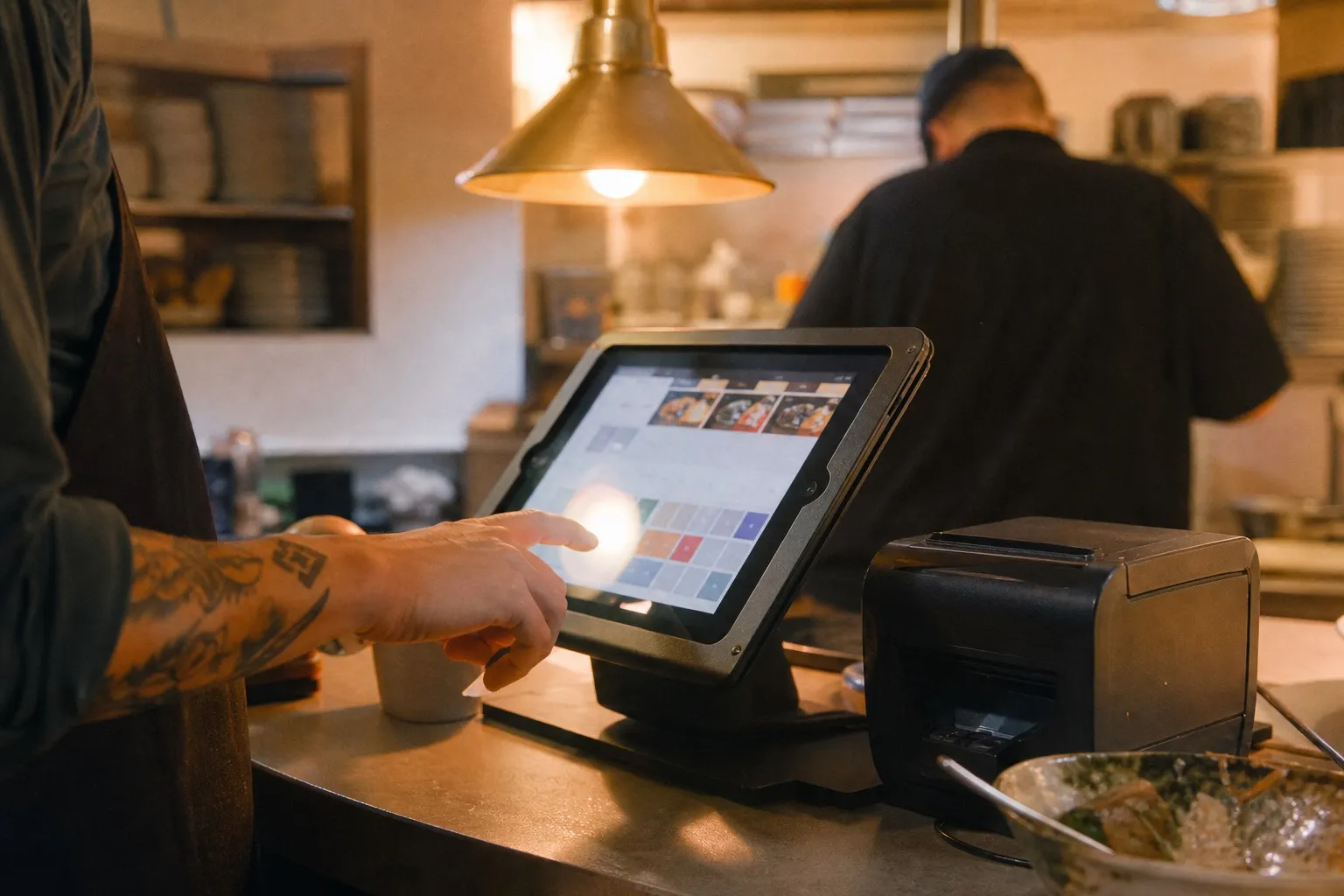
Toast IQ is being positioned as Toast's first real platform — not a feature, not an assistant, but the layer everything else hangs off. After Tuesday's Q3 print, we test the math behind 25,000 restaurants, 235,000 uses, an exclusive Coca-Cola hook, and what an operator should actually do on Wednesday morning.
I was standing behind the line at a 38-seat Italian place in Brooklyn Heights on Tuesday afternoon when the owner — a second-generation operator I’ll call Marco, because he asked me not to use his name on this one — pulled up the Toast back office on the manager’s iPad and tapped the new icon in the corner. “Just show me what to fix this week,” he said into the tablet, the way you’d talk to a sous chef who had already been there an hour. The screen spun for maybe three seconds and then came back with four things: a 9 p.m. labor spike on Thursdays, a chicken parm SKU running ten cents under its target margin, a lapsed-guest segment worth chasing, and a beverage page that hadn’t been touched in seven weeks. Marco read it, nodded once, and said, “Yeah. That’s the list.”
I had come to watch Toast IQ, which Toast made generally available in late October, in the hands of an operator who’d been on the platform for four years and had — until that morning — used exactly none of its AI. What I saw was a chat box. What Aman Narang is selling, if you read the Q3 prepared remarks PDF that landed on Toast’s IR site Tuesday night, is something more ambitious than that. The contrarian thesis worth stating out loud: Toast IQ is the first thing Toast has shipped that is structurally a platform rather than a feature. That is a load-bearing claim and Toast is not yet entitled to it. But the architecture of the bet — and the way Narang is framing it to the Street — only makes sense if you read it that way.
This is the operator’s case-study read on what changed Tuesday, what the 30-day numbers mean, what they don’t mean, and what you should do about it before next Monday’s manager meeting.
What Narang actually said on Tuesday
The Q3 release hit BusinessWire at 4:01 p.m. ET and the 10-Q exhibit went up on EDGAR the same evening. The headline numbers were strong — gross payment volume of roughly $51.5 billion in the quarter, 156,000 locations on platform, and the company once again raising the bottom of its full-year guide. But the print was not the story. The story was the Toast IQ disclosure that landed in the prepared remarks deck, which Toast posted alongside the 8-K.
Narang’s language is worth quoting closely, because the specifics are the whole point. According to the company-reported numbers in the prepared remarks, more than 25,000 restaurants used Toast IQ more than 235,000 times in its first month. That ratio is the part the company wants you to fixate on. It works out to roughly 9.4 uses per active restaurant in 30 days — not a single demo session, not a one-off curiosity click, but something that looks, at least at the aggregate level, like recurring use.
Two things to mark about that number before we move on.
First, “use” is Toast’s word and Toast’s count. We do not have a definition of session, of meaningful engagement, of distinct user, or of the floor below which a tap doesn’t count. In the absence of that definition, the right read is: this is a company-reported activation metric, the order of magnitude is real, and the unit economics will only become visible in Q4 and Q1 retention. I would not yet treat 9.4 uses per restaurant per month as a proof of stickiness. I would treat it as evidence that the cold-start problem — getting an operator to open the assistant a second time — appears to be solved at the population level.
Second, 25,000 of 156,000 locations is 16%. That is not a penetration number Narang wants to dwell on, because 84% of the installed base did not engage in month one. But it is the right denominator for what comes next, because the platform thesis lives or dies on whether Toast IQ converts from “the 16% who tried it” to “the layer the other 84% have to use to do their job.”
The first-platform claim, and why I’m taking it seriously
Toast has shipped a lot of AI in the last eighteen months. Sous Chef in 2024. The upsell prompt, which one pilot operator credited on the Q1 call with a 6% AOV lift. ToastIQ in its conversational form last October. The thing that is structurally different about what Narang described Tuesday is the framing: Toast IQ is no longer being positioned as a chat assistant that lives inside the back office. It is being positioned as the surface through which operators interact with every other Toast product, with third-party features mounted on top of it.
The tell is the Coca-Cola line. Narang disclosed Tuesday that Toast IQ has an exclusive Coca-Cola AI feature — a beverage-program optimization tool that, per the prepared remarks, is available only inside Toast IQ and only to Toast operators with a Coca-Cola relationship. That sentence is small in the document and large in implication. It says Toast is willing to let a CPG partner build inside the assistant, with category exclusivity, in exchange for what is presumably a co-funded distribution channel into 156,000 locations. That is not how features work. That is how platforms work.
Read the October launch coverage alongside Tuesday’s framing and the arc is clear. Sous Chef was a chat box. October’s GA Toast IQ was a conversational AI assistant. The November IR positioning is: third-party-extensible operator surface, with the first exclusivity deal already on the page. An upcoming desk review of the Toast AI suite — see the forthcoming module-by-module read — argues that the assistant was always the demo and the agents were the product. Tuesday’s print is that argument restated in financial terms.
Whether the claim survives contact with the next eighteen months is a different question, and one a forthcoming May piece will be better positioned to answer. The question on the table today is whether the early evidence is consistent with the framing.
Testing the math: 25,000 × 235,000, what it would take to be real
Let’s pressure-test the 30-day numbers the way an operator would pressure-test a vendor pitch.
Per-restaurant frequency. 235,000 uses / 25,000 restaurants = 9.4 uses per restaurant per month, or roughly twice a week. For an operator who runs a single shop, twice a week is plausible: once on the Monday post-mortem, once mid-week to spot-check labor or pricing. For a multi-unit operator running ten locations through a single back office, it’s a low bar — you’d expect at least one query per location per week if the product were doing anything load-bearing. The number is therefore consistent with light, recurring use across the active base, with a long tail of operators who opened it once and never came back.
Cold-start. Getting 25,000 of 156,000 locations to use any new feature in 30 days is, against the base rate of restaurant tech adoption, fast. The honest comparison is not to consumer software; it is to the Toast Marketing module, Toast Capital, or the email tool. Each of those took quarters, not months, to clear five-digit adoption. The fact that Toast IQ cleared it in 30 says the surface is being aggressively defaulted into the back-office experience — i.e., operators are seeing the prompt and tapping it, not seeking it out.
Free vs. paid. Toast IQ is, in its current form, included in the platform. The 235,000 uses are not a revenue signal. They are a precondition for one. Narang’s framing on Tuesday — and this is the part the Street will eventually price — is that the assistant is the wedge for a stack of attached features, of which Toast Advertising is the first that converts engagement to ARPU. The question for the modeling-minded reader is whether the AI-attached ARPU expansion shows up in 2026 fintech and SaaS-mix-shift, not whether 235,000 chat sessions clear a P&L hurdle.
Activation vs. retention. This is the one I want operators to actually track. Toast disclosed month-one usage. They did not disclose month-one retention — i.e., of the 25,000 restaurants who tried it in October, how many were still using it in week four. Without that number, the 9.4-uses-per-restaurant figure is a population-weighted average that probably masks a power-law distribution: a few hundred restaurants using it daily, a few thousand using it weekly, and a long tail that used it once. That is fine — it’s how every consumer and prosumer product on earth distributes — but it is not the same shape as “25,000 operators are now running their week through this.” Mark it. Watch for the retention disclosure on the Q4 call.
The Pizza by the Sea case: $400K, four locations, what it actually proves
The other set piece in Tuesday’s narrative was the Toast Advertising operator case study. Toast disclosed that Pizza by the Sea, a four-location operator, has attributed roughly $400,000 in revenue to Toast Advertising, the demand-generation product that sits adjacent to Toast IQ in the marketing stack. Narang used it as the proof point for the ad product’s unit economics; it is more useful, for our purposes, as a sanity check on what the platform claim actually delivers at the operator level.
Mark the math: $400K across four locations, on a window the company described as the deployment period, is $100K of attributed revenue per location. For a regional pizza concept with a four- to six-million-dollar unit volume range, that’s a 1.7% to 2.5% top-line lift attributed to a single channel. That is a real number — not life-changing, not Toast-changing, but well inside the range a marketing director would defend on the next budget cycle. The reason the case study works as a narrative beat is that it converts the AI conversation from “we shipped a chat box” to “here is an operator who can name a dollar figure.” That is the conversation Narang wants the Street to be having.
What the case study does not prove — and what an honest reading has to flag — is the counterfactual. We do not know what Pizza by the Sea would have spent on alternative demand generation in the same window, what their incremental margin on attributed revenue actually is, or how much of the $400K is true new demand versus channel-shifted demand that would have arrived through their own email list, their own social, or their own loyalty program. Attribution at the operator level is hard. Attribution claimed by the vendor who sold you the attribution tool is harder. The number is directionally credible. It is not a substitute for a controlled test in your own four walls.
What Marco actually did, and what it tells you about the assistant
Back to Brooklyn Heights. Marco’s four-item list — the labor spike, the chicken parm margin, the lapsed-guest segment, the stale beverage page — is what Toast IQ surfaced when he asked it to triage his week. Three of those four are things he could have pulled out of the Toast back office himself, given an hour and a willingness to click through five reports. The fourth — the lapsed-guest segment, defined as guests who’d been in three or more times in the prior six months and zero times in the last eight weeks — is something I do not think he would have pulled on his own, because the segment didn’t exist as a pre-built report. The assistant constructed it.
That is the part of the product that, in the hands of an operator who is good but time-starved, actually shifts behavior. Not the chat. The synthesis. The willingness to say: here is the segment that matters this week, here is the campaign that fits it, here is the offer that fits the campaign, do you want me to load it. Marco loaded it. Forty-three guests, a 15% off entrée offer keyed to a Tuesday-Wednesday redemption window, $0 incremental marketing spend because the email was free and the database was his own. He’ll know in ten days whether it worked.
The reason I’m telling that story in a piece otherwise about Narang’s framing is that it is, in microcosm, the platform claim. If Toast IQ is just a faster way to read reports Marco already had, it is a feature. If Toast IQ is the surface through which Marco runs his weekly action list, with Toast Advertising and Coca-Cola and the next dozen modules mounted inside it, it is a platform. The 30-day numbers don’t yet tell you which one it is. What they tell you is that 25,000 operators are now in the building.
What this looks like one quarter out
A few things to mark on the Q4 call, which will land in late February.
The retention number is the one. If Toast discloses something like “of the 25,000 restaurants who used Toast IQ in October, 70% used it again in November” — or any number with a comparable denominator — the platform thesis takes a real step forward. If they don’t disclose retention, or if they shift the metric to total cumulative uses without the active-restaurant denominator, that is information too: it tells you the cohort isn’t sticky and the company knows.
The Coca-Cola disclosure is the second. Tuesday’s framing was light on the commercial structure. Is Coca-Cola paying Toast for placement, paying Toast for build, splitting attributed beverage uplift, or none of those? Each of those structures implies a different platform. Watch for a follow-on disclosure — either in the K, in a partner announcement, or in a sell-side note from someone who got the meeting.
The ARPU mix is the third. Toast has been guiding to fintech-led growth for several quarters. If Toast IQ’s job is to be the wedge that lifts attached SaaS — Toast Advertising, Toast Marketing, the future modules — then 2026 should see SaaS ARPU per location reaccelerate. If it doesn’t, the platform claim has not converted to revenue and the multiple compresses.
And the fourth, which is the one only operators will care about and which the Street will not price: does the assistant get less stupid. The honest tell, six months from now, is whether Toast IQ can answer the questions Marco asked on Tuesday afternoon without hallucinating, without confusing two of his SKUs, without surfacing a stale campaign as a fresh recommendation. None of which I saw it do. All of which it will do, occasionally, at this stage. The interesting question is the rate at which it stops.
The operator action list
Five things you should do this week if you run a restaurant on Toast.
One. Turn it on, but do not let the manager turn it on. Toast IQ is going to default-open inside the back office for every operator on platform. The version of this that goes badly is the version where your GM opens the assistant for the first time during a shift change and asks it to do something load-bearing. Sit down with it for an hour on a Monday morning. Ask it the boring questions first — last week’s labor, last week’s mix, last week’s voided checks. Calibrate your own sense of whether the answers are correct against reports you can verify. Treat it like a new hire who is going to be very good in six months and is, today, an enthusiastic guesser.
Two. Pick one workflow to actually move into the assistant. The mistake operators make with any new tool is to use it for everything at 10% and nothing at 100%. Pick the workflow with the highest weekly friction — for most independents, it is the Monday-morning labor and mix review — and commit to running it inside Toast IQ for four weeks. Compare what comes out of the assistant against the report you would have pulled yourself. At the end of week four, decide whether it stays or goes back to the report.
Three. Audit the Coca-Cola feature on its actual merits. If you carry Coke product, the exclusive AI beverage feature is going to be pitched to you. Ask the specific questions: what is the recommendation engine optimizing — your margin or Coke’s volume? Can you see the inputs? Can you override the outputs? Who owns the data the recommendations are trained on? The feature may be great. The questions are non-negotiable.
Four. Demand the retention number from your rep. Your Toast account manager has access to a version of the activation and retention data for your region or your segment. Ask them, on your next QBR, what the 30-day and 60-day retention curves look like for Toast IQ in your peer set. If they cannot or will not answer, treat that as information.
Five. Do not pay for Toast Advertising on the strength of the Pizza by the Sea number alone. $100K attributed per location is a credible directional figure for a regional pizza concept with strong delivery mix and a defined geography. It is not a guarantee for your concept, your city, your day-part. Run a controlled four-week test against a comparable spend in your existing channels. The vendor has every incentive to take the win. You have every incentive to know whether it is one.
What to mark, and what to revisit
The honest summary, on the evening of November 4: Toast posted a strong quarter, disclosed activation numbers for Toast IQ that are good but not yet conclusive, layered in an exclusivity deal that hints at a platform structure, and named an operator whose attributed revenue gives the marketing product a face. The framing — first true platform, not a feature — is the most ambitious version of the story Narang could tell with the cards he was holding. He told it. Whether it survives Q4 is the question to track.
I am marking three things to revisit. First, the retention disclosure on the next call. Second, the commercial structure of the Coca-Cola deal, whenever it surfaces. Third, the question of whether the 84% of locations who did not use Toast IQ in month one show up in month three — because the platform claim cannot be made on the strength of an engaged minority alone. The 16% is the wedge. The other 84% is the thesis.
For Marco, in the meantime, the assistant got him a four-item list and a campaign for forty-three lapsed guests in under ten minutes. That is, today, the smallest correct version of the platform claim: a tool that produces a week’s worth of action faster than the operator could produce it themselves. That is not nothing. It is also not yet, by itself, a platform. The next two quarters will tell us which one Toast IQ becomes.
— Priya covers operators for TableTransfers. Tips: [email protected].
Featured
More
Browse all 494 posts
The Voice Agent Maturity Curve
mise
·12 min read
The Four Margins of a Restaurant
mise
·14 min read
The AI Premium in Hospitality M&A: Broker Story or Real Number?
the bottom line
·9 min read
What the DoorDash/SevenRooms Deal Actually Buys
the bottom line
·11 min read