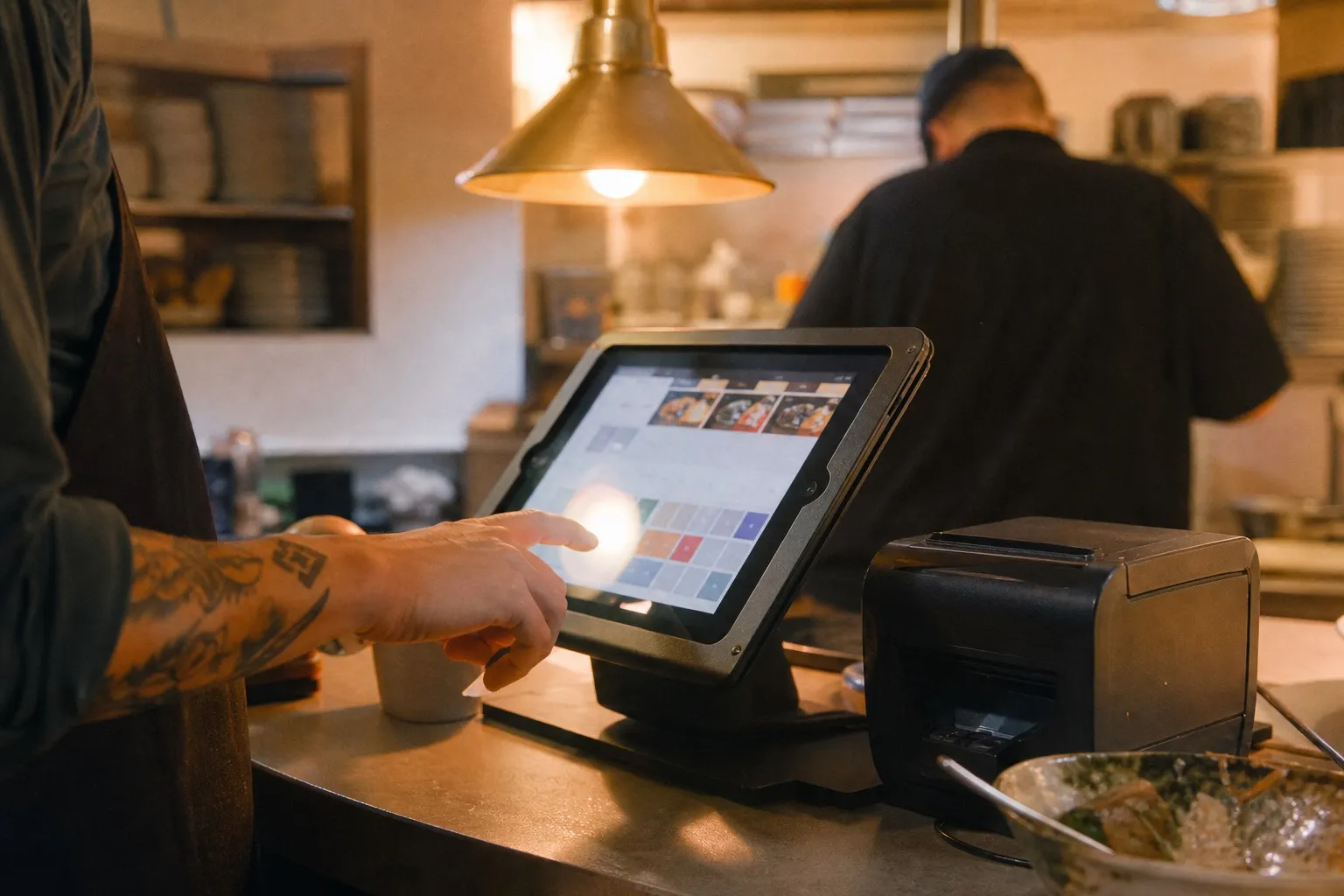
Lightspeed O-Series Turns iPhones into POS Terminals as Tap to Pay Rolls Out


Lightspeed's October O-Series release closes the hardware gap with Toast Go and Square Handheld — but the cellular-only Tableside fallback for outages and pop-ups is the feature operators should actually care about.
I spent Friday afternoon in a Brooklyn wine bar watching the manager hold his breath through a Spectrum outage. The card terminal was a brick. The handheld was a brick. The kitchen printer was still humming on its own UPS, fine, but every guest in the room was about to become a comp problem. He ended up taking photos of IDs and writing card numbers on a notepad, which is how restaurants paid in 1994 and apparently still pay in 2025.
I thought about that bar a lot while reading Lightspeed’s October O-Series release notes, which dropped this month with Tap to Pay on iPhone, Bar Tabs with card pre-authorization, brand customization for terminals, and — the line item buried near the bottom — cellular fallback for Tableside.
The Tap to Pay headline is the obvious story. The cellular fallback is the one that matters.
The hardware gap, closed (mostly)
For two years Lightspeed has been the cloud POS you picked when you cared about reporting and inventory but were willing to live with a slightly clunkier in-service experience than Toast or Square. Toast Go handhelds and Square’s Terminal-class hardware were the visible differentiators on the floor — servers running checks off a device that felt like it belonged in a restaurant, not a retail counter.
Tap to Pay on iPhone via Lightspeed Payments collapses most of that gap in a single SKU: any reasonably recent iPhone is now a contactless terminal. No dongle, no sled, no separate device to lose between shifts. For an operator standing up a second concept or a counter-service spin-off, the math changes — you can equip a runner with a phone and accept a card without a $400 hardware order and a two-week shipping window.
It is not, to be clear, a Toast Go replacement on every dimension. Toast Go has a real keyboard, a real receipt printer, and a chip slot for the dwindling-but-real share of guests still inserting cards. Tap to Pay is contactless-only and lives on hardware your staff is already going to drop into a fryer. The Toast and Square handhelds remain better for full-service environments where you genuinely need ruggedness and you genuinely need to take an EMV chip.
But for the long tail — pop-ups, food halls, hotel bars, second locations, catering, the 80% of new venues that are not white-tablecloth — the iPhone-as-terminal pattern is now table stakes, and Lightspeed has it.
Bar Tabs with card pre-authorization is the other meaningful in-service addition. Holding a card against an open tab without running the full charge is one of those features that sounds boring in a release note and feels essential the first Friday night you operate without it. The combination of Tap to Pay plus pre-auth tabs means a bar can theoretically open with an iPhone, a cash drawer, and Wi-Fi.
Why the cellular line item is the real story
Here is the feature that should have been the headline: Tableside now has a documented cellular fallback path. If your venue’s internet drops, the handhelds keep taking orders and payments over LTE.
Every operator I have talked to in the last year has a Spectrum-outage-or-equivalent story. The standard answer has been a dedicated cellular backup router on the network — Cradlepoint, Peplink, something with a SIM slot — sitting in the rack waiting for failover. That works if you set it up. Most independents do not set it up.
Pushing the fallback into the device itself does two things. It makes the resilience story default-on for any venue using Lightspeed-issued Tableside hardware, and it unlocks a meaningfully different deployment pattern: market stalls, farmers’ markets, festival booths, ghost-kitchen pickup windows in parking lots. Anywhere you have a tent and no Ethernet drop. That is a category Toast Go has owned by default because of its hardware story; Lightspeed is now competitive on it without requiring you to buy the bigger box.
The brand customization for terminals — your logo on the customer-facing screen, your colors on the tip prompt — is the kind of feature operators of single-location concepts will use immediately and the kind multi-unit groups have been quietly asking for since the first SkyTab rolled out. It will not move the needle on a software-evaluation spreadsheet. It will absolutely move the needle on a chef-owner walkthrough demo.
The thing to watch in the next two quarters is whether Lightspeed’s payments attach rate climbs sharply after this release. Tap to Pay on iPhone only works through Lightspeed Payments — there is no path to bring your own processor here. That is the same play Toast has run for years, and it is the play that gets you from “POS company” to “payments company that happens to ship a POS.” Mews is running the equivalent play on the hotel side, which we covered in a forthcoming May piece on PMS roll-ups; the pattern is identical across hospitality verticals.
For the wine bar manager in Brooklyn, the most useful upgrade in this release is not the iPhone terminal. It is that next time Spectrum goes down, the handhelds keep working.
— Maya covers restaurant tech for TableTransfers. Tips: [email protected].
Featured
More
Browse all 494 posts
The Voice Agent Maturity Curve
mise
·12 min read
The Four Margins of a Restaurant
mise
·14 min read
The AI Premium in Hospitality M&A: Broker Story or Real Number?
the bottom line
·9 min read
What the DoorDash/SevenRooms Deal Actually Buys
the bottom line
·11 min read