NRA Show Preview: COFE+ Robot Café and the Voice-AI Floor Plan No One Got Quite Right

NRA Show 2026 opens Saturday at McCormick Place. The pre-show announcements are loud — a fully-unattended robot café, Intel-powered edge boxes, ADA-accessible kiosks. The Pass call: the voice-AI on the floor will be more conservative than the funding rounds promised.
I am writing this from the press-room wire at McCormick Place on the Monday before doors open, which means I have a floor plan on one screen, four pre-show press releases on the other, and a slightly stale iced coffee that the union steward has politely told me I cannot bring onto the show floor proper. The NRA Show opens Saturday, May 16. The exhibitors have already started laying cable. The PR teams have already started laying the narrative.
Here is the contrarian read I am taking into the week: every voice-AI vendor exhibiting on this floor is going to ship a more conservative demo than their funding rounds led you to expect. The headline robotics will be photogenic and the kiosk partnerships will be real, but the conversational-ordering booths are quietly retreating to “deterministic flows with an LLM finish layer” — exactly the architecture operators have been asking for since the McDonald’s-IBM unwind. The big checks of the last six months bought confidence. They did not buy showmanship. (Interpretation flag: this is my call from the pre-show materials and last year’s floor, not a vendor confession.)
What the pre-show wire actually says
Start with the loud one. Shanghai Hi-Dolphin Robot Technology announced on Monday morning that its 7th-generation COFE+ — a fully-unattended robot café — will make its U.S. debut at Booth 5014. The press release uses the phrase “world’s first” twice and “fully automated” four times; the booth is in the North Building near the beverage cluster. Read past the superlatives and the interesting part is the unit economics framing: COFE+ is positioning against staffed kiosks and cart concepts, not against the third-wave coffee bar. That is a sober pitch for a robotics company on opening weekend.
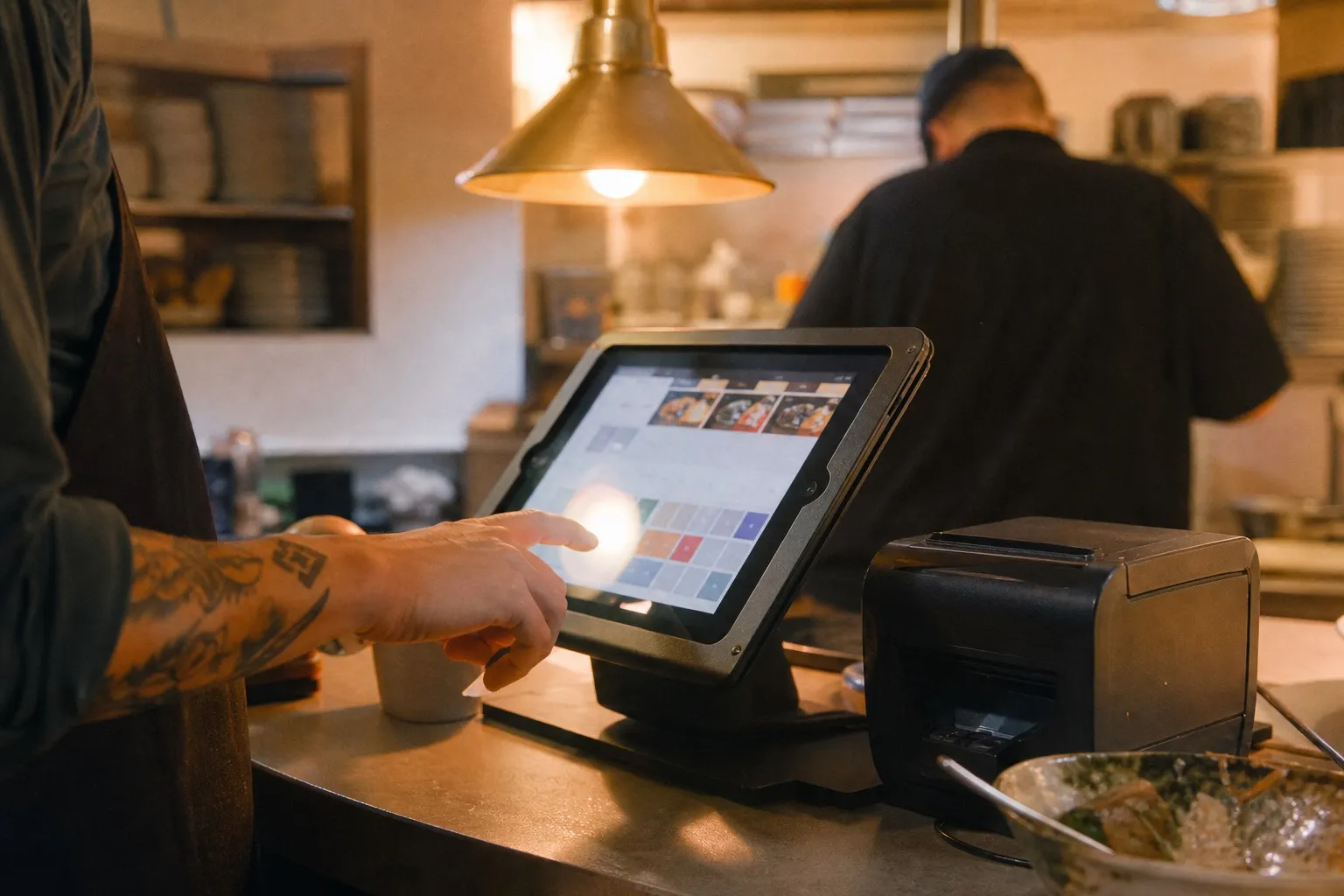
Second wire: the Industry Group and the Kiosk Association will share Booth #5829 — also North Building — with a partner stack that is, frankly, the most interesting square footage on the floor for anyone covering the operator side. Vispero is bringing JAWS-powered ADA-accessible kiosk hardware. SiteKiosk is bringing the lockdown layer. URway is bringing conversational voice ordering. MyCheckr is bringing AI age verification for alcohol and tobacco SKUs. The compute under the hood is Intel Core Ultra at the edge. That is four vendors who each have a real product and one shared booth, which tells you something about how the kiosk category is consolidating into a stack rather than a bake-off.
Third wire: NEXCOM is exhibiting Intel-powered edge compute paired with odor-sensing technology aimed at food safety. The odor sensor is the headline but the edge box is the story — NEXCOM is one of several IPC vendors pitching the same idea this year, which is that operators want compute close to the line, not in the cloud, for both latency and data-residency reasons. The food-safety angle gives the booth a regulatory tailwind that pure POS hardware does not have.
Fourth wire, and the one I am using as my comp: MenuSifu published its NRA Show 2026 restaurant-tech trends preview in mid-April. It is a POS vendor’s marketing post, so weight it accordingly, but their floor read maps cleanly onto what we are hearing from the exhibitor PR: AI ordering, payments, robotics, and back-office automation, in that order of booth count. Voice-AI is on the list. It is not at the top.
The voice-AI floor plan no one got quite right
Here is where the funding-vs.-floor gap matters. In the last twelve months the voice-ordering category has absorbed real money: Slang’s Series B, Vox’s expansion round, Loman’s seed extension, Newo’s quiet strategic. Sierra’s $950M round on May 4 — which I covered here — sits above the category and re-prices the ceiling whether or not Sierra ships into hospitality this year. The narrative coming out of those rounds was that 2026 would be the year of confident, general-purpose voice agents on the drive-thru and the phone. The McDonald’s-IBM episode, which my colleague walked through in February, was supposed to be a cautionary footnote, not the template.
The booths tell a different story. The voice-AI exhibitors I have pre-briefed with are leading their demos with order accuracy on the twenty most-common modifier permutations, not with “ask the agent anything.” URway’s conversational stack at #5829 is gated behind the kiosk’s deterministic menu tree — the LLM is the polish, not the brain. The three independent voice-AI vendors I cannot name yet are demoing on real chain menus with the off-menu items disabled. The robot café at 5014 takes voice orders but the SKU set is fixed and the upsell logic is rules-based.
That is the conservative turn. It is not a retreat from AI — it is a retreat from the demo that goes viral on a TikTok of a teenager ordering nine thousand chicken nuggets. Operators got that demo last year and decided they did not want it. The voice-agent maturity curve we sketched in January put us at “deterministic with LLM finish” for 2026, and that is exactly where the floor is landing. The funding rounds wanted to push us a stage further. The buyers said no.
What I am watching once doors open
Three things. First, whether the COFE+ booth posts a real throughput number — cups per hour, uptime, refill cadence — or hides behind the demo. Robotics-on-the-floor without unit economics is theater; robotics-on-the-floor with a throughput sheet is a category. Second, whether the Industry Group / Kiosk Association partner stack actually integrates on stage or just shares signage. A shared booth with four logos is a marketing artifact. A shared booth with one checkout flow is a product. Third, whether any of the back-office AI exhibitors — the Sysco AI360 cohort we tracked earlier this year and the BRE Day 1 and Day 2 crowd from March — show up with refreshed numbers, because the operator-side ROI conversation has been the missing piece of every voice-AI pitch deck.
If the floor confirms the conservative read, that is good news for the category — boring is how this technology gets bought. If the floor over-promises again, the funding-to-revenue gap gets uglier before NRA 2027.
I will be on the wire all week. Find me near the press room or at Booth 5014 trying to talk the robot into a flat white.
— Hana edits the newsroom for TableTransfers. Tips: [email protected].
Featured
More
Browse all 494 posts
The Voice Agent Maturity Curve
mise
·12 min read
The Four Margins of a Restaurant
mise
·14 min read
The AI Premium in Hospitality M&A: Broker Story or Real Number?
the bottom line
·9 min read
What the DoorDash/SevenRooms Deal Actually Buys
the bottom line
·11 min read