NRA Show Preview: COFE+ Robot Café and the Voice-AI Floor Plan No One Got Quite Right
Pre-show announcements ahead of NRA Show 2026 (May 16–19, McCormick Place) set the floor: COFE+ 7th-gen robot café U.S. debut at Booth 5014, AI age verification and conversational ordering at the Kiosk Association, edge compute everywhere. The voice-AI rollouts will be more conservative than the funding rounds suggested.
It’s late Sunday night and I have the NRA Show 2026 floor plan open on a second monitor, a half-cold espresso on the desk, and a red circle drawn around Booth 5014. McCormick Place opens its doors Saturday — five days from now — and the pre-show press wire has been doing what pre-show press wires do: leaking the prettiest demos early so the trade reporters who don’t fly in until Sunday have something to file. I’ve been reading those releases for two weeks. The picture they paint and the picture I expect to see when I actually walk the North Building on Saturday morning are not quite the same picture.
Here’s the thesis before I lose you to the next headline: the voice-AI cohort that has been raising money like it’s 2021 — Slang, Vox, Loman, Newo — is going to look quieter on the floor than its cap tables suggest. The loudest automation story at NRA 2026 won’t be a conversational ordering bot. It’ll be a robot pulling a latte in front of a crowd at Booth 5014, and a Kiosk Association booth that has quietly stitched together the unsexy parts of the stack: ADA accessibility, age verification, edge compute, ticket printing. Operators don’t want a chatbot. They want the kitchen printer to never miss a ticket. The show floor, I suspect, is going to reflect that more honestly than the funding announcements did.
What’s actually on the floor
Based on the pre-show announcements landing in the first half of May, here’s the floor I’m expecting to see Monday morning.
Shanghai Hi-Dolphin Robot Technology announced on May 11 — yesterday, as I’m writing this — that its 7th-generation COFE+ fully-unattended robot café will make its U.S. debut at Booth 5014. This is the headline. A robot café is exactly the kind of thing that draws a 30-deep crowd and the camera crew from every restaurant publication in the building, and Hi-Dolphin knows it. The 7th-gen claim is interesting because it implies six prior iterations operators outside Asia probably never saw. My read: this is a credibility play disguised as a product launch. They’re not selling robot cafés to T.G.I. Friday’s next quarter. They’re trying to establish that the platform is mature enough that a U.S. operator could sign a pilot without being the first ever to sign a pilot.
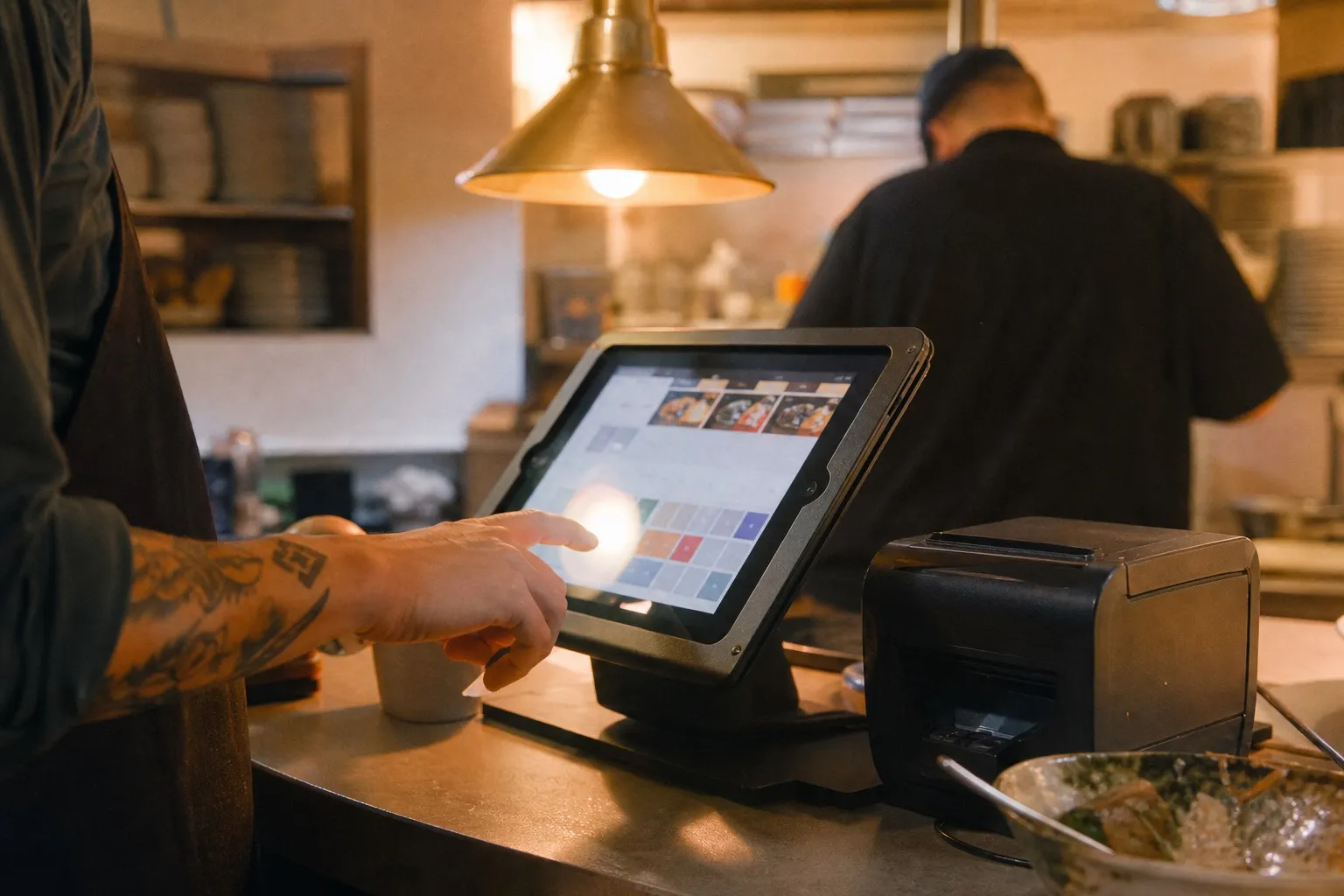
Down the way at North Building Booth #5829, The Industry Group and the Kiosk Association are running a joint exhibit that is, in my opinion, the more important booth at this show. The partner list reads like the bill-of-materials for a 2026 self-service stack: Vispero (the JAWS screen reader, for ADA-accessible kiosks), SiteKiosk (the lockdown and management layer), URway (conversational voice ordering, which is the voice-AI play they chose to feature), and MyCheckr (AI age verification — the alcohol and tobacco compliance use case nobody wants to talk about but every operator with a bar has to solve). The hardware story behind it is Intel Core Ultra–powered edge compute, which matters because it means the inference is local. No round-trip to a cloud GPU between “I’d like a margarita” and “please show ID.”
And NEXCOM is bringing Intel Core Ultra–powered edge computing of its own, plus — and this is the bit that made me sit up — odor-sensing tech aimed at food safety. I have no idea if odor sensors at the kitchen line are going to be a 2026 product or a 2030 product, but I’m booking 20 minutes to find out.
The published attendance figure is 58,000+ attendees and 2,000+ exhibitors. It will feel like more.
Why the voice-AI cohort will look quieter than its raises
Here’s the part where I get to be a skeptic.
Over the last 18 months, Slang AI, Vox AI, Loman AI, and Newo have collectively raised the kind of money that, in a previous cycle, would have funded a category. The pitch — phone agents that take reservations, answer FAQs, handle off-hours orders — is real. The funding is real. But scan the pre-show press for NRA 2026 and the voice-AI cohort is conspicuously not headlining. URway is on the kiosk booth as one of several partners. The rest are either taking small booths or doing the suite-meeting-not-floor-presence thing that means “we’ll see who shows up.”
My read: the gap between voice-AI fundraising and voice-AI floor presence is a tell. Operators who walked an NRA show floor in 2024 or 2025 and watched a conversational agent fumble a modifier in front of a crowd of GMs are not going to spend their 2026 budget on conversational ordering. They’ll spend it on the things that don’t fail in front of guests — kiosks with reliable payment terminals, ticket routing that doesn’t drop sides, age verification that doesn’t make a 19-year-old’s grandmother fish out her driver’s license. The voice cohort isn’t dead. It’s at a different point on what we covered in the voice agent maturity curve piece — closer to “scoped pilots in chain QSR” than “every booth at NRA.”
If you want to understand where the chain-QSR end of that curve actually sits, the McDonald’s drive-thru piece is still the most honest write-up of what scoped voice in production looks like when the operator is willing to pay for it and the failure mode is still a human escalation.
What an operator should book a meeting for
If I’m a multi-unit operator flying in Sunday and I have eight 30-minute meeting slots to spend, here’s how I’d allocate them based on what’s been announced.
Two slots at Booth #5829. One with URway specifically about voice on kiosk — the failure modes, the modifier handling, the offline behavior. One with MyCheckr about age verification accuracy rates and what happens when the model is wrong. Age verification is the unglamorous product that will pay for itself in a single avoided liquor-license issue.
One slot at Booth 5014. Not because you’re buying a robot café. Because Hi-Dolphin’s 7th-gen platform is a useful proxy for where the unattended-format conversation is going, and you want to know what the lease terms and remote-monitoring SLAs look like before a competitor signs first.
One slot with NEXCOM on the edge compute side. If your stack is still doing inference in the cloud for anything latency-sensitive — drive-thru voice, kitchen vision, age verification — the 2026 conversation is about pulling that to the edge. Get the spec sheet.
One slot on the supply side. The Sysco AI360 piece we ran covers why this matters: the distributor-side AI tooling is where the margin-recovery story is actually playing out, and it’s worth a meeting even if you don’t switch distributors.
The remaining three slots: leave open. The best meetings at NRA are the ones you take Sunday afternoon with a vendor you’d never heard of Saturday morning.
The booth I’d skip
Any booth whose demo starts with “talk to our agent.” Not because the tech is bad. Because the demo environment is a trade show floor, which is acoustically the worst possible environment for voice-AI, and the demo will not generalize to your dining room. If a voice-AI vendor can’t show you call recordings from production at a real operator — not a pilot, production — politely take the swag and walk.
I’ll be on the floor Saturday through Tuesday. If you see someone in a navy jacket squinting at a robot pulling a latte at Booth 5014, that’s me. Find me. Tell me what your kitchen printer broke this week.
— Luca covers restaurant operators. Tips: [email protected].
Featured
More
Browse all 494 posts
The Voice Agent Maturity Curve
mise
·12 min read
The Four Margins of a Restaurant
mise
·14 min read
The AI Premium in Hospitality M&A: Broker Story or Real Number?
the bottom line
·9 min read
What the DoorDash/SevenRooms Deal Actually Buys
the bottom line
·11 min read