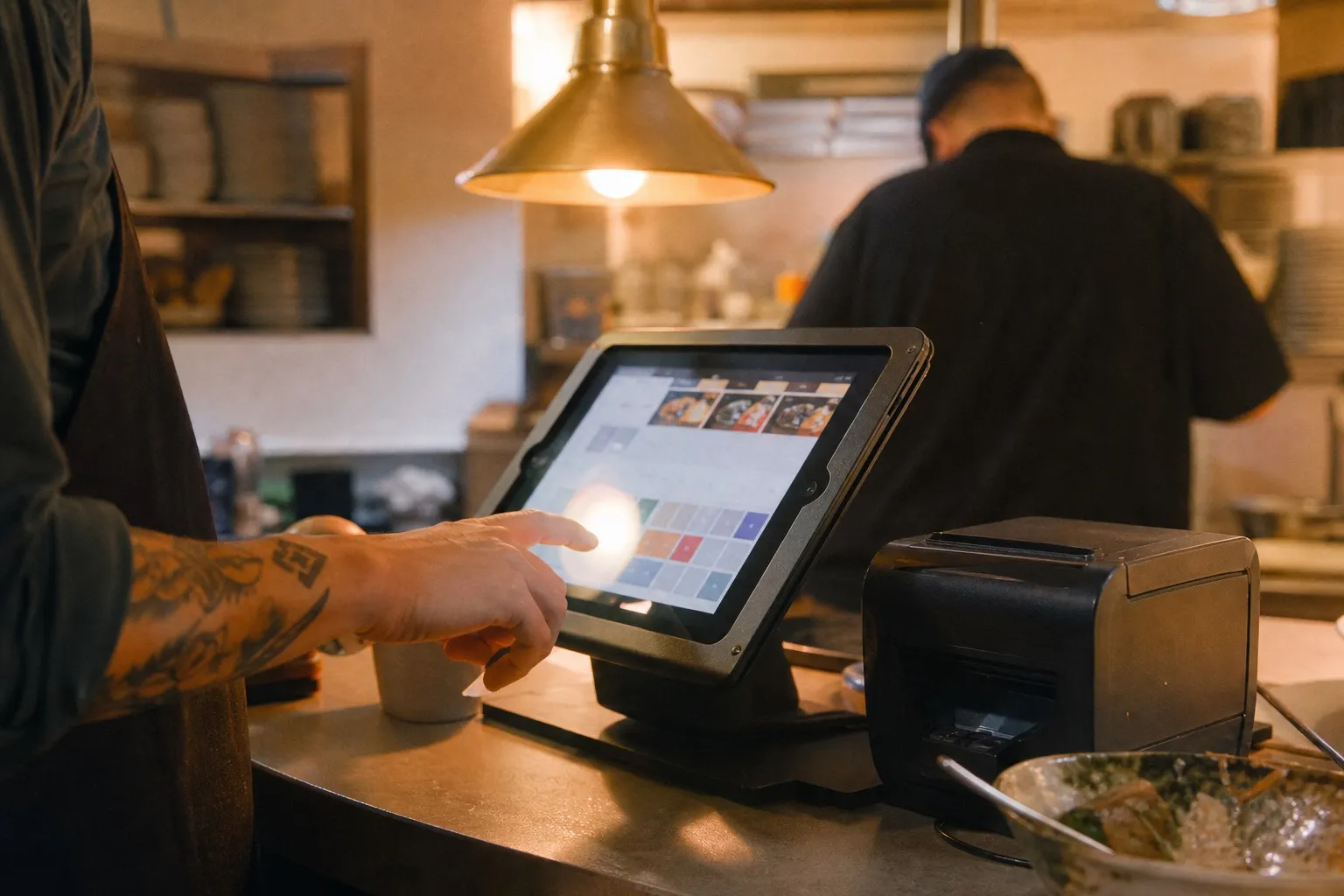
Sweetgreen guides to negative comps but doubles the Infinite Kitchen footprint — automation is now defense

Sweetgreen's Q4 cratered: comps -11.5%, EPS -$0.42, restaurant-level margin halved. The 2026 guide is rougher. And yet roughly half of fifteen planned new units will be Infinite Kitchens. The automation thesis is no longer offense.
Thursday, 4:31 p.m., and I’m reading Sweetgreen’s Q4 release at the desk because the after-close print is bad enough that the wires are already running with it. Same-store sales down 11.5%. Transactions down 13.3%. Restaurant-level margin 10.4% against 17.4% a year ago. EPS -$0.42 versus a Street -$0.27. Q4 adjusted EBITDA loss of $13.3M. FY revenue $679.5M, FY comps -7.9%, AUV $2.68M against $2.92M. Net loss $49.7M.
The print is worse than the print was supposed to be.
The 2026 guide is rougher. Same-store sales -2% to -4%. Adjusted EBITDA $1M to $6M. Restaurant-level margin 14.2% to 14.7%. About 15 net new units, with nearly half featuring the Infinite Kitchen.
Read that last sentence twice. The chain that just printed a -11.5% comp quarter is telling you it will keep automation at roughly half the development pipeline. That is the more interesting call on this release, and it’s the wrong way around from how the wires will file it tonight.
The miss is the headline, but the IK doubling is the strategic story
The setup for this print was Maya’s piece three weeks ago on the Spyce-to-Wonder sale. Her read was that the durable story from the November transaction wasn’t Sweetgreen’s $116M paper gain — it was Marc Lore quietly assembling the only credible cross-cuisine restaurant-automation IP portfolio in the US. The Sweetgreen side she filed as a balance-sheet win for a chain whose comps had started to crack.
Tonight’s print is what “started to crack” looks like when the crack runs through Q4. The $100M cash from the Spyce sale lands on the balance sheet at exactly the moment Sweetgreen needs liquidity. The cost-plus-roughly-5% supply agreement Maya unpacked is the explanation for why the IK rollout isn’t being cut alongside everything else.
Eighteen months ago, Sweetgreen guiding to negative comps and shrinking the development pipeline would have meant cutting capex. Automation is the most discretionary capex line a fast-casual operator has. It is the first thing you cut when you cut.
Sweetgreen is not cutting it. Of the 15 net new units guided for 2026, nearly half are IK builds. That’s roughly seven on top of the 30 at year-end and the 32 they’re already at in Q1. The denominator is shrinking. The IK share is holding. That is a defensive posture, not an offensive one.
Defense, not offense
In the original 2023-2024 IK pitch, automation was a top-line story. Faster throughput, higher AUV, the Sweetlane drive-thru format. A year ago that framing was credible because the comp was still flat-ish.
In a quarter where comps are -11.5%, the IK pitch can’t be a top-line pitch anymore. The top line is the problem. So Jonathan Neman pivots on tonight’s call: “established Infinite Kitchens delivered more than 700 basis points in labor savings over classic locations of similar age.” Labor savings. Margin protection. The same number, quarter after quarter, framed as a defensive lever.
That is automation as defense. The premise is no longer that IK will pull comps higher. It is that IK protects the unit-level margin envelope while management works on demand through everything else — wraps, Nashville, Salt Lake City, the Sweet Growth Transformation Plan, Project One Best Way.
A Kavout note tonight argues 700bps of labor savings “risks becoming an expensive gimmick rather than a game-changer” if it makes an unprofitable unit more efficient without addressing demand. That’s the bear read. The bull read — implicitly what Sweetgreen is doing — is that you don’t get to the demand fix without surviving the deleverage on the way there. IK is the survival lever.
Why the wires will misread this
The wires will lead with the miss, which is correct. What they’ll underweight is that Sweetgreen is doubling down on the automation thesis it is now relying on for defense. Most chains under this much comp pressure cut capex. Sweetgreen is holding the IK share — and IK builds cost more than classic builds. Management is making that call because cutting the rollout would compress the long-run margin envelope further than the comp pressure already has.
The IK rollout is no longer a growth bet. It is the chain accepting that the next two years are about margin, not revenue, and committing capex to the lever that protects margin. That changes what the Infinite Kitchen is for.
What this means for operators reading this in the morning
Two reads.
For multi-unit operators evaluating automation vendors. Sweetgreen’s IK rollout is now a defensive case study, not an offensive one. If your 2026 automation business case is built on “this will grow comps,” tonight’s print is a data point against you. If it’s built on “this will protect margin while comps stay flat or fall,” Sweetgreen is the cleanest public reference you have for that posture. The 700bps labor savings number has held across multiple quarters, including one with a -11.5% comp on top of it. That is a more rigorous test of an automation thesis than a stable-comp year would have been. The foundational Operator case study on IK is the long-form version of the argument.
Against the DoorDash Commerce Platform pattern. Different shape, same underlying mechanic. DoorDash is consolidating the front-of-house layer across operators. Sweetgreen is consolidating production-side automation inside its own four walls. Both are bets that durable margin in fast-casual moves to whoever owns the technology spine. The DoorDash version is going well. The Sweetgreen version is going badly at the comp line and well at the margin line — and the bull case is that the second matters more than the first in 2026.
The 700bps holds. The comp doesn’t. The IK rollout continues anyway. That is the story.
— Hana edits The Pass. Tips: [email protected].
Featured
More
Browse all 494 posts
The Voice Agent Maturity Curve
mise
·12 min read
The Four Margins of a Restaurant
mise
·14 min read
The AI Premium in Hospitality M&A: Broker Story or Real Number?
the bottom line
·9 min read
What the DoorDash/SevenRooms Deal Actually Buys
the bottom line
·11 min read