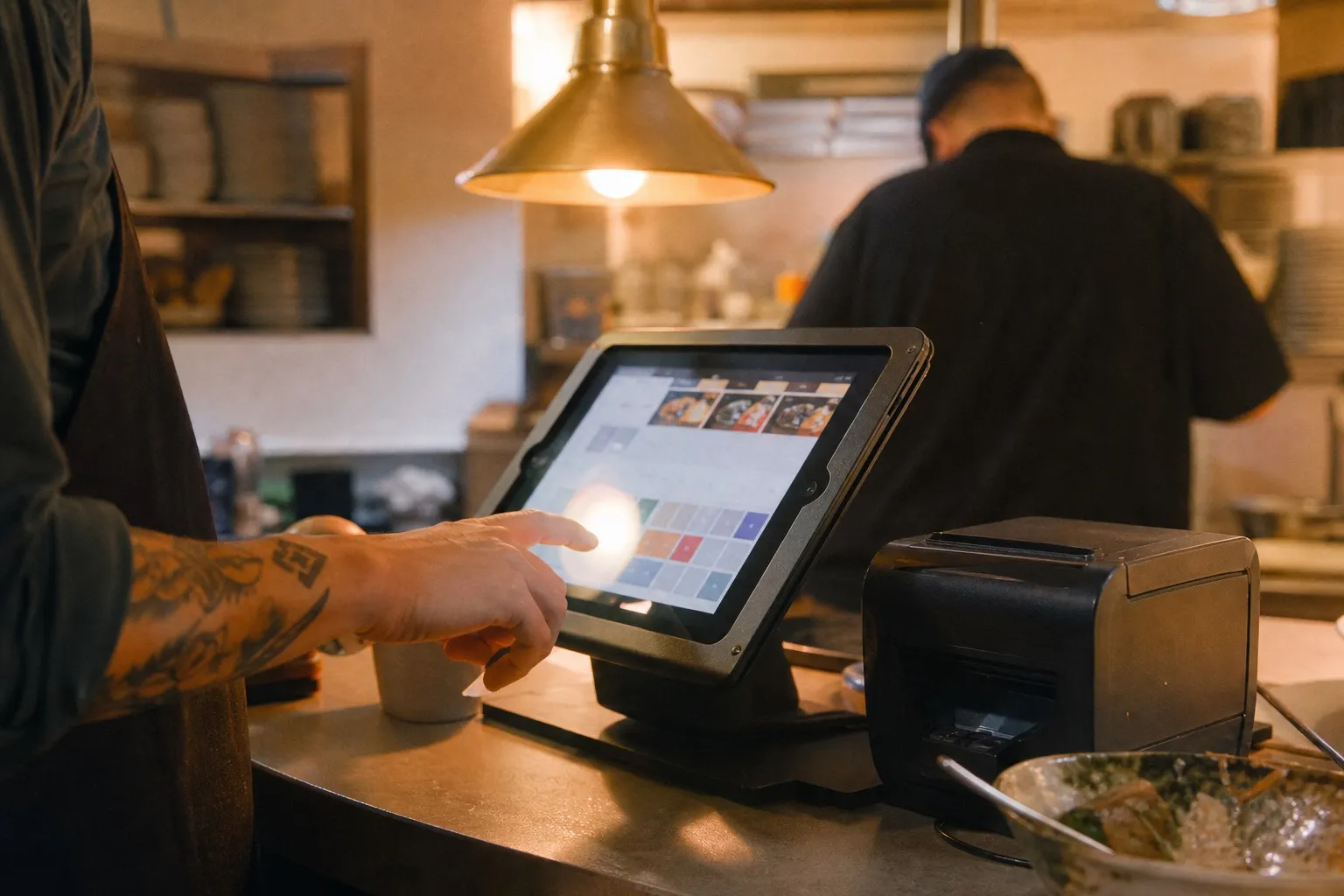
Wingstop's Smart Kitchen Lands at 200+ Stores — and the In-House AI vs. Vendor AI Debate Just Got Concrete Numbers

Wingstop's Q1 2025 print confirms Smart Kitchen is live in over 200 stores and underlies the path to $3M AUVs — a public-company data point that should make every multi-unit franchisor's tech committee revisit build vs. buy.
I was halfway through my second coffee when the Wingstop print hit the wire this morning. Revenue $171.1M. EPS $3.24. Net income $92.3M. Domestic same-store sales up a thin 0.5% against a brutal comp. Those numbers are interesting on their own — the SSS softness will be the easy headline by lunchtime — but they’re not what made me put the mug down.
The number that did: Smart Kitchen is live in over 200 restaurants by end of Q1. And the company is guiding to roughly 400 by the end of April.
That’s not a press release about a pilot. That’s a 2,689-store franchise-heavy concept telling its analyst base that an in-house production system is already deployed in roughly 7% of the system, will double inside a single month, and is being explicitly tied — in CEO Michael Skipworth’s own words — to the climb toward $3M AUVs.
My read: today’s print is the cleanest public-company datapoint we have on the in-house-vs-vendor question in restaurant operations tech. Every multi-unit franchisor’s tech committee should put it on the next agenda.
The numbers that matter on today’s print
Strip the noise off the Q1 release and the operationally relevant facts are tight:
- Revenue: $171.1M
- EPS: $3.24
- Net income: $92.3M
- Domestic same-store sales: +0.5%
- System size: 2,689 restaurants
- Smart Kitchen deployment: 200+ stores by end of Q1 2025, plans to reach approximately 400 by end of April
The SSS number is the one the sell-side will chew on — a deceleration is real, and the macro setup for QSR is what it is. But the Smart Kitchen disclosure is the one that changes how I think about Wingstop as an operating model. They didn’t bury it in a footnote. They put it in the prepared remarks and tied it directly to long-term AUV ambition.
Here’s Skipworth, verbatim: “We believe it’s going to make Wingstop more of the consideration set… we believe over time it’s going to help us continue to increase frequency, which we know will be a big driver as we continue to scale AUVs toward $3 million.”
That’s a CEO using a kitchen production system as a frequency lever. Read that sentence twice. Frequency, not throughput. Not labor. Frequency. That’s a demand-side claim built on a supply-side investment, and it’s the kind of thing CFOs underwrite multi-year capex against.
Why 200+ stores is the inflection number
I’ve been writing about restaurant tech long enough to know the rough shape of the build-vs-buy curve. At 50 stores, you buy. At 500, you usually build. The interesting band is 200–400, and that’s exactly where Wingstop is sitting today.
Two things flipped for me on the 200+ number:
-
It’s past pilot. Anyone can run a 20-store pilot of anything. Two hundred stores is operations. It means a deployment runbook, a training program, a support tier, a parts pipeline, and a measurement framework that survived contact with a franchise base. That’s expensive to fake.
-
The forward number is the tell. Going from 200+ to ~400 in a single month says the rollout machinery already exists. You can’t 2x a system-level deployment in 30 days unless the install playbook has been pressure-tested. That’s the kind of throughput Wingstop’s vendor partners (Toast, Olo, the various order-aggregator and KDS players) typically have to deliver to Wingstop, not the other way around.
When a franchisor at this scale ships its own production-grade system at this pace, the implicit message to its vendor stack is: we will own the parts of the kitchen that touch the AUV thesis. You can keep the parts that don’t.
NRN had a useful read on the Smart Kitchen rollout context earlier this year (nrn.com/fast-casual/wingstop-plans-smart-kitchen-rollout-later-this-year), and Restaurant Business has the better operational deep-dive on what actually changes at the line (restaurantbusinessonline.com/operations/how-wingstops-smart-kitchen-upgrades-will-change-game). Worth reading both back-to-back.
One discipline note before I keep going: Smart Kitchen is in-house. It is not a vendor product white-labeled into Wingstop’s stack. Conflating the two is the single most common mistake I’m seeing in early sell-side notes today, and it changes the entire build-vs-buy reading if you get it wrong.
The $3M AUV math, decoded
Wingstop’s current AUV sits roughly in the $2.1–2.2M zone depending on which slide you trust. The $3M target Skipworth keeps referencing is the long-arc ambition — and the framing today is that Smart Kitchen is one of the structural unlocks that gets the system there.
Here’s the back-of-napkin I ran while the call was still going:
- Roughly $800K of incremental AUV across 2,689 stores is ~$2.1B of system sales upside at full ramp.
- Royalty rates being what they are, the corporate take on that is materially accretive to revenue and franchise-margin lines.
- Even partial credit — say Smart Kitchen explains a quarter of the AUV climb — is a nine-figure structural lift.
That’s the math that justifies in-house investment. A vendor solution at any reasonable take rate would skim a meaningful slice of that upside off the top. Build economics get very compelling, very fast, once the AUV-lift narrative is anchored in CEO commentary on a public call. As our later piece on enterprise AI deployment argues, the playbook for AI at scale increasingly favors operators who can own their own production loop rather than rent it.
My read: the moment a CEO ties a system to AUV expansion in prepared remarks, the corporate development team has already run the buy-side comparison. Today’s disclosure is the result, not the start, of that exercise.
What this means for Toast and Olo as vendors
This is where I’ll get a few angry emails, but here goes.
Vendors who are in Wingstop’s stack today are not in trouble — but the expansion surface available to them just got narrower. The parts of the kitchen and ordering experience that the CEO links to AUV growth are going to be insourced. That leaves vendors competing for the layer of the stack that’s commoditizing: payments rails, transactional POS, basic loyalty plumbing, generic delivery integration.
The vendors that thrive in this environment will be the ones that move toward consumer-facing surfaces and the discovery layer (in a later piece on the discovery layer, I dig into why guest acquisition is becoming the only place left for vendors to add asymmetric value). Production-side software, where the franchisor sees a direct AUV link, is going to keep getting pulled in-house at every chain large enough to amortize the engineering team.
If you’re sitting on a vendor product roadmap this morning and your big H2 bet was “we’ll be the smart kitchen for franchise X” — today is the day to reread that strategy doc. The Wingstop print is permission, at the board level, for every chain in the 300+ store band to ask whether they should be doing the same thing.
McDonald’s prints tomorrow. DoorDash and SevenRooms in early May. I’ll be watching for whether any of them gives operators a counter-narrative — a credible vendor-led path to the same AUV math. So far, the public datapoints are stacking on Wingstop’s side of the table.
— Maya covers restaurant tech. Tips: [email protected].
Featured
More
Browse all 494 posts
The Voice Agent Maturity Curve
mise
·12 min read
The Four Margins of a Restaurant
mise
·14 min read
The AI Premium in Hospitality M&A: Broker Story or Real Number?
the bottom line
·9 min read
What the DoorDash/SevenRooms Deal Actually Buys
the bottom line
·11 min read